

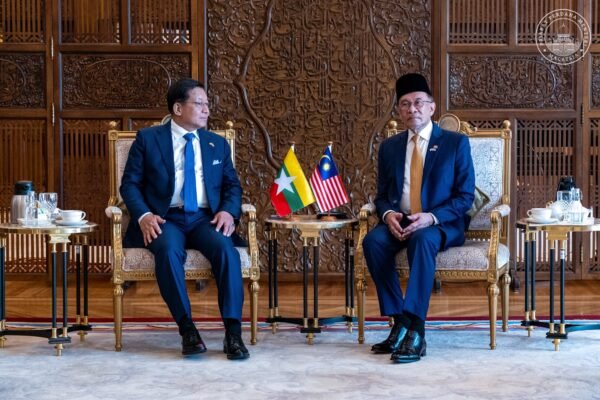
Myanmar’s military-appointed President Min Aung Hlaing could follow up his controversial state visit to Malaysia with trips to Indonesia and Brunei, according to a Myanmar government spokesperson.
Speaking at the conclusion of Min Aung Hlaing’s two-day visit to Malaysia on Thursday, spokesperson Khaing Khaing Soe told reporters that the two nations planned to invite the Myanmar leader to make an official visit on an unspecified date. She added that Malaysia’s Prime Minister Anwar Ibrahim had shared the information with Min Aung Hlaing during their meeting in Putrajaya last week.
Malaysia was the fifth member state of the Association of Southeast Asian Nations (ASEAN) to host Min Aung Hlaing since he took office as president in April, after trips to Laos, Thailand, Cambodia, and Vietnam. It was also the first nation from maritime Southeast Asia to host him.
The spokesperson’s comments, if confirmed, would represent just the latest diplomatic success for Min Aung Hlaing, who led the military coup of 2021. Since shedding his military fatigues and taking office as president in April, he has been on a regional charm offensive aimed at consolidating key partnerships and seeking injections of much-needed foreign investment.
In addition to visits to India, China, Russia, Belarus, and Kazakhstan, a particular priority has been the normalization of Myanmar’s relations with ASEAN. Since late 2021, the 11-nation bloc has excluded the country from its summits over its failure to implement its Five-Point Consensus conflict resolution plan, which called for a cessation of violence, access to humanitarian aid, and inclusive dialogue involving “all parties” to the country’s conflict.
Since the military coup of 2021, Myanmar’s mainland Southeast Asian neighbors have been less publicly critical of the military and shown more inclination to engage the military government. The six maritime ASEAN states – Malaysia, Indonesia, the Philippines, Singapore, Brunei, and Timor-Leste – have generally been more critical and advocated a tougher regional line on Myanmar. But with a new and more legitimized government now in office in Naypyidaw, and after five years of apparently scant progress on the Five-Point Consensus, it appears that ASEAN and its member states have coalesced around a new approach.
In an interview with Singapore’s Straits Times, Philippine President Ferdinand Marcos Jr., who holds the rotating chairmanship of ASEAN this year, said that while the Five-Point Consensus was “absolutely correct,” the bloc needed to try a fresh approach to Myanmar.
During the bloc’s last summit in May, Marcos said, “I proposed and said we need to have a new approach on Myanmar. Nothing’s happening, so we had to do something else. And I am happy to know, because today I saw the news that the leader of Myanmar has visited Malaysia, has visited Cambodia. And that is the beginning which has never happened before.”
Whether this push towards engagement results in the full normalization of Myanmar’s relationship with ASEAN remains unclear. As Marcos’ comments suggest, the bloc has not formally abandoned the Five-Point Consensus, and there are also evidently still differences within ASEAN over how fast engagement should proceed, and to what end. While some nations, including Thailand and Malaysia, have explicitly stated that their goal is Myanmar’s eventual reintegration into ASEAN, others place more emphasis on the implementation of the Consensus.
In February, Singapore’s Foreign Minister Vivian Balakrishnan told Parliament that the Five-Point Consensus remained the primary ASEAN reference for the Myanmar conflict, and that as such it would continue to uphold “the decision to maintain Myanmar’s non-political representation at ASEAN Summits and ASEAN Foreign Ministers’ Meetings,” until there is “meaningful progress” in its implementation. More recently, Singapore, which holds ASEAN’s chairmanship next year, defined this as the “permanent cessation of violence,” the release of all political detainees, and access for the ASEAN Coordinating Center for Humanitarian Assistance.
Meanwhile, Timor-Leste, which has been outspoken in its criticism of the Myanmar junta, has even permitted its legal authorities to initiate a legal case against Min Aung Hlaing and other senior officials. Indeed, Dili’s position on Myanmar may offer the first real test of whether it has been successfully socialized into the “ASEAN way.”
This suggests that even with more member states willing to roll out the red carpet for Min Aung Hlaing, full normalization with ASEAN, which will require a consensus among its 11 member states, will necessitate at least some gestures of compliance with the Five-Point Consensus. Myanmar military’s continued violent attacks on civilian populations, as well as its increasingly explicit rejection of the Consensus and ASEAN demands such as for an audience with detained civilian leader Aung San Suu Kyi, suggest that this is unlikely anytime soon.
The main question going forward, therefore, is how little ASEAN’s member states will be willing to accept in order to approve full normalization – if they don’t choose to abandon the Five-Point Consensus altogether.
