

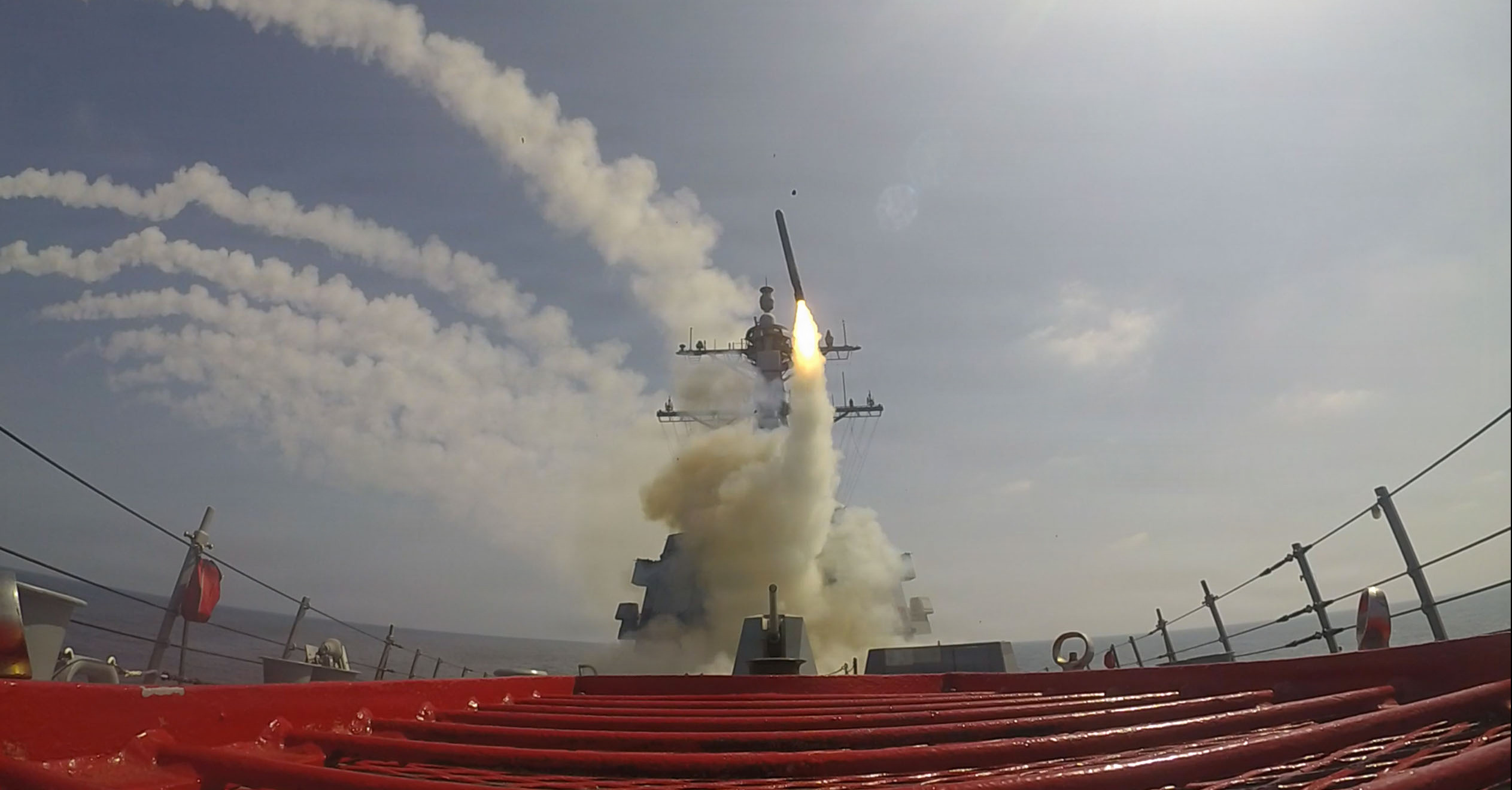
WASHINGTON — The Pentagon’s budget request for fiscal 2027 increases funding for missile procurement by 188 percent — a shocking spike in demand that experts agree completely outstrips the defense industry’s production capacity.
As a result, the experts say, the Pentagon and Congress are likely to provide the ability to spend this year’s funding over multiple years, while sending a signal to industry that munitions are a long-term priority amid global uncertainty.
“I think the Pentagon is viewing this as a generational budget, as something to try and overcome some of the longstanding challenges that existed and to essentially reposition the United States so that it does have the stockpiles it needs in the future,” said Becca Wasser, the defense lead for Bloomberg Economics.
That budget request, delivered to Congress earlier this month, calls for $1.5 trillion in defense spending for FY27 with $1.15 trillion in the base budget request and an additional $350 billion from a forthcoming reconciliation bill. (A separate supplemental funding request for operations in the Middle East could be forthcoming too.)
Within that $1.5 trillion plan for FY27, budget documents broadly detail a roadmap for spending approximately $70.5 billion on missiles and other related line items — $36.6 billion for the Army, $22.6 billion for Navy weapons, and $11.3 billion for the Air Force. By comparison, the munitions figures for the three services combined were just under $20 billion in FY25 and $24.4 billion in FY26 — meaning FY27’s request is a 188 percent increase over what was approved for FY26.
“This is a recognition of the fact that there is a munitions gap, that there is a problem with the US not having sufficient levels of some of its higher end munitions and recognition that they would need more, which isn’t something that we always hear from the Pentagon,” Wasser said.
“Ultimately, what this request does,” Wasser said, “[is] it puts the onus on Congress. It says, ‘Here’s what the Pentagon is willing to do. You’ve told us to be more steady in procurement. That’s what we’re going to do. Now you’ve got to fund it.’”
A Gamble
For several years Pentagon leaders have been eyeing ways to boost weapons numbers ahead of a potential military contingency with China, and as they watched Ukrainian and Russian forces burn through munition rounds. That sense of urgency has only intensified as US forces draw deep into stockpiles of key weapons like Tomahawk cruise missiles and PAC-3 interceptors for Operation Epic Fury against Iranian forces.
Those pushes have taken several shapes, including gaining congressional approval to sign multiyear buys for certain weapons such as the Patriot Advanced Capability-3 (PAC-3) Missile Segment Enhancement interceptors.
And, more recently, the Pentagon has inked a series of framework deals designed to boost munition production over the next seven years by having companies invest in their manufacturing facilities for programs like PAC-3 interceptors, the Precision Strike Missile (PrSM), and seekers for both Terminal High Altitude Area Defense (THAAD) interceptors and PAC-3 interceptors. While subsequent production contracts to actually buy more of those weapons have not yet been finalized, the Pentagon on Thursday awarded Lockheed Martin a $4.7 billion undefinitized contract action to begin work associated with the framework deal.
The Pentagon has not yet released budget justification documents that could provide additional details on how the department will structure buys, and the services did not directly answer Breaking Defense’s questions about weapon spending plans.
But Tom Karako, a missile defense expert with the Center for Strategic and International Studies, said the FY27 budget request likely includes funding that will be spread over multiple years, as the huge production increases laid out in FY27 simply cannot be achieved in a single year.
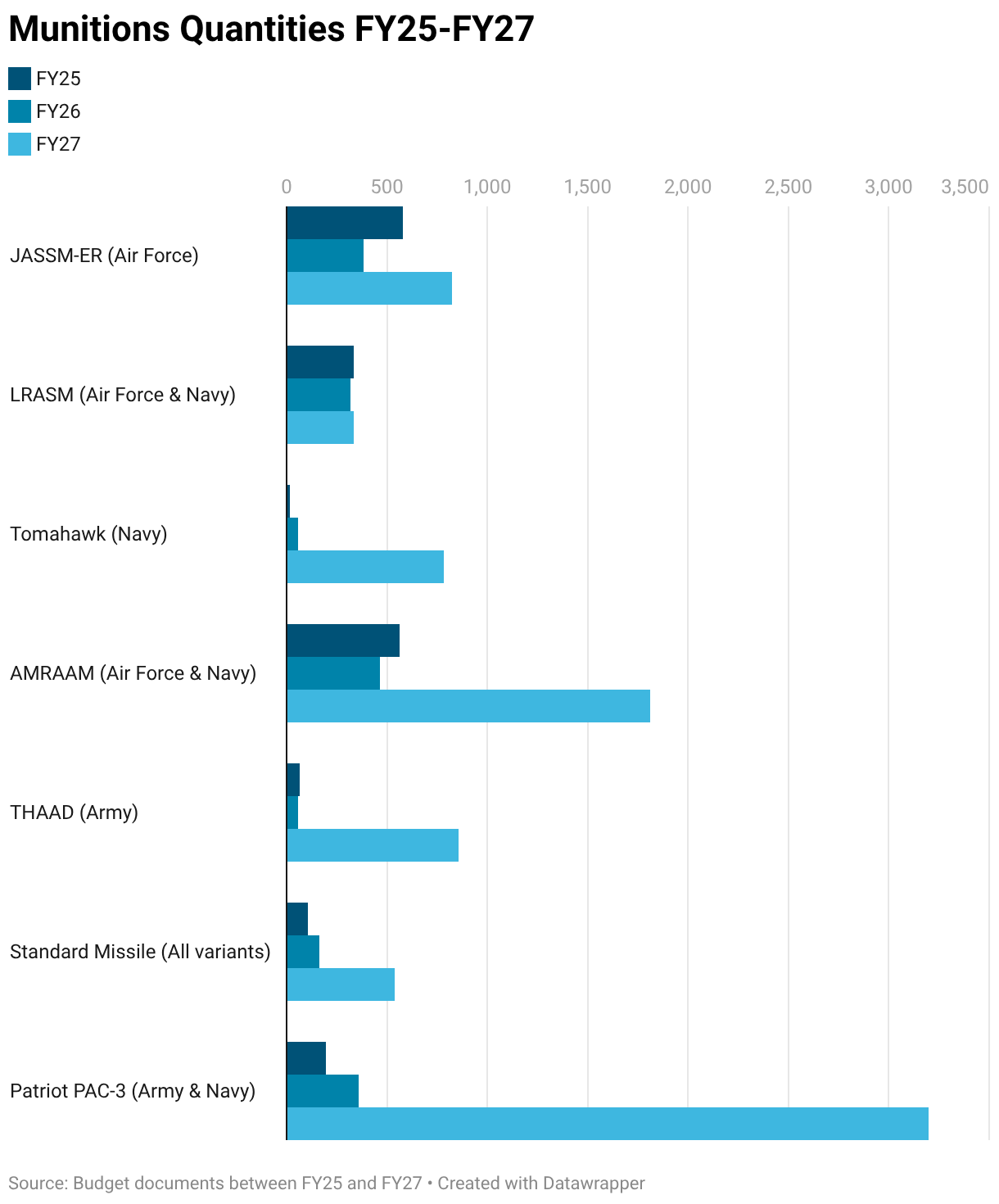
As an example, he pointed to the Terminal High Altitude Area Defense (THAAD) interceptor line. In FY26, 55 interceptors were funded, a number that mushrooms to 857 in FY27.
The budget request also includes funding for 785 Tomahawk missiles — broken into 58 Tomahawk missiles in the base budget and another 727 in reconciliation. That sum is a whopping 1,327 percent increase from FY26, when the Navy procured 55 Tomahawks, itself a major boost from 20 units in FY25.
“They can’t buy that many in a single year, and [Tomahawk-producer] Raytheon can’t produce that many at once,” said Todd Harrison, a defense budget expert with AEI. “But the intent is they will have the money there so that they can go to Raytheon and say, ‘Hey, we want to place a big order. We know you can’t build them all at once, but we want you to expand your production and we already have the funding. We can now guarantee this to you.’”
“It’s even better than a multiyear procurement,” Harrison added, “because in multiyear procurement, you still have to wait for future appropriations.”
Several analysts also emphasized that roughly $40 billion, or around 55 percent, of the munitions request is being sought through reconciliation, which opens more flexibility to the services because that “mandatory” funding is available over a longer period than is typical for discretionary funds.
“Things they put into reconciliation, they tend to be things where they are essentially pre-funding acquisition,” said Harrison. “It’s things where they know they’re not going to be able to buy that many of that item at once in one year. But they also know that reconciliation money, unlike regular appropriations, is available for longer.”
But getting a second reconciliation bill over the finish line before Democrats likely reclaim a chamber of Congress in the upcoming midterm elections will be a strategic “gamble,” Karako said.
“The plan for reconciliation is a little bit of a risk, but I think it’s probably a good one, because [including the weapons] makes it a must-pass. But the gamble of putting the things that we really need the most into the reconciliation makes it harder to vote against,” he explained.
But Harrison noted that while the munitions budget is typically an area where there is bipartisan support, deep cuts to the nondefense budget and the overall scale of the defense budget boost could result in more “hangups” on weapons spending.
What The Budget Buys
The Pentagon’s Munitions Acceleration Council has identified a dozen or so munitions as “critical,” many of which could receive a large windfall in FY27. That includes eight munitions Congress approved multiyear procurement authority for in the FY26 appropriations bill:
- PAC-3 MSE: These Patriot missiles could jump from 357 rounds on the books for FY26 for just the Army to 3,203 in FY27 for the Army and Navy — nearly a nine times hike.
- Standard Missile-3 and Standard Missile-6: When it comes to all varieties of the Standard Missile, the department received funds for 166 of those weapons in FY26 but is now looking to boost that to 540 in FY27, of which 434 would be funded through reconciliation.
- Long Range Anti-Ship Missile (LRASM): The Air Force and Navy plan to buy a total of 333 LRASMs next year, a slight bump up from the 314 total for FY26.
- Joint Air-to-Surface Standoff Missile Extended Range (JASSM-ER): The Air Force wants funding for 821 rounds, up from the 381 count included in the FY26 budget.
- THAAD interceptors: The Army is requesting funds to cover 857 THAAD interceptors in its FY27 budgets, with 830 included in reconciliation, a large increase over the 55 interceptors budgeted for the year before.
- Advanced Medium Range Air to Air Missiles (AMRAAM): The Air Force and Navy are hoping to fund 1,811 AMRAAMs in FY27 with the bulk coming from reconciliation funding. If approved, that would nearly quadruple the number of 464 AMRAAMs greenlit in FY26.
- Tomahawk Cruise Missiles: The Navy is requesting funding for 785 Tomahawk missiles with 58 missiles placed inside the base budget and another 727 in reconciliation. That sum is a 1,327 percent increase from FY26, when the Navy procured 55 Tomahawks.
Spokespeople for both RTX and Lockheed Martin did not directly address questions about how their respective companies could meet the missile and interceptor numbers detailed in the FY27 budget request.
RTX, instead, referred to previous statements that the company plans to spend $3.1 billion on capital expenditures in 2026, while Lockheed said it has invested more than $7 billion since President Donald Trump’s first term to expand capacity for priority systems.
“Lockheed Martin is planning a multibillion-dollar investment over the next three years to expand production and build and modernize more than 20 facilities in Arkansas, Alabama, Florida, Massachusetts and Texas,” a company spokesperson said. “This includes upgrading existing facilities and incorporating advanced manufacturing techniques, production lines, tooling and plant layouts to meet urgent production demand.”
Ultimately, Congress is going to have to take a serious look at what industry can actually deliver before it signs off on such a historic spending plan, said Carlton Haelig, a defense budget expert at the Center for a New American Security.
“I would suspect that right now there is an extreme delta between what the department expects on an annual basis and what industry is able to produce with the supply chains and the manufacturing pipelines that they have in place right now,” he said. “I fully support the amount of munitions being requested. I think it’s the right call. But we need to start talking about the defense industrial base support for that request.”
And there are already signs that Congress is hungry for more information about the Pentagon’s planned munitions ramp up, thanks to language included in the FY26 appropriations legislation that requires the Pentagon to provide two reports on the state of the industrial base.
First, it requires the department to submit a classified report on expended munitions to the congressional defense committees, while also requiring a second unclassified report asks the department to detail the maximum production rates for critical munitions achievable by the industrial base.
A Senate staffer told Breaking Defense that neither report has been sent to Capitol Hill yet, but that both are expected to be delivered later this month when the Pentagon issues detailed FY27 budget justification documents.
Ultimately, Wasser said, the Pentagon, Congress and industry are all going to have to have honest conversations about what is and isn’t possible, or lose the chance for a historic plus-up that could redefine the country’s arsenal for years to come.
“Do they have additional floor capacity? Do they have the supply chains that can enable this level of production?” she said. “And for munitions, I think we’re going to see solid rocket motors and seekers continue to be really significant bottlenecks, and I’m not sure that there’s a dollar figure that can overcome those bottlenecks.”
Michael Marrow, Carley Welch and Diana Stancy contributed to this reporting.
