

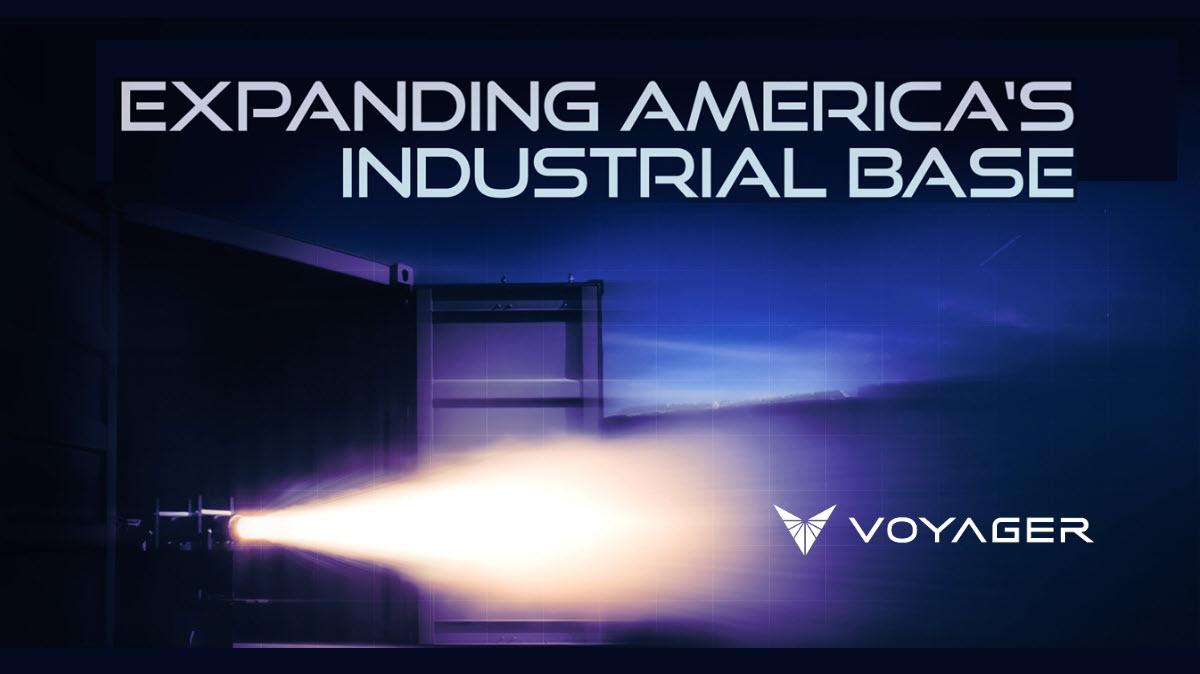
As global threats and supply-chain bottlenecks increase, national security requires a U.S.-centered industrial base that can meet demand with greater speed, flexibility and execution. The Pentagon’s Acquisition Transformation Strategy issues a clear directive: reshore supply chains and scale domestic production.
“Strengthening the domestic defense supply chain is key to maneuverability and resilience for programs like Golden Dome,” said Matt Magaña, president of Space, Defense & National Security, Voyager. “Voyager is expanding our capabilities, ensuring the ability to scale propulsion production quickly and predictably.”
Reversing a Decades-Old Trend
For decades, portions of the energetics supply chain have shifted offshore. While lower costs made global sourcing attractive, the tradeoff created strategic vulnerabilities, limiting U.S. domestic production capacity, increasing reliance on foreign suppliers and exposing supply chains to disruption. The cost savings cannot justify the national security risk of losing access to mission-critical resources and equipment during times of crisis.
Reinforcing the domestic defense supply chain directly impacts mission readiness and operational velocity, and strategic propulsion production plays a significant role. Propulsion systems are essential to powering missiles, rockets and other defense systems, all of which are vital to Golden Dome, a multi-layer missile defense system, intended to detect and destroy ballistic, hypersonic and cruise missiles in flight or before they launch.
A system of Golden Dome’s scale depends on propulsion at every layer, from the interceptors that must accelerate to hypersonic speeds within seconds to maneuvering with precise thrust control in the terminal phase. Each intercept demands propulsion that is fast, reliable and produced at scale. That places domestic energetics manufacturers at the center of the program’s success, and squarely in the critical path of national defense.
Gaining End-to-End Control
In November 2025, Voyager acquired Estes Energetics, a leading U.S. manufacturer of energetics, propulsion materials and critical resources that support missile defense. The acquisition provides full vertical integration from raw materials to ballistic release, giving Voyager greater end-to-end control over production quality and closing a key gap in the domestic defense industrial base.
Voyager’s American Defense Complex in Pueblo, Colorado further advances that mission. The 150,000 square-foot facility, which is slated to open later this year, will be the site of operations, testing and manufacturing. The AI-enabled facility is designed to support high-volume production of advanced propulsion technologies, including Voyager’s proprietary solid controllable propulsion technology for use across the U.S. military. The advanced robotics and highly automated manufacturing at the complex will cut lead times and accelerate delivery, enabling the scalability the U.S. defense industrial base requires.
“As global supply chains become increasingly fragile, these capabilities must be built, qualified and safeguarded here at home,” said Karl Kulling, general manager, Voyager Energetics. “We are ensuring American leadership over energetics, which are foundational to how we maneuver and project strength.”
Supply chain resilience equals mission readiness. That is why Voyager is building mission-ready systems that secure America today and power what comes next. The company is advancing partnerships with industry and government programs to expand the role of domestic energetics across next-generation defense platforms. As hypersonic threats evolve and missile defense requirements grow more complex, the demand for reliable, U.S.-sourced propulsion will only accelerate. Voyager is positioned to not just meet that demand, but to define the standard for how America maneuvers and defends itself in the decades ahead.
