The information environment moves fast. State-sponsored adversaries can push coordinated narratives within hours of a triggering event, seeding confusion, shaping perception, and filling the space before a deliberate response can be organized. The challenge for Western democratic institutions is not a lack of capability — it is a structural one. Every action requires approval chains, legal review, interagency coordination, and documented authority. Narratives must be factually coherent and internally consistent. A single exposed influence operation can generate years of diplomatic friction. These are not weaknesses to be eliminated. They are features of the system we are sworn to defend.
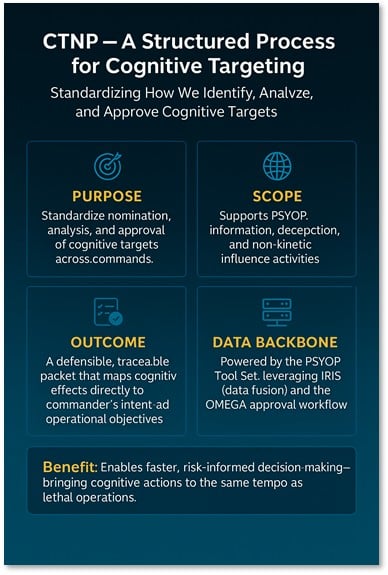
The opportunity lies in building operational methodology that works within those constraints at a tempo the environment demands. That is precisely what the Cognitive Target Nomination Packet (CTNP) framework is designed to do. The CTNP is not an academic concept — it is a practitioner’s answer to a problem observed across multiple commands: the joint force runs lethal targeting on a disciplined 72-hour cycle with a standardized packet vetted through existing command processes; non-lethal cognitive operations have never had an equivalent common packet, and that asymmetry costs information professionals clarity, speed, and credibility at the targeting board.
The CTNP applies the same doctrinal rigor to cognitive targeting that the joint force has long applied to kinetic operations. Kinetic targeting is mature, auditable, and grounded in doctrine, specifically JP 3-60, CJCSI 3370.01A, and the joint targeting cycle provides a standardized, repeatable process that trained practitioners can execute. Cognitive targeting deserves the same discipline. The doctrine already exists. What has been missing is the physically manageable and repeatable packet, the standardized, auditable artifact that moves cognitive targeting from concept to execution.
The CTNP follows a seven-stage lifecycle that mirrors the joint targeting cycle: Cover, Characterize, Analyze, Test, Decide, Deliver, and Assess. The Cover stage establishes mission linkage to commander’s intent. Characterize uses the FIVE-O framework — Facility, Individual, Virtual node, Equipment, Organization — extending the standard target taxonomy to include virtual entities and aligning with the Kill Web’s five-aspect architecture (Cognitive, Entity, Data, Logical, Geophysical). The Analyze stage builds behavioral profiles using Rogers’ Diffusion of Innovation adopter categories and positions each target audience on the Hierarchy of Psychological Effects Model (HPEM): Awareness, Understanding, Attitude, Preference, Intention, Behavior. The Test stage converts insights into Lines of Persuasion (LOPs) that are validated against the audience’s latitude of acceptance before dissemination — treating persuasion the way fires treat munitions: test it before employing it.
The Decide stage routes packets through established governance structures — Boards, Bureaus, Centers, Cells, and Working Groups (B2C2WGs), Target Development Working Groups (TDWGs), and Joint Targeting Coordination Boards (JTCBs) — ensuring legal review, intelligence validation, and command authority at every step. Deliver converts approved packets into tasking orders with specified messengers, channels, cadence, and timing. Assess tracks leading and lagging indicators, feeding results back into future operations.
A critical design principle distinguishes cognitive targeting from kinetic targeting: it is influence-led, not intelligence-led. PSYOP, Public Affairs, Information Operations, and Civil Affairs practitioners lead target development; intelligence validates and supports; legal reviews; command decides. Who you touch first determines how much blowback you create later. Targeting Innovators and Early Adopters, the 16% of any population with the widest tolerance for new ideas and the greatest network influence, creates social proof that moves the Early Majority without requiring direct engagement. Critical mass, defined as 15–35% adoption, makes change self-sustaining. That is the measurable endpoint most influence campaigns lack.
The CTNP also introduces a governing constraint that is not a guideline but a hard operational rule: you can only move an audience one HPEM step per cycle, and only inside their latitude of acceptance. Attempting to skip stages does not accelerate outcomes, it generates backlash, hardens opposition, and creates strategic blowback. Evidence must confirm that an audience has reached the current stage before any advancement. The era of personality-driven cognitive operations, where outcomes depend on the practitioner’s intuition and the commander’s risk tolerance, can now give way to a standardized process that is institutional, repeatable, and teachable. Methodology captures what intuition knows implicitly and makes it explicit. That is the foundation on which effective cognitive operations are built.
About the author: Stangle is a retired U.S. Army PSYOP officer who commanded the 4th Psychological Operations Group — the Army’s premier influence operations force. At Peraton, he leads the development of AI-enabled frameworks that bridge research, industry, and operational requirements to deliver decision advantage for Operations in the Information Environment and Irregular Warfare