

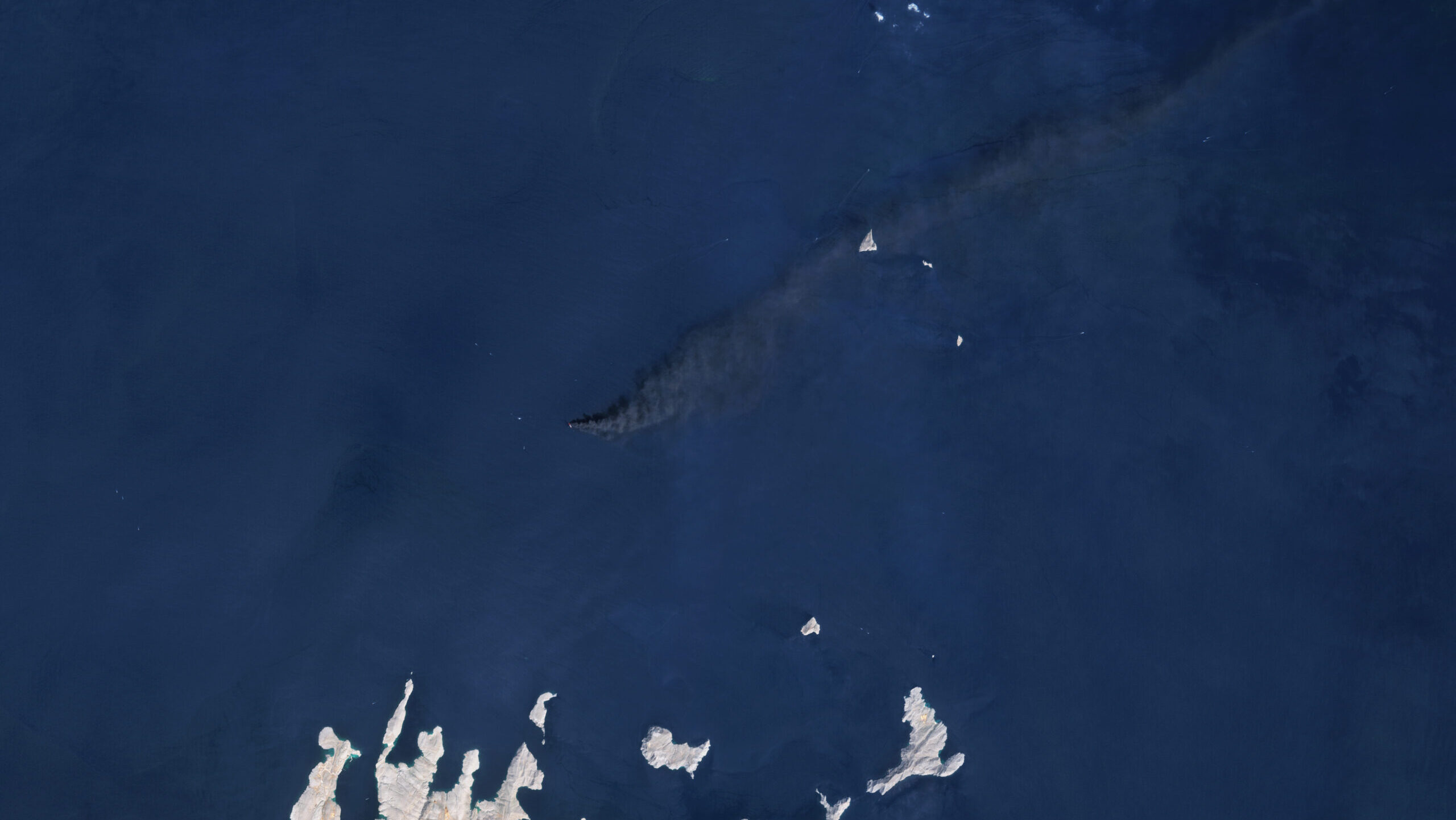
WASHINGTON — The ubiquity of commercial satellite imagery enabling unprecedented public transparency about military operations is changing the way the US military has to think about conducting battlefield operations, according to the chief of the US Space Force.
“How are commercial companies affecting the battle space? Maybe that wasn’t something you asked 60 years ago. You certainly have to ask it now. You know, the transparency that exists in the world, whether through cyber, digital means or commercial imagery, we just have to recognize and adapt to the changing battle space,” Gen. Chance Saltzman said April 1.
Military leaders can try to ignore the situation, or even try to tell commercial firms what to do, he said, but in the end the fact that there is increasingly no way to hide wartime operations is “just the way it is,” he told the Mitchell Institute’s annual Spacepower Security Forum in an answer to a question from Breaking Defense.
“The security environment is progressing; the world is progressing. … And it comes with new complications that we have to deal with,” Saltzman added.
In 2022, US government officials were lauding commercial remote sensing satellite operators as key partners in Western efforts to aid Ukraine’s defense against invading Russian forces — both directly buying unclassified imagery and analysis that could easily be shared and encouraging firms to make images of Russian military operations and warzone damage publicly available via the news media.
The situation in the ongoing war between the US and Israel against Iran could not be more different. While Washington has not issued any direct orders, three industry sources told Breaking Defense that US government officials quietly have urged firms to voluntarily constrain public access to imagery of the conflict zone and the surrounding region.
That dichotomy spotlights the double-edged nature of the global spread of commerial remote sensing capabilities for governments and military planners.
On one hand, unclassified satellite images from commercial firms can be used to try to deter adversary action, and if that fails easily shared to aid allied and partner nations in a fight as well as be deployed as a strategic-level information warfare tool aimed at influencing public opinion.
On the other hand, governments have little formal control about what even domestically-based private companies choose to sell and/or make public.
Somewhat prophetically, David Gauthier, then head director of commercial operations at the National Geospatial-Intelligence Agency (NGA), said in April 2022 that a Middle East contingency could try both the US government and domestic commercial remote sensing firms — as companies wrestle with obligations to customers and the desires of the US military and IC.
“It could be very messy,” Gauthier told reporters at that year’s annual Space Symposium.
That said, many US remote sensing satellite companies, and a few allied firms with US subsidiaries, are beholden to the US Intelligence Community via contracts with NGA, which collects and disseminates commercial imagery analysis, and the National Reconnaissance Office that operates US spysats. These include two of the biggest US imaging firms, Planet and Vantor, which last month decided to ratchet back public provision of imagery over the Gulf region.
Planet in a March 9 notice to its customers, obtained by Breaking Defense, explained that the company would be instituting a 14-day delay on release of imagery not just of Iran, but also of nearby military bases, the Gulf States and “existing conflict zones.”
The letter explained: “After consulting with experts inside and outside of government, and as we continue to balance operational security needs and our transparency mission, Planet has decided to take additional, proactive measures to ensure our imagery is not tactically leveraged by adversarial actors to target allied and NATO-partner personnel and civilians.”
A spokesperson for the company told Breaking Defense that the decision was “an independent decision by Planet to proactively limit risk of misuse of our data in the conflict.”
A spokesperson for Vantor, one of the two spinoffs from former US remote sensing behemoth Maxar, told Breaking Defense that it has had a longstanding policy to consider whether and how to limit imagery access over conflict zones.
“Because of the higher resolution and geospatial accuracy of our intelligence, Vantor may implement enhanced access controls during times of geopolitical conflict to prevent the misuse of sensitive geospatial intelligence and to help protect allied forces and civilians. protect allied forces and civilians,” the spokesperson said.
The spokespeople did not address whether or not they had been urged by the government to implement these policies.
With regard to the Iran war, the Vantar spokesperson added that the company has “controls in place over parts of the Middle East. This includes slowing distribution of News Bureau imagery in the Persian Gulf.”
The Vantor News Bureau provides imagery to news media outlets for free.
US-based SAR satellite operators, which in particular garnered the spotlight in the Ukraine way for their capability to provide imagery despite heavy cloud cover, also have been silent with regard to Iran. None of the three firms now holding NRO contracts — Capella Space, ICEYE US and Umbra — responded to requests for comment about their release policies.
However, the US government has zero say in what foreign satellite imaging firms release.
Europe’s Airbus, for example, continues to provide customers including US news media battle damage images in Iran and surrounding countries. However, a spokesperson for the company would not elaborate on whether any restrictions were in place such as time delays or reductions in resolution.
“The public release of Airbus satellite imagery is governed by several regulations and contractual terms and conditions, the specifics of which we will not comment on,” the spokesperson said.
Further, China’s English-language newspaper Global Times on Jan. 30 published detailed pictures of the US buildup of aircraft and naval forces at Middle Eastern bases prior to the launch of Operation Epic Fury. The images were provided by Chinese commercial geospatial intelligence firm MizarVision, which uses artificial intelligence to analyze open-source satellite imagery. As reported on April 4 by the Washington Post, the company continues to post to Chinese social media and market images of the conflict and US military forces in the region on its website.
Saltzman said that one thing that should be done is to ensure that the challenges presented by widespread access to commercial imagery are factored into military wargaming.
“How many times in a war game have we said, ‘and here’s the commercial imagery that the adversary is using to target us, and what are you going to do about it?’ It’s just not something that we’ve been in the habit of doing, but we better start doing, because that is the that is the new world, that is the new battle space, and we got to be ready for it.”
