

On April 8, Bangladesh’s parliament passed the Anti-Terrorism (Amendment) Bill, 2026, by voice vote, thereby making the Anti-Terrorism (Amendment) Ordinance, 2025 legally binding. The act amends the Anti-Terrorism Act, 2009 (ATA) and designates the Awami League and its affiliates as “terrorist organizations.” Originally a stopgap measure to hold political leaders accountable for the crimes committed in July-August 2024, the law provides for a proscription mechanism that can apply not only to the Awami League but also to other political organizations.
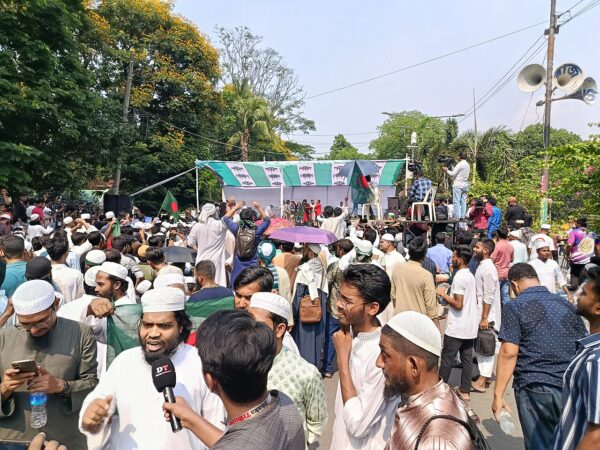
This framework emerged following the July 2024 uprising and consequent toppling of the Awami League government. On October 23, 2024, the interim administration, led by Dr. Muhammad Yunus, issued an executive order declaring the Awami League’s student wing, the Bangladesh Chhatra League, a “terrorist organization.” A little over six months later, following protests led by the National Citizen Party (NCP), the interim administration promulgated the Ordinance, which amended the 2009 ATA. The amendment temporarily barred the Awami League from engaging in political activities pending the trial of its leadership.
The Ordinance brought critical changes to the ATA, widening the definition of an “organization” to include “political parties.” Section 18(1) gave the executive the right to proscribe the activities of a political party through a temporary ban. The prohibition further extends to the party’s activities, including the “dissemination of propaganda online and via social media,” sidestepping any constitutional test that should be required for such sweeping restrictions.
Human Rights Watch condemned this amendment as draconian. The threshold for banning a political party in any democratic society requires a higher standard and often calls for the court’s intervention, given that freedom of association is a fundamental constitutional value.
With the Ordinance now ratified by the legislature, the Awami League, Bangladesh’s oldest political party, and its politicians, activists, and supporters, fall under a proscribed regime. Without judicial review of the Act, such an executive action, on its face, appears to violate fundamental rights guaranteed by the Constitution and international standards prohibiting collective punishment.
The question of the ban on the Awami League was first raised in a writ petition, which the High Court summarily rejected on the grounds that the Awami League was not a party to the petition and that a political party could not be tried before the High Court. During the petition, then Attorney-General Md. Asaduzzaman advised the Court to reject the petition, arguing that the interim government had no intention of banning political parties and that the petitioner lacked locus standi.
Subsequently, the executive arm of the interim government gave in under pressure from the NCP, which was demanding the Awami League’s ban, resulting in the promulgation of the Ordinance. The influence of another political party compromised the process of adopting the Ordinance, despite the administration’s initial stance of neutrality, necessitating judicial review of the due process issue.
It should be noted that the very same person who had advised against imposing the ban on the Awami League became the law minister after the February 2026 election and was responsible for formalizing the proscription framework. This is where the court should step in to scrutinize the mala fide (bad faith) intent by the executive and legislative wings to determine if powers were exercised for improper, dishonest, unauthorized purposes, as well as the proportionality and reasonableness of the amendment.
The amended ATA raises serious concerns because it limits basic freedoms protected under Bangladesh’s Constitution and international human rights law. That is why a court should carefully examine whether the law has gone too far. Absent such review, the law is susceptible to executive misuse and overreach. Moreover, the government could weaponize the Act to ban any party without properly reviewing whether such a drastic step is really necessary, whether less severe options were available, or whether the party was given a fair chance to respond.
The urgency for judicial review of the amended ATA stems from several concerns. The first problem is that the amendment uses vague language. It allows the government to ban a political party if it merely has a “reasonable belief” that the party should be restricted. That is a very loose standard to apply to ban any political party.
Proscribing the Awami League potentially disfranchised millions of supporters from participating in the national election. Furthermore, counterterrorism law experts usually caution against overly broad definitions, as they increase the risk of deliberate misuse by the executive.
The amendment also conflicts with the basic principle that everyone is innocent until proven guilty. Here, the ban is tied to the trial of party leaders, which means the party can be punished before the leaders are even convicted. It treats ordinary members and supporters as responsible for crimes they did not commit.
The law further grants the government vast power to determine what constitutes proscribed activities. It lets officials decide, with very little guidance, what counts as behavior that “creates panic,” threatens the state, or supports a banned group. The amendment fails to define terms like “membership” and “support,” making it easier to stretch the law beyond its original intent. The prohibition further extends to the party’s activities, including the “dissemination of propaganda online and via social media,” sidestepping any constitutional test that should be required for such sweeping restrictions. Previously, the interim administration incarcerated an emerging YouTube influencer, whose content was critical of the administration, on charges of terrorism.
This becomes even more worrying in cases where the law is used to address events and history connected with Bangladesh. On March 7, 2026, the government arrested several Dhaka University students for replaying Bangabandhu Sheikh Mujibar Rahman’s historical March 7 speech, simply because the government associates it with the Awami League. In another incident, 12 teenagers faced terrorism charges for filming a video where they can be seen chanting Joy Bangla (Victory to Bangla), the Liberation War slogan that later became associated with the Awami League.
After the violent protests of July-August 2024 and the subsequent breakdown of law and order during the interim administration, banning the former ruling party might be considered a quick fix. Instrumentalizing anti-terrorism law to achieve a political goal, however, creates a dangerous precedent in any democratic polity.
There are serious questions that need to be raised before the court regarding the absence of pre-ban hearings for the Awami League, the retrospective ratification of the Ordinance, and the vague “until trial concludes” clause, which could span years and invite abuse. Although the government claims that national security interests are involved, when the exercise of executive authority curtails people’s freedoms and political rights, such actions must be examined in court. Not doing so means that freedoms and rights belong only to the powerful and the privileged.
