

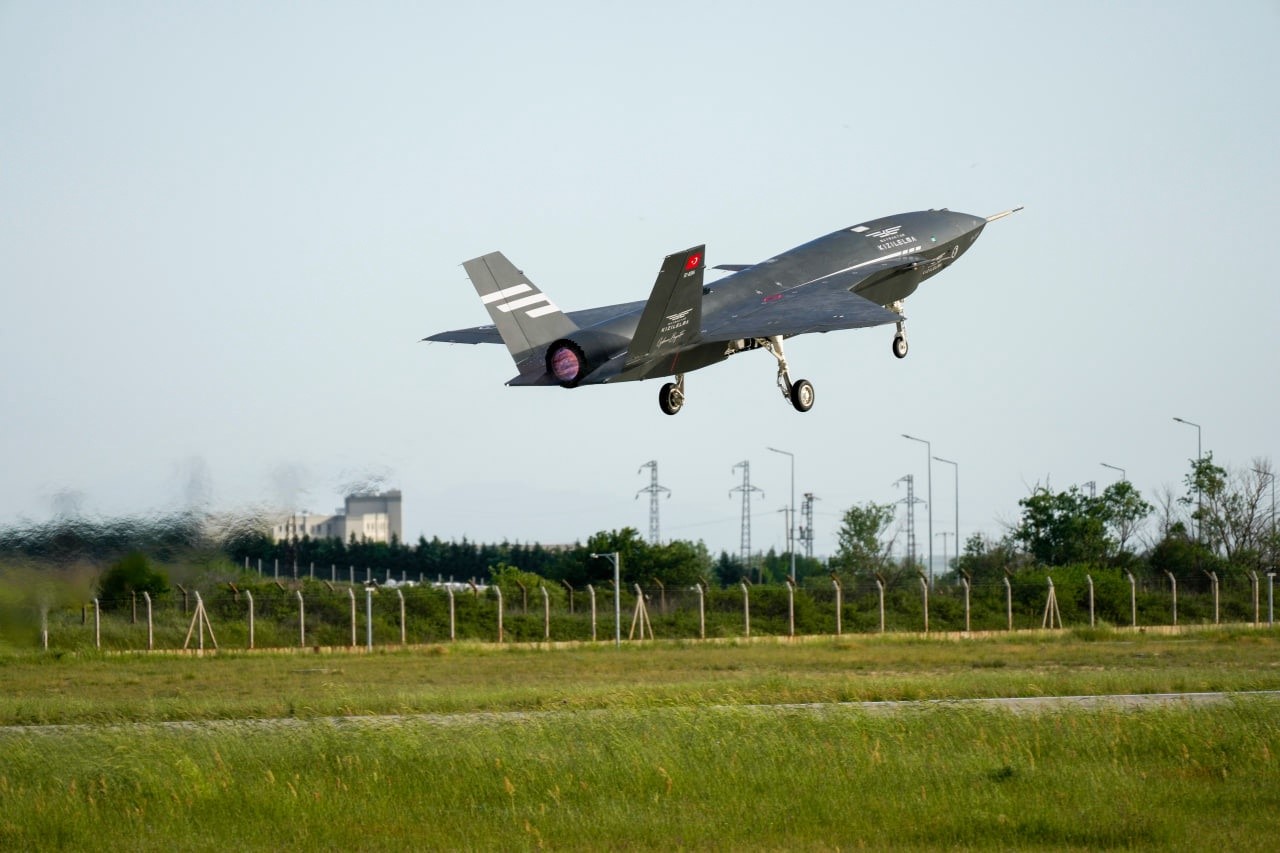
Türkiye’s Baykar and Italy’s Leonardo have completed the first live trials of their K-SWARM crewed-uncrewed teaming concept, flying the Bayraktar Kızılelma uncrewed combat air vehicle (UCAV) under the direct control of the crew of an M-346 jet, the two companies announced in a joint statement on 22 June.
The flight campaign took place last month at Baykar’s flight and test centre in Çorlu, in northwestern Türkiye, and paired a Leonardo-owned M-346 Fighter Attack aircraft with a Kızılelma, while an Italian Air Force T-346A flew as chase aircraft.
It marks the first time a Turkish UCAV has been commanded in flight by the crew of a separate combat aircraft, placing Türkiye among a small group of states – publicly limited to the United States, China and Russia – known to have flown this kind of crewed-uncrewed teaming.
See Where Turkish Defence Vendors Are Expanding Next
Understand which export markets matter most, how Turkish suppliers are pitching their capabilities, and where buyer interest is turning into real opportunity.
What the Trial Involved
According to Leonardo and Baykar, the Kızılelma completed an autonomous taxi and take-off before rejoining the M-346 in formation, at which point the two-person crew in the jet assumed full control of the drone.
The Kızılelma flew using Smart Fleet Autonomy algorithms developed by Baykar’s Hardware-in-the-Loop (HIL) Laboratory. The M-346 pilots, using a newly developed and fully integrated onboard avionics suite, then commanded a series of formations, position changes, separations and rejoins, which the drone executed autonomously on those instructions.
Per Daily Sabah, citing Anadolu Agency, the synchronized real-time data exchange between the aircraft was protected and monitored by a Leonardo cyber-defence system known as the GCC Tactical Platform.
The companies describe the concept as crewed-uncrewed teaming, an approach more widely known as manned-unmanned teaming (MUM-T) or, in its armed form, as collaborative combat aircraft (CCA) operations. Throughout, the human pilots retained full control and decision-making, the firms said.
From the Simulator to Çorlu
The live phase followed months of preparation in the virtual environment, including work on an M-346 full-mission simulator in Venegono, Italy, and at Leonardo’s product capability and concept laboratory in Turin, where the algorithms, tactics and procedures were first rehearsed.
Leonardo Chief Executive Roberto Cingolani had signalled the direction in March, saying demonstrations with the Kızılelma would begin in mid-2026 using an M-346 as the controlling aircraft.
The two companies say a further set of K-SWARM tests is planned for the coming months, with greater complexity and additional functions that will demand higher levels of situational awareness and assets working together more closely. The stated long-term aim is to use artificial intelligence to reduce pilot workload and, eventually, to enable swarming.
The Kızılelma Behind the Trial
The Kızılelma is one of only a handful of fighter-type combat-drone projects anywhere to have reached flying hardware. Baykar began the program around 2013, revealed it publicly in 2021, and flew the aircraft for the first time in December 2022.
The UCAV is claimed to be supersonic in its later configurations and to carry some reduced-observable shaping, and Baykar has positioned it as a drone companion to Türkiye’s crewed TF Kaan fighter. In its definitive form it is powered by a single Ukrainian Ivchenko-Progress AI-322F turbofan giving close to 10,000lb of thrust with afterburner.
Late last year, Baykar reported that the Kızılelma had used a Turkish Gökdoğan missile to destroy a target drone – described at the time as the first occasion on which a UCAV had launched a radar-guided air-to-air missile (AAM). The aircraft has also been tested with the Toygun electro-optical targeting system and an active electronically scanned array (AESA) radar.
Notes and Comments
The K-SWARM trial is best understood as the latest step in a partnership that has moved unusually quickly. Leonardo and Baykar signed a memorandum of understanding in Rome in March 2025, then formally launched their joint venture – LBA Systems – at the Paris Air Show that June, with Baykar chairman Selçuk Bayraktar and Leonardo chief executive Roberto Cingolani signing the deal.
The venture is a 50:50 company headquartered in Italy, and it is meant to cover the full lifecycle of unmanned aerial systems – design, development, production and sustainment. LBA Systems is intended to build Baykar’s TB2, TB3, Akıncı and Kızılelma in Italy, across three sites.
The two firms divide the work clearly. Baykar brings a portfolio of combat-proven, already-flying unmanned platforms, while Leonardo brings mission systems, payloads, sensor fusion and – decisive for European sales – the certification experience and political standing that a Turkish exporter cannot supply on its own.
Baykar’s move into Italy predates the venture itself. It acquired the Italian aircraft maker Piaggio Aerospace in late 2024, giving it a manufacturing base in Italy before LBA Systems was announced – a sign that the European push was a deliberate strategy rather than an opportunistic deal.
Politically, the partnership cleared its most important obstacle only this month. On 17 June, Rome approved the venture under Italy’s “Golden Power” rules, which let the government attach conditions to investments in strategic sectors.
In this case, Rome required that sales and any further international development be confined to countries politically aligned with Europe and NATO, and that the drones’ technology be classified. That confines Baykar’s European arm to allied customers and away from the broad export base on which its name was built.
K-SWARM is the part of the partnership that develops actual fighting capability, as distinct from production and market access. The two companies have described the unmanned market as worth roughly US$100 billion over the next decade, and crewed-uncrewed teaming is the most valuable and hardest-to-copy work within it.
Leonardo’s stake in the Eurofighter consortium means the teaming work could extend beyond the M-346. One can see the Typhoon – a type Türkiye is itself moving to acquire – taking on the same drone-commander role now that the Franco-German Future Combat Air System (FCAS) has collapsed.
The venture is also a test of how far a Turkish and an Italian firm can integrate inside NATO, where export controls and competing national programs still apply. The next K-SWARM tests, the completion of the Italian production lines, and the first joint export campaigns will show whether LBA Systems becomes a permanent part of Europe’s drone industry or stays a narrower bilateral arrangement.
For now, one can read the Çorlu trials as evidence that the partnership has moved from paperwork and factory planning into demonstrated capability – and as a measure of how central the Leonardo relationship has become to Baykar’s ambition to compete in high-end combat aviation rather than unmanned aircraft alone.
Quwa Pro
Understand Where Türkiye’s Defence Export Momentum Is Building
Follow how Turkish companies are presenting their products, where militaries are showing interest, and what those moves reveal about demand across regional defence markets.
Featured & Trusted By
