

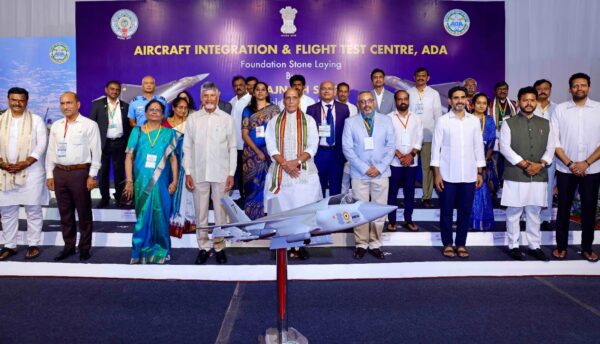
On May 15, India’s Defense Minister Rajnath Singh and Andhra Pradesh Chief Minister Chandra Babu Naidu laid the foundation stones for a range of strategic aerospace and defense projects in the southern Indian state of Andhra Pradesh.
These include a Core Integration and Flight-Testing Center at Puttaparthi to fast-track the development of Fifth-Generation Advanced Medium Combat Aircraft (AMCA) and other future indigenous platforms, as well as the Naval Systems Manufacturing Facility at T Sirasapalli village near Visakhapatnam to meet the Indian defense forces’ requirement for advanced underwater weapon and naval combat systems.
In addition, five drone manufacturing and technology companies to be set up at Drone City in Orvakal were virtually inaugurated.
According to Singh, Andhra Pradesh is set to emerge as a major hub of aerospace and defense production.
Andhra Pradesh has joined Tamil Nadu, Karnataka, and Uttar Pradesh in setting up defense production corridors, with preferential tax and excise rates that are intended to attract public and private companies to set up research and development and production units in their tax jurisdictions.
With the AMCA project, Puttaparthi will become a strategic defense hub of national importance. Naidu noted that the project aligns with India’s push to modernize and strengthen defense capabilities and highlighted the centers. He also said that the drones used in Operation Sindoor were manufactured and tested in Andhra Pradesh, showcasing the state’s defense potential.
On May 19, Pune-headquartered Bharat Forge signed a memorandum of understanding (MoU) with the Andhra Pradesh government to establish India’s first private sector marine gas turbine facility (MGTF) at Visakhapatnam. The proposed facility, to be developed through Bharat Forge Aerospace division within the Andhra Pradesh Defense Manufacturing Corridor, will strengthen India’s indigenous naval propulsion ecosystem and support the country’s long-term defense self-reliance objectives. The facility will include advanced repair and overhaul capabilities, indigenous marine gas turbine development infrastructure, and a full-spectrum testing ecosystem, while also generating approximately 750 direct and indirect jobs.
At the Puttaparthi event, Naidu drew attention to Andhra Pradesh’s emerging strategic ecosystem, which includes Sriharikota as a space hub, Nagayalanka for missile capabilities, Puttaparthi for defense strength, and Visakhapatnam as a naval hub. Together, these would transform Andhra Pradesh into a defense shield for the nation.
The Naval Systems Manufacturing Facility at Visakhapatnam, which is co-located with the Naval Dockyard, INS Eksila and the Eastern Naval Command Headquarters, will for the first time bring critical propulsion sustainment capability into India’s private sector.
Phase 1 will deliver a full marine gas turbine repair and overhaul complex; hot section restoration of blades, vanes and combustion liners; component manufacturing; NDE Laboratory, and a 72-hour turnaround capability for the Naval Dockyard at Visakhapatnam.
Phase 2 will establish India’s first private sector Marine Gas Turbine Development and Assembly Hall, a full-spectrum hot test cell scalable across all propulsion ratings, and for the very first time on Indian soil, the development and qualification of an indigenous Marine Gas Turbine. The facility will also serve as a regional hub for navies from friendly nations, creating 750 direct and indirect jobs.
These projects will cater to all three services and strengthen efforts to make India self-reliant in defense manufacturing. India’s warships have traditionally been propelled by engines built abroad. That dependence ends at Visakhapatnam.
Bharat Forge’s Aerospace Division is committed to bringing marine gas turbine, repair, overhaul and indigenous development on Indian soil for the first time in the private sector, co-located with the very Naval Command that depends on these.
Gas turbines are the propulsion backbone of the Indian Navy’s frontline service combatants. The overall supply chain for these engines has been severely disrupted in recent years, directly impacting fleet R&O cycles and operational readiness. This facility by Bharat Forge is a national strategic imperative, laying a decisive cornerstone toward India’s goal of a Developed India by 2047.
