

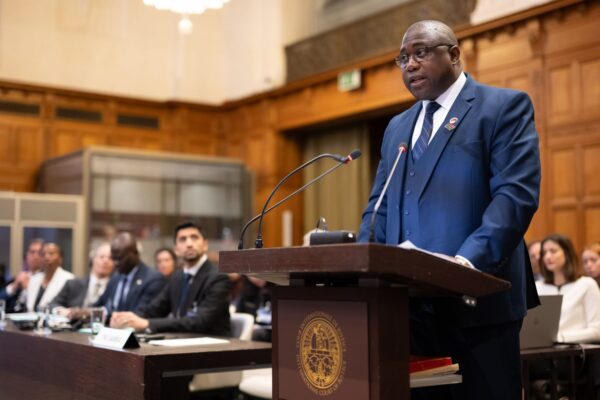
The past few years have seen a proliferation of legal cases against Myanmar’s military, for crimes committed before and since the military coup of February 2021. Many of these efforts have been undertaken on the principle of “universal jurisdiction,” which allows the victims of atrocities to bring charges in foreign courts against particular crimes of international concern, regardless of where the crime was committed or the nationality of the victims and perpetrators.
Among the most recent was filed in Australia by Legal Action Worldwide (LAW), an international legal advocacy organization, alleging crimes against humanity and war crimes committed by Myanmar security forces since the 2021 coup, including widespread sexual violence.
LAW’s Executive Director Antonia Mulvey spoke with The Diplomat’s Sebastian Strangio about her organization’s case in Australia, the challenges facing international law at a time of growing geopolitical tension, and other attempts to bring Myanmar’s generals to account.
Let’s start with the case that your organization is pursuing in Australia – the first dealing exclusively with post-coup atrocities in Myanmar. Where does the case stand, and what is notable about it, both in terms of Myanmar accountability efforts and in relation to the Australian legal system?
On 29 October 2025, LAW filed a 125-page criminal complaint with the Australian Federal Police on behalf of ten victims of serious crimes committed in Myanmar between February 2021 and May 2023. These include killings, unlawful detention, torture, sexual violence, persecution, and attacks on civilians linked to the military’s repression of pro-democracy movements. Some of the victims are currently in Australia, and others are willing to travel to support the case.
We requested an investigation into at least 35 officials from the Myanmar military, police, and prison system under Australia’s universal jurisdiction laws. The AFP took the complaint seriously and met with us in person, but ultimately declined to proceed. The main barriers were practical: no extradition pathway, no access to crime scenes, and no suspects present in Australia.
Despite this outcome, the case shows that Australia has the legal framework to address international crimes. It also highlights a wider challenge: without cooperation or access, these cases are difficult to move forward. Even so, universal jurisdiction remains one of the few available avenues for accountability for Myanmar victims.
LAW’s case adds to a growing list of international criminal cases facing the Myanmar military and its leaders, including a number of similar “universal jurisdiction” cases in other nations. All of these legal cases hinge on the eventual apprehension of Min Aung Hlaing and other alleged perpetrators. What do you think is the chance of this happening at some point? And if it doesn’t happen, is it all for nothing?
In the short term, the likelihood of Myanmar’s military leadership appearing before a court is low, but not impossible.
History shows that political change can open the door to accountability. Leaders once seen as untouchable — such as Milošević or Charles Taylor — were eventually brought to justice after shifts in power, exile, or arrest abroad. Similar scenarios could emerge in Myanmar over time.
Even without arrests, these efforts are not symbolic. They preserve evidence, document patterns of abuse, and recognize victims. This work is time-sensitive — evidence can be lost, and witnesses disappear. What is done now can determine whether prosecutions are possible in the future. The question is not only when arrests will happen, but whether the groundwork is ready when they do.
As a member of the U.N. Fact-Finding Commission on Myanmar, you were involved in documenting atrocities committed against the Rohingya during the “clearance operation” of 2017, and in the subsequent genocide case at the International Court of Justice (ICJ) in The Hague, which held trial hearings in January. What has been significant about the ICJ case, and are you optimistic about a favorable ruling later this year?
The ICJ case is one of the most significant genocide cases in recent decades. It focuses on whether Myanmar, as a state, breached its obligations under the Genocide Convention, shifting the Rohingya crisis firmly into a legal framework.
A key development was the Court’s confirmation that any state can bring such a case, even if not directly affected. This strengthens the idea that preventing genocide is a shared international responsibility.
The evidentiary record is now far more substantial, including direct testimony from Rohingya survivors who traveled from camps in Bangladesh. A central issue is whether genocidal intent can be inferred from a pattern of conduct. While this remains a high legal threshold, there are strong indications that at least some violations may be found.
Regardless of the outcome, the case has already had lasting impact. It has elevated the voices of survivors and reinforced the role of legal processes in addressing mass atrocities.
Earlier this year, the government of Timor-Leste agreed to examine a case file relating to the Myanmar military’s atrocities against member of the country’s Chin minority. On the one hand, this was significant, as it was the first time one ASEAN member state had agreed to consider investigating another. On the other hand, ASEAN’s approach to the Myanmar conflict has shown that the region is sensitive about transgressing its principle of “non-interference.” How do you see things standing in ASEAN? Do you think there is momentum in the region for greater international accountability?
Timor-Leste’s decision to examine crimes in Myanmar is significant because it challenges the long-standing principle of non-interference that has shaped the region’s response. It shows that accountability is not only being driven from outside Southeast Asia.
At the same time, ASEAN remains divided. Some states have taken a more critical approach to the junta, while others continue to prioritize stability and sovereignty. There is no clear regional consensus on accountability.
What is emerging instead is gradual, uneven momentum. Alongside international mechanisms, individual states and institutions are beginning to engage with justice processes. This suggests that the political space for accountability is expanding, even if it has not yet translated into collective regional action.
You mentioned in a recent talk that we live at a time when “the international commitment to international law, international justice institutions and human rights” were being “challenged in an unprecedented manner.” What are the main challenges, and is it possible to be hopeful that this project has a future in a more geopolitically tense world in which international law is more baldly employed by states for political ends?
International justice is facing a difficult moment. There are concerns about selective application, increasing geopolitical tensions, and the limits of enforcement, particularly where cooperation from states is lacking.
At the same time, the system is more decentralized than ever. National courts, international mechanisms, civil society, and survivor-led efforts are all contributing to documenting crimes and preserving evidence. This makes accountability harder to ignore and easier to sustain over time.
International law also continues to shape state behavior. Governments still justify their actions in legal terms, which reflects its ongoing relevance. Progress is often slow and uneven, but these processes build the foundation for future accountability.
One common criticism that one hears about international criminal justice efforts is that they can compromise peace-making processes by perpetuating zero-sum conflict dynamics and giving alleged perpetrators greater incentives to keep fighting. Do you think there is a potential tension here? How has LAW approached this issue, both in Myanmar and beyond?
There can be real tension between peace and justice, particularly where leaders fear prosecution and may be less willing to negotiate.
But durable peace rarely comes from ignoring serious crimes. Impunity can deepen grievances and increase the risk of future violence. The challenge is how to balance accountability with political realities, not to treat them as mutually exclusive.
LAW’s approach is to keep pathways to justice open while focusing on victims and evidence. This supports long-term peacebuilding by recognizing harm and ensuring that accountability remains possible, even if prosecutions take time.
