

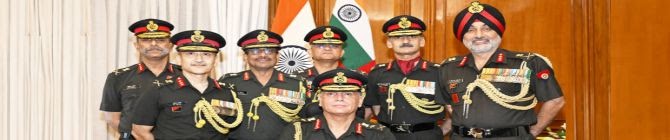
The armed forces have undergone a significant reshuffle in senior leadership positions, marking a major transition across both the Army and the Air Force.
This change of guard comes at a time when the country has already seen new leadership at the very top of the defence establishment, with General Dhiraj Seth assuming charge as Chief of the Army Staff, Admiral Krishna Swaminathan taking over as Chief of the Naval Staff, and General Subramani appointed as Chief of Defence Staff.
Together, these appointments reflect a broad restructuring of India’s military leadership aimed at strengthening operational readiness and strategic oversight.
In the Army, General Dhiraj Seth has formally taken charge as the new Chief of the Army Staff. An officer from the Armoured Corps with nearly four decades of service, he brings extensive operational and command experience to the role.
Following his elevation, General Seth relinquished his previous position as Vice Chief of the Army Staff. That post has now been assumed by Lieutenant General Sandeep Jain, who earlier served as General Officer Commanding-in-Chief of the Southern Command. His appointment ensures continuity of leadership at the highest levels of the Army.
Lieutenant General Rajesh Pushkar has taken charge of the Pune-based Southern Command, a critical operational theatre, while Lieutenant General Mohit Malhotra has assumed command of the Jaipur-based South Western Command.
These appointments strengthen leadership across two of the Army’s most important regional commands, both of which play a vital role in India’s defence posture. Another key appointment is that of Lieutenant General Madanraj Pande, who has taken over as Commander of the Leh-based 14 Corps, also known as the Fire and Fury Corps. This corps is responsible for operations in the sensitive Ladakh sector, including Kargil and Siachen, areas that remain strategically significant given the prevailing security environment.
In the Air Force, Air Marshal Ashutosh Dixit has relinquished the post of Chief of Integrated Defence Staff to the Chairman, Chiefs of Staff Committee, and has taken over as the Vice Chief of the Air Staff. His appointment reflects the Air Force’s emphasis on operational preparedness and institutional continuity, ensuring that the service remains aligned with the broader objectives of jointness and integration within the armed forces.
These changes collectively represent a major leadership transition in India’s defence establishment. The new commanders bring with them a wealth of operational experience, strategic understanding and institutional knowledge.
Their appointments come at a time when the armed forces are focused on readiness, modernisation and addressing emerging security challenges. The reshuffle underscores the importance of continuity in leadership while simultaneously injecting fresh perspectives into the command structure, ensuring that India’s military remains prepared to meet the demands of a rapidly evolving strategic environment.
Agencies
