

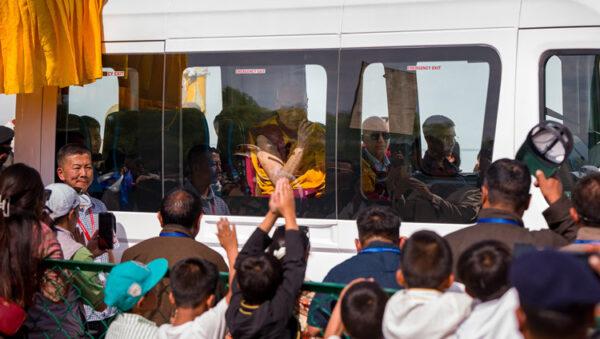
On July 6, the 14th Dalai Lama turned 91. In Dharamshala, the Himalayan town that has served as his home in exile since 1959, the day was marked, as it was last year, with long-life prayers, khata scarves, and delegations of devotees from across Asia and beyond. But the birthday of the Dalai Lama is no longer merely a religious observance. It has become an annual reminder of a clock that is ticking on one of Asia’s most combustible questions: who will choose the 15th Dalai Lama. Behind that question lies a broader contest between India and China over which of Asia’s two giants can credibly claim custodianship of Buddhism itself.
That contest has been building for decades, but the past year sharpened it dramatically. At his 90th birthday celebrations in July 2025, the Dalai Lama ended years of speculation by affirming that the institution will continue after his death, and that his Gaden Phodrang Trust holds sole authority to recognize his reincarnation. It was a pointed exclusion of Beijing, reinforced by his long-standing suggestion that his successor will be born in the “free world,” outside Chinese control. Within hours, China rejected the plan, insisting that any reincarnation must comply with Chinese law and “historical conventions,” a reference to the Qing-era Golden Urn ritual that Beijing codified in its 2007 State Religious Affairs Bureau Order No. 5, which requires state approval for all reincarnations of living Buddhas.
The world has seen this movie before. After the 10th Panchen Lama died in 1989, the Dalai Lama recognized a six-year-old boy, Gedhun Choekyi Nyima, as his reincarnation in 1995. Within days the child disappeared into Chinese custody; he has not been seen in the three decades since, a case United Nations human rights experts formally raised with Beijing last year. In his place, the Chinese Communist Party installed its own candidate, Gyaltsen Norbu, who remains largely unrecognized by Tibetans but is now being deployed as an instrument of Chinese religious statecraft. Gyaltsen Norbu pledged loyalty to Xi Jinping in a rare 2025 audience, and nearly traveled to the Buddha’s birthplace at Lumbini, Nepal, in 2024 before Indian and American diplomatic pressure helped scuttle the visit.
A rerun of the Panchen Lama playbook – two rival Dalai Lamas, one chosen in exile and one anointed in Beijing – is now the baseline expectation of most Tibet watchers.
Beijing’s Bid for Buddhism
For China, the succession fight is the sharp end of a much larger soft power project. Over the past decade, the officially atheist state has spent lavishly on temples, Buddhist universities, relic loans, and monk exchanges across Asia, marketing a state-managed version of the faith. The flagship is the World Buddhist Forum, which in its 2024 edition drew roughly 800 monks, scholars, and religious figures from more than 70 countries. Former Indian ambassador to China Ashok Kantha argued that the forum was designed to “project China as the center of the Buddhist universe,” as Bloomberg paraphrased it, and to quietly erode India’s status as the faith’s ancestral home.
Nepal has been a particular target. Chinese-backed institutions have proliferated around Lumbini, the birthplace of the Buddha located a short drive from the Indian border. New Delhi reads this as an attempt to relocate Buddhism’s sacred geography northward, away from India.
For Beijing, Buddhist diplomacy serves three purposes. First, it softens China’s image in the Theravada belt – Sri Lanka, Myanmar, Thailand, and Cambodia – where Belt and Road infrastructure has generated both dependence and unease. Second, it builds a constituency of foreign monasteries and sanghas that may one day be induced to recognize, or at least not reject, a Beijing-appointed Dalai Lama. Third, it serves the domestic project of “sinicizing” Tibetan Buddhism, folding a unique faith into the party-state.
Yet China’s Buddhist diplomacy comes with a built-in paradox: the party that claims exclusive authority to certify reincarnation is itself staunchly atheist and insists that all faiths subordinate themselves to “Xi Jinping Thought.” China’s government bans images of the Dalai Lama inside Tibet, surveils monasteries, and restricts the use of Tibetan language, including a new insistence on calling Tibet “Xizang.” The disappeared Panchen Lama remains, for Buddhists worldwide, the most eloquent rebuttal to Beijing’s claim of religious stewardship.
As Dibyesh Anand, a professor in International Relations at London’s University of Westminster, told The Diplomat for a previous article, Beijing “remains trapped by its own absurd logic… an atheist party that doesn’t believe in past lives insisting it alone can authorize reincarnation.”
India’s Counter
India’s own Buddhist diplomacy is built on history and geography. The Buddha attained enlightenment at Bodh Gaya, preached his first sermon at Sarnath, and died at Kushinagar – all on Indian soil. New Delhi’s challenge has been converting that civilizational inheritance into strategic effect, and under Prime Minister Narendra Modi the effort has been given new momentum.
India launched the International Buddhist Confederation in 2011 as an institutional rival to China’s forums. New Delhi has since hosted Global Buddhist Summits, upgraded pilgrimage infrastructure through its Buddhist Circuit project, and welcomed leaders such as Vietnam’s To Lam and Myanmar’s Min Aung Hlaing at Bodh Gaya, turning sacred sites into venues of statecraft.
Relic diplomacy has become India’s signature instrument. Sacred remains associated with the Buddha have traveled in recent years to Thailand, Vietnam, and Mongolia, drawing enormous public veneration in precisely the countries where China’s economic influence runs deepest. In January 2026, Modi inaugurated “The Light and the Lotus,” an exhibition of the Piprahwa gems, relics excavated in 1898 and widely regarded as among the first discovered bodily remains of the Buddha, after India intervened to halt their auction at Sotheby’s, a move celebrated domestically as both heritage repatriation and a geopolitical win.
Across the border in Lumbini, Nepal, India is building a $10 million international center for Buddhist culture within sight of Chinese-backed projects, refusing to cede the Buddha’s birthplace to Beijing’s narrative.
And then there is India’s singular, irreplaceable asset: the Dalai Lama himself. Hosting him and the Central Tibetan Administration for 67 years has given India a moral standing in the Buddhist world that no exhibition can match. Modi’s public birthday greetings to the Dalai Lama – which drew formal Chinese protests in 2025 – signal that New Delhi increasingly views this card as one to be played rather than hidden.
India, however, has struggled to make the most of its many advantages. Buddhist sites in India capture only a sliver of global Buddhist tourism, hampered by poor connectivity and visa friction. Relic exchanges have at times stalled in bureaucratic channels. The revival of Nalanda University, meant to be the crown jewel of Indian knowledge diplomacy, was marred by governance turmoil that saw both Amartya Sen and George Yeo depart as chancellors. Where China’s problem is credibility, India’s is execution.
The Dalai Lama Succession as Referendum
The coming succession will function as a referendum on both strategies. Beijing will almost certainly produce its own 15th Dalai Lama and lean on its Buddhist client networks and on economically dependent neighbors, like Nepal and Sri Lanka, to acknowledge him.
The exile establishment, backed by the Gaden Phodrang Trust’s exclusive claim, will identify a child beyond China’s reach, quite possibly on Indian soil; the sixth Dalai Lama, after all, was born in Tawang, in today’s Arunachal Pradesh. Whether governments across Asia and the West recognize the exile candidate, hedge, or stay silent will reveal how far each side’s decades of Buddhist statecraft have actually purchased loyalty.
For India, the moment carries acute risk as well as opportunity. New Delhi and Beijing have spent the past two years cautiously stabilizing ties after the Galwan freeze; a succession crisis in which India hosts, protects, and implicitly legitimizes a 15th Dalai Lama could detonate that fragile détente. Yet abandoning the Tibetan cause would squander the moral capital that distinguishes India’s Buddhist diplomacy from China’s transactional version.
With the 14th Dalai Lama now in his tenth decade, this competition is heating up. It is, on its face, a paradox: two nuclear-armed states, one officially atheist and one majority-Hindu, are contending for leadership of a faith that preaches non-attachment. The 91st birthday celebrations in Dharamshala this week are a reminder that this contest may ultimately be decided not by either government but by the world’s Buddhists themselves. Their verdict on which claimant they find credible will begin to be delivered the day the search for the 15th Dalai Lama begins.
