

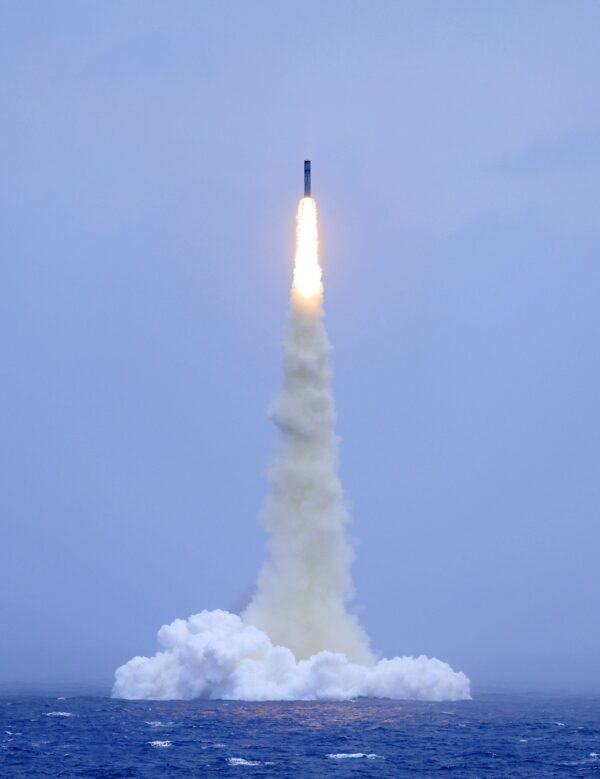
On July 6, China fired off a submarine-launched ballistic missile (SLBM) carrying a training warhead from a People’s Liberation Army (PLA) Navy nuclear-powered submarine into the Pacific Ocean. This marked China’s second intercontinental ballistic missile (ICBM) launch into the Pacific region, following the PLA Rocket Force’s test of a land-based ICBM in 2024.
As in 2024, Beijing did not publicly disclose detailed information about the operation. The submarine’s location, the missile type, and the missile’s flight path all remain unknown. This lack of transparency makes it difficult for outside observers to assess the current development of the PLA’s nuclear strike capabilities.
Although the details of the PLA’s missile launch remain unclear, Beijing did notify selected countries in advance, thereby offering clues about the intent behind the launch. Before the SLBM was fired, China informed countries including Australia, New Zealand, Papua New Guinea (PNG), and Japan through diplomatic channels – although several of the notified governments said they had been informed mere hours in advance.
On the same day as China’s SLBM launch, the leaders of Australia and Fiji signed a mutual defense treaty in Suva, Fiji. The fact that the countries notified in advance all maintain close ties with Australia, combined with Beijing’s decision to conduct the military operation during a major Australian diplomatic agenda, suggests that China’s purpose was not merely a straightforward display of military power.
Although bilateral tensions between Australia and China have gradually eased since 2022, and trade and economic relations have largely recovered, Australia has continued to build up its defense capabilities in response to potential threats. At the same time, Beijing has increasingly begun to use military actions as a way to signal its position to Australia. In early 2025, the PLAN sent ships to circumnavigate Australia. While in the Tasman Sea, the naval task group even conducted live-fire exercises, without any advance warning to Australia.
Therefore, when China chose to launch a missile on the same day Australia concluded a new alliance, the action carried political intent in addition to demonstrating military strength.
Cutting the Web
As one of the world’s top three nuclear powers, China possesses a large nuclear arsenal and a nuclear triad strike capability. Given the need to maintain open communication channels and avoid miscalculation, Beijing usually provides advance notification to countries located along or near the missile’s projected flight path when conducting intercontinental ballistic missile exercises.
For this reason, during its 2024 missile test, Beijing notified the United States, France, Australia, and New Zealand in advance. Ahead of this latest missile test, however, only Australia, New Zealand, PNG, and Japan publicly stated that they had received advance notification from Beijing.
Because China likewise did not release a complete list of countries it notified in advance, whether Beijing notified the United States remains open to speculation. A State Department statement declined to address the question. At the same time, this ambiguity also helps sharpen the political signal that China sought to convey.
The missile launch took place on the same day that Australia and Fiji signed the Ocean of Peace Alliance, also known as the Veitacini Treaty. The treaty’s legal status is like that of the Pukpuk Treaty signed by Australia and PNG in October 2025. It emphasizes that, in the event of an armed attack, both sides will act in accordance with their domestic procedures to address common threats. This makes Fiji Australia’s fourth ally and expands Canberra’s influence in the South Pacific.
At the level of the individual event, Australia’s establishment of an alliance relationship with a single Pacific Island country would hardly be sufficient reason for China to respond with military action. However, Beijing would like to prevent Australia from continuing to build security relationships through formal treaties. This may be partially driving the PLA’s harder-line approach.
Under the principle of non-interference in other countries’ domestic affairs, Beijing cannot directly use its diplomatic system to demand that Pacific Island countries refrain from establishing security relationships with Australia. At the same time, however, China also needs to signal to the South Pacific that its regional influence remains intact.
Therefore, by launching a missile on the same day Australia established a new alliance relationship, China used military action to warn Pacific Island countries of the risks of building security relationships with Australia, thereby expressing its diplomatic position through military means.
In addition to signaling its intent to the broader South Pacific region, China also directed its message toward countries that have deepened their defense ties with Australia in recent years. New Zealand, PNG, and Japan – the countries we know Beijing gave advanced warning to – all share one common feature: each has achieved a breakthrough in its defense relationship with Australia in recent years.
Papua New Guinea signed a treaty in October 2025, becoming Australia’s third ally. In March 2026, Australia and New Zealand stated at the ANZMIN 2+2 meeting that they would advance the Anzac 2035 Vision to strengthen interoperability between their militaries. In August 2025, Australia awarded Japan its first major defense sale, selecting the Mogami class for a $14 billion program to acquire 11 new frigates.
All three countries have upgraded their cooperation and relations with Australia within a short period of time. From Beijing’s perspective, these are among the relationships that need to be disrupted.
Why a Missile Launch?
Australia, Australia’s allies, and Pacific Island countries all formed part of the intended audience for China’s political signaling. Because this audience was both large in number and geographically dispersed, stretching from the East China Sea to the South Pacific, Beijing needed to strike a balance between clearly conveying its intent and relying on a single instrument.
Unlike the PLAN’s drill in the Tasman Sea in February 2025, Beijing’s objective this time was to deter Australia’s allies, rather than Australia alone. Conducting an operation like the Tasman Sea drill would not only have made it difficult for Beijing to communicate its intent clearly but also risked further encouraging cooperation between Australia and its allies.
At the same time, China’s missile launch also signals its intent to raise the level of escalation. Beijing has repeatedly used missiles in the past to express its position. After then-U.S. House Speaker Nancy Pelosi visited Taiwan in 2022, for example, Beijing fired ballistic missiles over Taiwan during its surrounding military exercises to demonstrate both the seriousness of its response and its dissatisfaction. Similarly, the United States’ 2024 deployment of the Typhon land-based medium-range missile system to the Philippines was also one of the reasons behind China’s ICBM launch that same year and its advance notification to the US.
In terms of escalating the situation and demonstrating military capability, Beijing’s latest launch of a SLBM followed the same operational logic.
Through the missile launch, China not only demonstrated the military power of a major nuclear-armed state but also warned of the potential risks of deepening defense ties with Australia. By relying on an escalatory military measure, Beijing was able to signal its position to the South Pacific region while avoiding the diplomatic friction that could have resulted from overly direct wolf-warrior diplomacy. At the same time, this approach allowed China to preserve the face of its major-power diplomacy.
As Beijing continues to build its influence in the South Pacific, whether Australia can ensure that Pacific Island countries do not tilt toward China under military pressure will depend on how Canberra balances its external security commitments.
