

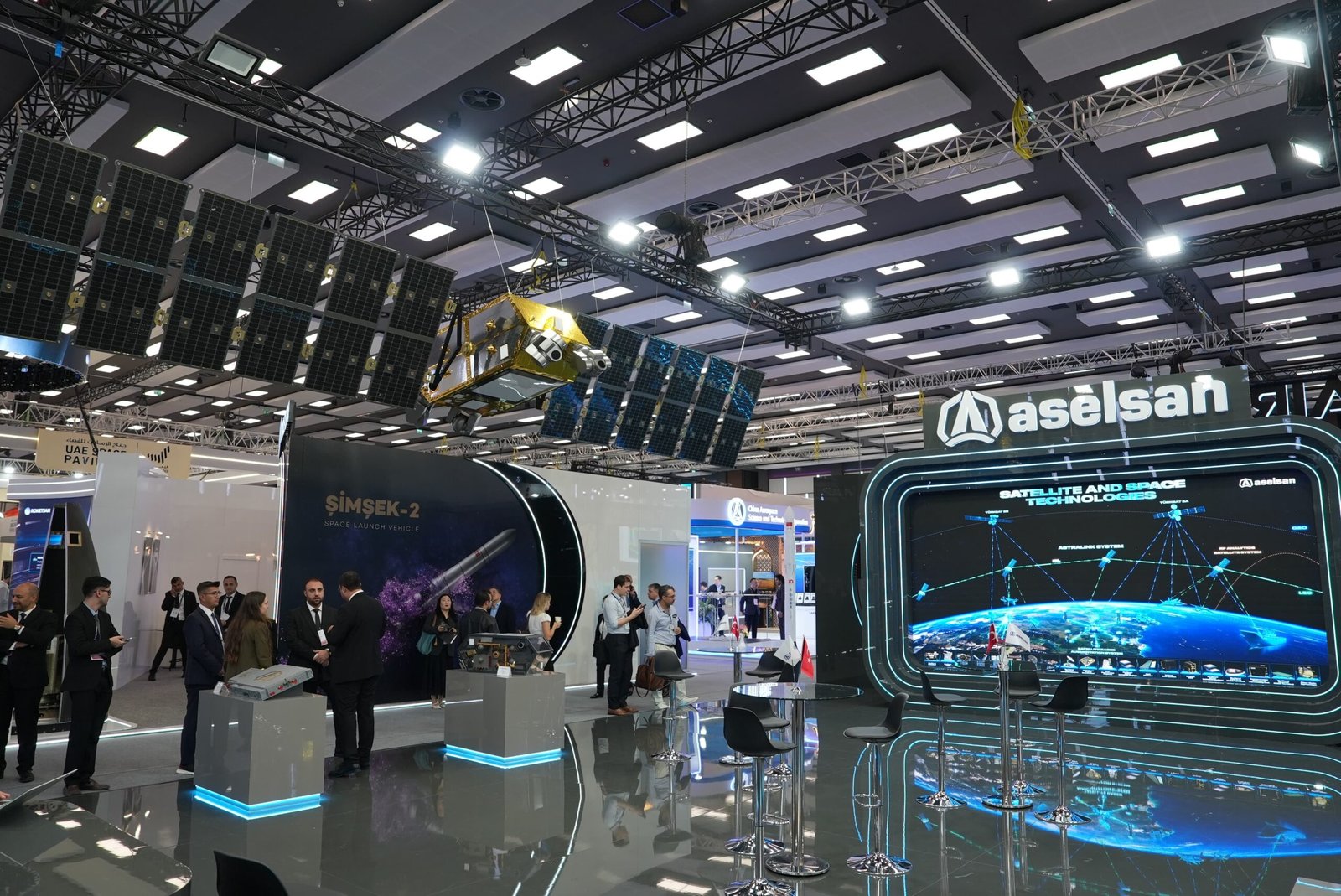
ASELSAN outlined 198 ASTRALINK satellites, a first launch within two years and a target production rate of up to four satellites per month.
A planned ASTRALINK constellation of 198 interconnected satellites would serve Türkiye and allied countries, ASELSAN chief executive Ahmet Akyol said in remarks published on 6 October 2026. Speaking at the International Astronautical Congress (IAC) in Antalya, he outlined a low Earth orbit (LEO) network whose first satellite is targeted for launch within two years.
ASTRALINK belongs to ASELSAN’s LEO Satellites and Military 5G/6G Communications System Project, the company said in its IAC program presentation. The future network is intended to deliver secure, high-capacity communications beyond terrestrial line of sight, with low latency and uninterrupted connectivity among its requirements.
Akyol traced the constellation development work to late 2025, describing plans for ASELSAN-developed waveforms, domestic chips and subsystems made with local suppliers. The stated launch timetable applies to the first spacecraft in the proposed network.
The space and terrestrial networks would operate under common management through integration with ASELSAN’s communications infrastructure. Akyol said that infrastructure already included more than one million user terminals, referring to equipment that the company has in the field.
In an interview on 5 October, Akyol explained the ASTRALINK and GÖKBAĞI names: ASTRALINK is the international designation for the system called GÖKBAĞI in Türkiye. Its intended users span military, government and civilian customers requiring communications beyond the coverage of conventional terrestrial networks.
Akyol said electronically steered ground antennas would use active electronically scanned arrays to follow satellites without mechanically turning an antenna. ASELSAN is developing technology at both ends of the link, with receiving equipment and spacecraft forming parts of the same communications system.
The company’s satellite manufacturing target is scalable capacity reaching up to four spacecraft per month. ASELSAN described a planned manufacturing model supporting expansion of the constellation and its longer-term development, with the monthly output figure presented as a target.
Akyol also described new-campus space production investment and the display of satellite hardware to an international audience at IAC. Communications payloads and ground receivers appeared alongside satellite technologies in ASELSAN’s broader exhibition at the congress.
The October details follow the earlier GÖKBAĞI architecture disclosure, which combined low-orbit satellites with a military 5G/6G core. July coverage set out the intended network functions, but the number of satellites and the fielding schedule had not yet been disclosed publicly.
Public discussion of GÖKBAĞI began in February, followed by a contract signed at SAHA 2026 and a project-opening meeting at ASELSAN’s Macunköy Technology Base. The July announcement then described communications requirements and identified ASELSAN as the program’s prime contractor.
ASELSAN’s satellite-communications work started with ground and user systems in the early 2000s, later encompassing space electronics, payloads, platforms and control infrastructure. The IAC display also highlighted the company’s TÜRKSAT-6A communications payload work and engineering activities directed toward TÜRKSAT-7A.
In TÜRKSAT-6A prototype development, reported in August 2017, ASELSAN worked alongside the Scientific and Technological Research Council of Türkiye (TÜBİTAK), Turkish Aerospace and CTECH. The geostationary communications-satellite project formed an earlier element of Türkiye’s development of domestic satellite hardware and industrial capabilities.
Alongside communications systems at IAC, ASELSAN presented its ongoing work for the GÖKTÜRK-3 radar satellite program, including development of the synthetic-aperture imaging radar, secure data communications and main security unit.
