

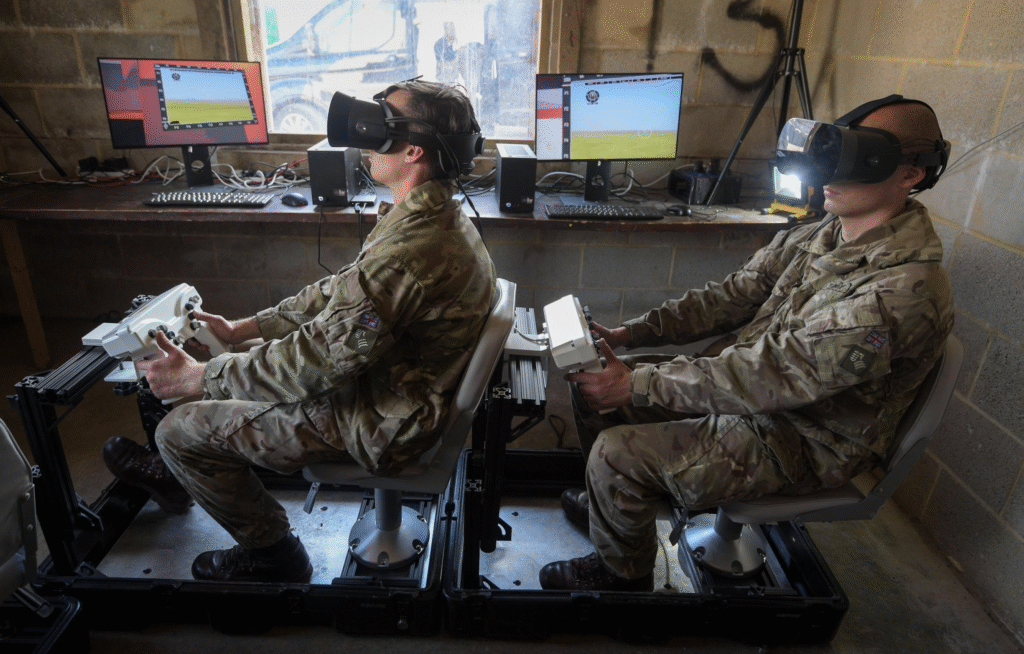
Up to 60,000 British soldiers a year will train using artificial intelligence, advanced data analytics and virtual battlefields under a £2 billion programme designed to prepare the Army for modern warfare.
The 15-year contract has been awarded to Omnia Training, a consortium led by Raytheon UK, and will replace and modernise the way troops rehearse large-scale military operations.
The government said the system would allow commanders to recreate the complexity of contemporary conflicts, analyse soldiers’ performance and identify weaknesses before units are deployed.
At the centre of the programme will be a digital platform known as the Combat Laboratory, which will combine computer simulations, live exercises and battlefield data.
Soldiers and commanders will be able to use virtual environments to practise operations at different levels, ranging from units of around 100 personnel to formations involving as many as 50,000 troops.
Ministers said the programme would incorporate lessons from the war in Ukraine, where drones, electronic warfare, data analysis and rapidly evolving battlefield tactics have played an increasingly important role.
The technology will allow troops to train in different locations and at different times, reducing the need for every participant in a large exercise to be assembled in one place.
Artificial intelligence will be used to detect patterns, monitor performance and help commanders assess decisions made during simulated operations. The government said the system would not replace military judgement but would give personnel more detailed information about the consequences of their actions.
Dan Jarvis said the programme would ensure soldiers received the training needed to respond to emerging threats.
“Our soldiers serve our nation with courage and exceptional dedication,” he said. “I am absolutely determined they get the quality training they need to keep us safe.”
He added that the contract was “good news for our national security and for new jobs in communities across the country”.
The deal forms part of the Army’s Collective Training Transformation Programme, which is intended to improve the readiness of British forces and strengthen their ability to operate alongside NATO allies.
It also supports the government’s stated ambition to make the British Army “ten times more lethal” by 2035, although ministers have not set out a single measure by which that target will be assessed.
The contract is expected to support around 400 jobs across Britain, including 270 newly created skilled positions in software engineering, cloud computing, artificial intelligence and data analysis.
Many of the roles will be based in Wiltshire, including in Warminster, which has longstanding links with the Army. Some posts will require previous military experience and will be aimed at veterans.
A further 100 apprenticeships are planned in partnership with Wiltshire College and the University of Staffordshire. Courses will cover subjects including modelling, data and project management.
Omnia Training comprises five companies: Raytheon UK, Capita, Cervus, Rheinmetall UK and Skyral. The consortium will also draw on a supply chain of more than 40 British businesses in Wiltshire, Leicestershire, Hampshire and elsewhere in the UK.
Two of the systems involved, developed by Skyral and Cervus, are British-owned technologies that have previously received more than £2 million in government innovation funding.
Officials said retaining the intellectual property in British ownership would reduce reliance on overseas suppliers and preserve expertise within the domestic defence industry.
James Gray, chief executive of Raytheon UK, said the programme would provide troops with a greater degree of realism during training.
“Our UK-based team of innovators, engineers and experts will give soldiers and commanders a new level of training realism,” he said.
The contract comes as the government prepares to spend £298 billion through its four-year Defence Investment Plan.
Ministers claim the wider programme could support up to 60,000 jobs, although that figure includes employment and skills initiatives beyond those directly associated with the Army training contract.
The new training service is expected to be introduced in stages, with the Combat Laboratory eventually becoming the Army’s principal digital environment for planning, conducting and evaluating collective exercises.
