

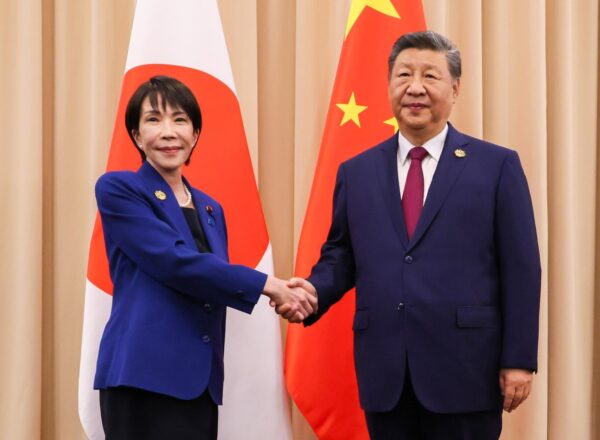
China-Japan relations are at their most difficult point in years. Sharp exchanges between Tokyo and Beijing at the Shangri-La Dialogue in Singapore in late May underscored a relationship increasingly defined by strategic rivalry, mutual suspicion, and competing security narratives.
Many observers assume that Prime Minister Takaichi Sanae is poorly positioned to improve ties with China. Her hawkish reputation, outspoken views on Taiwan, and support for strengthening Japan’s defense capabilities have made her a frequent target of criticism from Beijing.
Yet there is a historical irony here.
Two decades ago, many Chinese officials and analysts held similarly negative views of then-Prime Minister Abe Shinzo. He was widely regarded as a conservative nationalist associated with Yasukuni Shrine and a more assertive Japanese security policy. Few expected him to become the leader who would eventually stabilize relations with Beijing, yet that’s exactly what happened.
That history raises an important question: Could Takaichi ultimately achieve what Abe did?
The answer may lie in the experience of the man who helped engineer Japan’s last major diplomatic thaw with China.
The Man Who Built the Last Bridge
Yachi Shotaro served as Japan’s vice foreign minister and later as the inaugural secretary-general of the National Security Secretariat under Abe. He played a central role in two separate diplomatic recoveries with Beijing, each beginning from a position that appeared irreparable.
On a television program aired on BS-TBS on June 2, Yachi reflected on those experiences and offered a frank assessment of where China-Japan relations stand today.
The first crisis emerged during the Koizumi Junichiro era, when the prime minister’s repeated visits to Yasukuni Shrine froze summit diplomacy entirely during the early 2000s.
Working closely with Chinese State Councilor Dai Bingguo, one of Beijing’s most influential foreign policy figures, Yachi sought to create political space for renewed dialogue. The breakthrough relied on deliberate ambiguity. Japanese officials conveyed that Abe, who was then preparing to succeed Koizumi, would neither pledge to visit Yasukuni nor publicly renounce doing so.
“The logic we used,” Yachi recalled, “was that from China’s perspective, not saying you will visit is essentially the same as not visiting.”
That ambiguity proved sufficient.
In October 2006, Abe traveled to Beijing in what became known as the “ice-breaking” visit. The two governments subsequently established the framework of a “Mutually Beneficial Relationship Based on Common Strategic Interests,” designed to expand cooperation while managing persistent disagreements.
The next rupture came in 2012, when Japan nationalized the Senkaku Islands (known as the Diaoyu Islands in China and Diaoyutai in Taiwan), triggering large-scale anti-Japanese protests across China and sending bilateral relations into freefall.
By then serving as Japan’s first national security advisor, Yachi conducted extensive negotiations with Chinese State Councilor Yang Jiechi.
The resulting four-point agreement ahead of the 2014 APEC summit in Beijing did not resolve the territorial dispute. Instead, both sides acknowledged that differing views existed and concentrated on building crisis-management mechanisms to prevent escalation.
The summit between Abe and Chinese President Xi Jinping that followed was not reconciliation; it was stabilization.
“The achievement,” Yachi observed, “was not solving the problem but preventing it from getting worse.”
That lesson remains relevant today. The diplomatic breakthrough came when both governments concluded that continued deterioration serves neither side’s interests.
A More Difficult Environment
Still, Yachi readily acknowledged that today’s circumstances are less favorable than those of a decade ago. “When I was conducting those negotiations, the gap in national power between Japan and China was not yet so large,” he said. “Now China is clearly looking down at Japan.”
China’s economy and military have expanded dramatically since the mid-2000s. Beijing increasingly approaches Tokyo from a position of confidence, while Japan finds itself confronting a far more unequal relationship than the one Abe inherited.
A Chinese scholar who spent decades living in Japan and now teaches at a provincial university in China described the current atmosphere in unusually bleak terms. “This is probably the most difficult period in Japan-China relations that I have experienced,” he said. “Student exchanges have almost completely stopped.”
He was equally blunt about Chinese perceptions of Japan’s current leadership. “Chinese public opinion strongly dislikes Prime Minister Takaichi. Many people feel there is virtually no chance for her to turn things around.”
His conclusion was sobering: “This atmosphere could last for several years.”
Against that backdrop, even a meeting between Takaichi and Chinese President Xi Jinping at the APEC summit in Shenzhen this November cannot be taken for granted.
Deterrence and Dialogue
Yet Takaichi’s conservative credentials may ultimately become an advantage rather than an obstacle.
Abe succeeded in improving relations with Beijing precisely because his nationalist reputation protected him from domestic accusations of weakness. A conservative leader often possesses greater political freedom to pursue pragmatic diplomacy than a leader constantly vulnerable to criticism from the right.
The challenge is convincing both domestic and foreign audiences that deterrence and diplomacy are not contradictory.
Japan’s security environment has changed fundamentally. China’s military modernization, North Korea’s growing missile arsenal, and uncertainty surrounding future U.S. commitments all create strong incentives for Tokyo to strengthen its defense posture.
At the same time, geography remains immutable. Japan and China are neighbors that cannot relocate.
Defense Minister Koizumi Shinjiro captured this reality during the Shangri-La Dialogue in Singapore on May 31. “We engage in talks because we have differences,” he said. “We continue to talk because there exist tensions between us.”
That principle may offer the most realistic framework for managing the relationship today.
Managed Rivalry
The optimistic language of “strategic partnership” that characterized Japan-China diplomacy in the 2000s appears increasingly distant. The more realistic objective today is managed rivalry.
Japan and China will continue to disagree over maritime disputes, regional security, and Taiwan. Those friction points are unlikely to disappear; what matters is preventing them from spiraling into confrontation.
One practical step would be the creation of a high-level Japan-China Strategic Stability Dialogue focused on military risk reduction, maritime incidents, emerging technologies, and crisis communication.
Cold War history offers a useful precedent. The United States and Soviet Union never resolved their rivalry, but they developed mechanisms that helped prevent it from escalating into catastrophe. East Asia increasingly needs similar guardrails.
Any future thaw will also require stable management of Japan’s alliance with the United States, but the primary challenge remains rebuilding channels of communication between Tokyo and Beijing.
Today, few expect Takaichi to engineer a thaw with China. However, a decade ago, most thought the same way about Abe – and he managed to pull off the diplomatic feat. History suggests that leaders who appear least likely to stabilize China-Japan relations sometimes prove most capable of doing so.
