

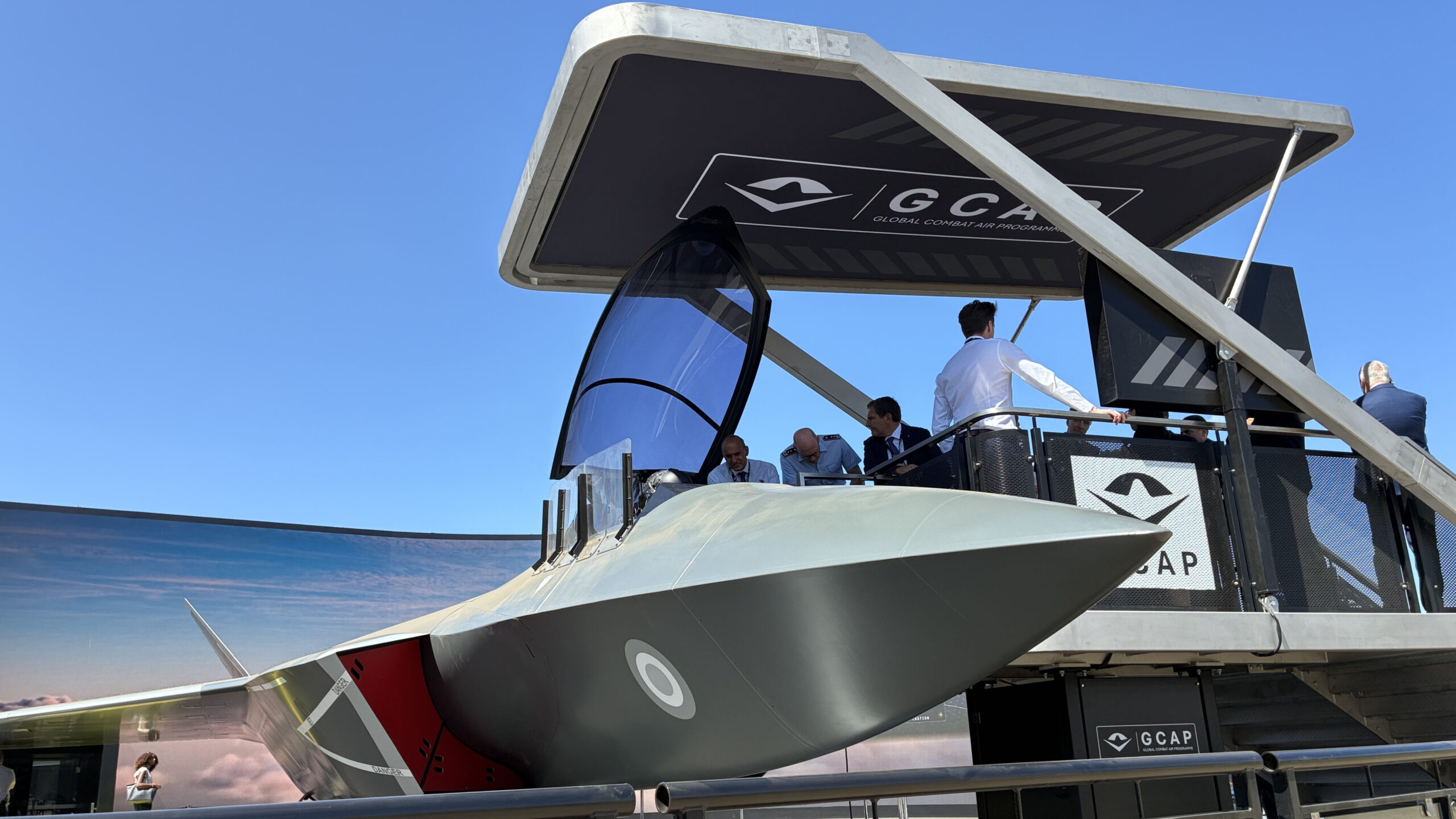
FARNBOROUGH — Today Canada officially joined the Global Combat Air Programme (GCAP) as its first “observer,” granting it “privileged access” to capability development, industrial cooperation, and long-term delivery plans, British Chief of Defense Wes Streeting said.
Canadian Defense Minister David McGuinty, who spoke alongside Streeting as well as the defense leaders from other GCAP participating nations Italy and Japan said the new status “will provide us with the opportunity to deepen our understanding of next-generation combat air capability, strengthen industrial collaboration, and contribute more closely to partnerships that will define the future of airpower.”
GCAP is the sole remaining active international next-generation fighter jet program, envisioning a stealthy sixth-gen fighter as well as a host of interlinked systems, including drone wingmen. A rival sixth-gen program, the French-German-Spanish Future Combat Air System, collapsed last month amid industry disagreements. The US Air Force is unilaterally pursuing its own F-47 next-gen fighter.
Japanese defense chief Shinjiro Koizumi said Canada’s new involvement in GCAP was “monumental,” adding that the security landscape of the Indo-Pacific and Euro-Atlantic region is no longer separable.
A key theme touched on by the officials was the ongoing joint naval operations conducted by the Chinese and Russian navies as part of the “Joint Sea-2026” exercise in waters surrounding Japan. Koizumi highlighted that a Chinese military vessel also carried out live-fire drills as part of the exercise.
In the same fashion, a Russian warship fired live rounds off the coast of England on Monday, the same day that the new British Prime Minister Andy Burnham was sworn in. When asked if this was Russian President Vladimir Putin’s way of sending a message, Streeting called the event “performative and irresponsible.”
“It is not the first time Russia has behaved like this, and frankly it is the tip of the iceberg of daily threats this country [the United Kingdom] faces,” Streeting said.
For Canada, the new ties to the international program come as tensions mount with the US, the provider of its current most advanced fighter jet, the F-35. Overnight, President Donald Trump imposed a 50 percent tariff on a wide range of goods imported from Canada. However, McGuinty said that Canada has not joined GCAP as a result of its ongoing negotiations with the US to resolve the economic rift between the two long-standing trading partners.
As for what the observer role means for Canada and the existing trilateral partnership, the official announcement offered few concrete details.
“Observer status will provide Canada with enhanced insight into GCAP and an opportunity to deepen its understanding of the Programme’s governance, capabilities and industrial framework, as well as the related security requirements and wider partnering opportunities,” it said. “For Italy, Japan and the UK, Canada’s involvement will also support greater alignment of strategic priorities and deepen mutual understanding of future combat air ambitions, thereby strengthening global security.”
In speaking about the need to strengthen Canada’s industrial base and supply chains, McGuinty noted that the country’s aerospace sector “is ready to help meet that challenge.”
