

Russia’s Su‑57 stealth fighter is significantly cheaper than the Rafale, but cost alone does not determine value. India must weigh Russia’s unprecedented technology‑transfer offer and faster induction against concerns over the Su‑57’s maturity, reliability, and long‑term support compared to the proven Rafale fleet.
India is at a critical juncture in its airpower modernisation. The Indian Air Force currently lacks a fifth‑generation fighter, while China expands its J‑20 fleet and Pakistan eyes the J‑35. Russia has now offered India joint development and licensed production of the Su‑57, including access to sensitive source codes.
This would allow India to integrate indigenous weapons, sensors, and avionics without foreign approval, a level of sovereignty rarely granted in global defence deals. Production would involve Hindustan Aeronautics Limited, with an initial batch of around 30 aircraft delivered directly from Russia before local manufacture begins.
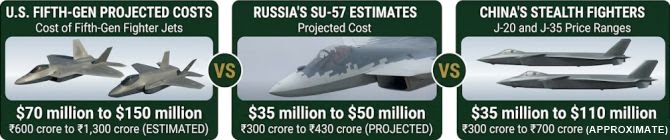
The Su‑57’s estimated unit cost of $35–50 million (₹300–430 crore) makes it the cheapest fifth‑generation fighter on the market. However, the final bill would be much higher once missiles, maintenance, spares, training, and infrastructure are included.
India’s earlier Rafale deal in 2016 cost ₹59,000 crore for 36 jets, working out to about ₹1,640 crore per aircraft once all support packages were factored in.
The Rafale’s higher cost reflects its proven combat record, India‑specific modifications, and advanced weapons such as Meteor and SCALP missiles.
Russia’s pitch is not limited to aircraft supply. It includes joint development, unrestricted technology transfer, and even a two‑seat Su‑57D variant tailored for India’s operational preferences.
Russian officials have emphasised that there are “no issues or limitations” on cooperation, a contrast to American offers of the F‑35, which India declined due to restrictive conditions and limited technology access.
The Su‑57 program, however, faces challenges: Russia has delivered only about 30 aircraft to its own forces by early 2026, far short of targets, due to sanctions, supply chain issues, and delays in the advanced Izdeliye 30 engine. Current production models rely on transitional engines without full supercruise capability, raising questions about maturity.
India’s parallel path with France is also significant. In early 2026, New Delhi cleared a $30+ billion deal for 114 Rafale F5 fighters, with over 60% indigenous content planned. This aligns with India’s self‑reliance goals and ensures compatibility with existing Rafale squadrons.
The Rafale has already proven itself in Indian conditions and integrates smoothly with indigenous munitions. By contrast, the Su‑57 would require extensive evaluation of reliability, export restrictions, and integration with Indian systems before adoption.
Strategically, the Su‑57 offer could bridge the gap until India’s indigenous Advanced Medium Combat Aircraft (AMCA) enters service in the mid‑2030s. The AMCA program, supported by a ₹61,000 crore engine co‑development deal with Safran, aims to deliver a stealth twin‑engine fighter with sixth‑generation traits.
Russia’s willingness to share source code and co‑develop the Su‑57 could accelerate India’s aerospace capabilities, but risks remain regarding long‑term support and sanctions exposure.
In conclusion, the Su‑57 is undeniably cheaper and offers unmatched technology transfer, but the Rafale provides proven reliability, rapid induction, and strong industrial participation.
India’s decision will hinge on whether it prioritises immediate stealth capability and sovereignty through Russia, or long‑term stability and proven performance through France, while continuing to invest in its own AMCA program.
Agencies
