

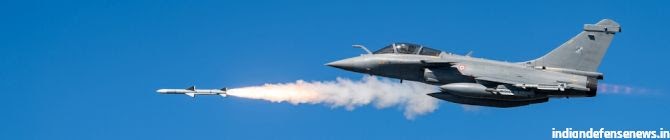
France has successfully conducted the second development firing of the MICA-NG air-to-air missile from a Rafale fighter jet, marking the first time the next-generation weapon has been tested in a supersonic flight configuration.
The trial, carried out at the French defence procurement agency DGA’s Missile Testing Centre in the Mediterranean, represents a significant milestone in the missile’s qualification and integration with the Rafale platform.
The MICA-NG, designed to counter stealth aircraft, drones, and highly manoeuvrable cruise missiles, is intended to provide France with enhanced operational superiority in contested and high-intensity airspaces.
Missile manufacturer MBDA emphasised that the MICA-NG incorporates advanced technologies to address future threats that will be faster and stealthier. Unlike traditional air-to-air missiles, the MICA-NG extends its capabilities to targets with very low infrared and electromagnetic signatures, including stealth fighters and drones.
The firing was conducted jointly by MBDA, DGA, Dassault Aviation, and the French Air and Space Force under demanding operational conditions, underscoring the collaborative effort behind the programme.
The test focused on the missile’s infrared seeker, which automatically adjusts trajectory based on heat signatures emitted by targets. MBDA explained that validating the seeker in a supersonic environment was critical, as higher speeds generate greater ambient temperatures, reducing the contrast between targets and background imagery.
Despite these challenges, the seeker successfully demonstrated its ability to detect and track targets, confirming its resilience in extreme flight conditions. The company noted that this achievement validated the full deployment chain of the infrared version of the missile, particularly its seeker, even in high-temperature scenarios.
MBDA highlighted that the MICA-NG will ensure interception, close combat, and self-defence capabilities for fighter aircraft, while also being adaptable for naval and ground-based applications through its VL MICA-NG variant.
This versatility is expected to strengthen France’s ability to maintain air superiority across multiple domains. The successful supersonic test follows the first development firing from a Rafale in June 2025, marking steady progress towards full operational readiness.
The development comes at a time when India is advancing plans for a major expansion of its Rafale fleet. On 1 June 2026, India issued a Letter of Request to France for a government-to-government deal worth approximately ₹3.25 lakh crore to procure 114 Rafale fighter jets.
Under the proposal, 94 of these aircraft would be manufactured in India by Dassault Aviation in partnership with an Indian company, marking the first time Rafales would be produced outside France under such an arrangement. The French government is expected to respond within two to three months, with both sides aiming to conclude negotiations within a year.
Prime Minister Narendra Modi is scheduled to visit France in mid-June, with the Rafale acquisition likely to feature prominently in discussions with French leadership. India, facing a critical shortage of fighter squadrons, has already placed orders for 62 Rafale aircraft for the Air Force and Navy.
If approved, the new order would raise the total number of Rafales on order to 176, with the Indian Navy also expressing intent to induct 31 additional aircraft for maritime operations, potentially taking the fleet size beyond 200. The Defence Acquisition Council cleared the proposal earlier this year, reflecting India’s urgency in strengthening its combat capabilities.
Air Chief Marshal AP Singh recently concluded a three-day visit to France, reaffirming the strong partnership between the Indian Air Force and the French Air and Space Force. The proposed Rafale programme is expected to include around 50 per cent localisation, offering India greater flexibility to integrate indigenous weapons and systems.
This arrangement would not only bolster India’s aerial combat strength but also deepen its strategic cooperation with France in defence technology.
ANI
