

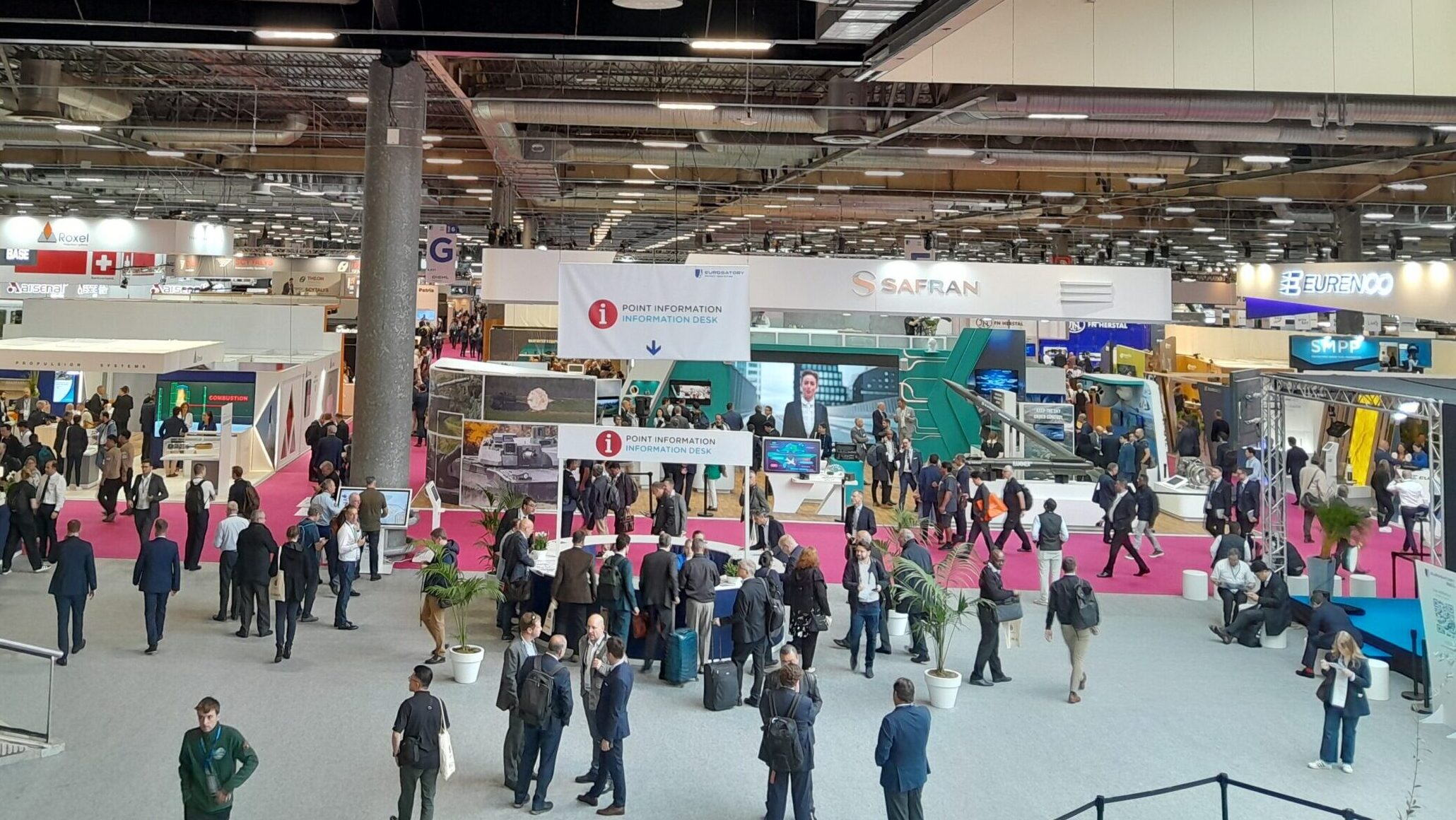
JERUSALEM — Despite the French government placing new restrictions on Israeli firms and barring government officials from participating in this month’s Eurosatory exhibition, major Israeli firms are still planning to present their wares at the exhibition.
The Israeli Ministry of Defense said that the French government have informed Jerusalem “of its decision to bar Israel’s official participation” in the event, which takes place June 15-18 outside of Paris.
Per the IMOD, the move serves as “a ban on government representatives attending the exhibition; a ban on opening an Israeli national pavilion; and a restriction limiting Israeli defense industries to displaying air defense products only, with offensive systems explicitly excluded.”
The ministry accused France of applying this policy “selectively and discriminatorily.” It said this is a violation of norms governing international defense exhibitions.
“This is a disgraceful decision, one that reeks of political and commercial calculation, and regrettably, it comes as no surprise,” the IMOD continued. “It fits a deeply troubling pattern in French conduct in recent years – a pattern that has consistently placed France on the wrong side of history.”
That last point is a reference to the ongoing issues Israeli has found with French-based defense conferences that traces back to the 2024 edition of Eurosatory, when France made a more sweeping decision to ban Israeli companies entirely from the show in the wake of the war in Gaza. A French court reversed the decision days before the exhibition.
The 2024 ban was a surprise, but set in motion future bans in France. At the Paris Air Show Israeli companies were allowed to set up their booths, only to have them placed behind a black barricade right at the start of the event. The organizers had also attempted to have Israeli companies remove offensive weapons from the show. France had appeared to end bans on Israeli companies in November 2025, in the wake of the Gaza ceasefire, but apparently that situation changed.
An inquiry by Breaking Defense to the French Embassy in Israel regarding the 2026 Eurosatory ban did not receive a comment by press time.
Jerusalem also indicated there may be an ulterior motive behind trying to bar Israeli firms: France is “hiding behind a pretense of political justification to exclude Israeli offensive defense systems from an international forum — systems that have proven far superior to their French counterparts,” the IMOD wrote.
Despite the bans and barricades, Israeli companies have sought to attend the shows in past years and will do so again in 2026. The reason is simple: Israeli companies have seen increasing sales in Europe in recent years. For instance, in 2024 of Israel’s $14.7 billion in defense exports, 54 percent were for European customers.
Most notably, Israeli defense giants Elbit Systems and Rafael Advance Defense Systems confirmed to Breaking Defense they will attend the show, although Elbit said it was more focused on the clear-in ILA Air Show in Berlin, which starts next week. Rafael has a webpage devoted to Eurosatory 2026, where it highlights lasers, counter-UAS systems and precision strike capabilities.
IAI, the third of Israel’s major firms,is also focused on ILA where is it highlighting close cooperation between Germany and Israel. But the company did not provide a comment about Eurosatory in reply to Breaking Defense’s inquiry.
However, smaller companies seem to be caught in limbo a bit, because they often exhibit with the ministry’s International Defense Cooperation Directorate (SIBAT) which has led delegations of them to other events. For instance, in mid-May SIBAT led a delegation of 32 Israeli companies to the second Finnish-Israeli Defense Industry Seminar in Helsinki. They also led 11 companies to SOF Week in Florida. In October 2025 the ministry did the same at ADEX in Seoul. Thirty Israeli companies were expected to attend Eurosatory.
Without the ability to set up a national pavilion, those smaller firms may be out of luck, as procuring individual booth space is both difficult two weeks out from a conference and likely prohibitively expensive for these companies.
