

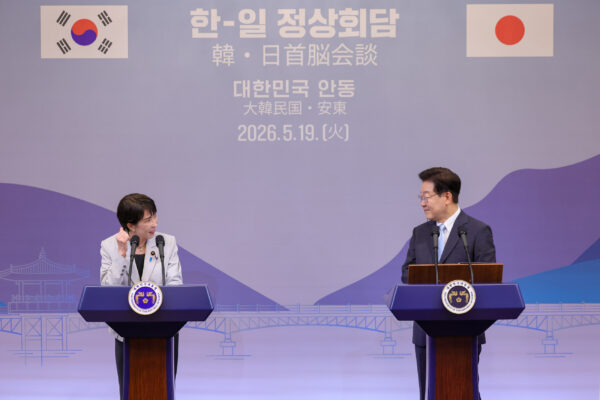
Japanese Prime Minister Sanae Takaichi visited South Korea on May 19-20, meeting South Korean President Lee Jae Myung in Lee’s hometown of Andong. It was the first reciprocal summit visit since the two met in January in Nara, Takaichi’s hometown, reinforcing the sense that shuttle diplomacy between the two countries is taking root.
Japan and South Korea are neighbors and U.S. allies, and in a Northeast Asia beset by threats from China, Russia, and North Korea, communication between them on their shared values – democracy, a market economy, the rule of law – matters. Both countries also need to coordinate their response to U.S. President Donald Trump’s demands for higher tariffs and greater defense spending. This latest meeting advanced their cooperation on energy security.
Takaichi is one of the LDP’s leading hawks and has pledged to continue the legacy of former Prime Minister Shinzo Abe. Lee, by contrast, is a progressive from the Democratic Party of Korea, a background that in Japan is often associated with conciliation toward North Korea and a frosty attitude toward Tokyo. Some feared relations would deteriorate accordingly, but Lee has pursued pragmatism and moved closer to Japan, and Takaichi has responded in kind. The two countries’ many thorny disputes – historical and territorial – have been effectively shelved in favor of the urgent agenda.
Undergirding all this is a shift in public attitudes. Young people on both sides now hold broadly positive images of each other, driven in no small part by the soft power of anime and K-pop. Both leaders are moving quickly to build on that goodwill. Lee received Takaichi with state guest-level treatment, exactly as he did for former Prime Minister Shigeru Ishiba last September. Whoever the prime minister, South Korea is making Japan a priority.
The warm atmosphere, however, should not obscure a real gap in the two leaders’ positions. Where Japan focuses on the bilateral relationship and the U.S.-Japan-South Korea trilateral framework, Seoul has also pushed for Japan-China-South Korea cooperation, an emphasis that, given South Korea’s geography, is difficult to avoid.
Where the gap is most apparent is North Korea. Takaichi stressed “complete denuclearization” and “immediate resolution of the abduction issue,” while Lee spoke of a “peaceful Korean Peninsula where there is no need to fight” and “building permanent peace” through dialogue.
This divergence is not new, and reflects a structural reality. For South Korea, the Korean Peninsula issue is existential. For Japan, North Korea is a threat across the water: serious, but differently so.
Trade figures tell the story clearly. Since 2010, Japan has maintained zero trade with North Korea, driven by public anger over the abduction issue, a state-sponsored crime. Tokyo has sought Seoul’s cooperation repeatedly, and successive South Korean administrations have expressed understanding, but none has made serious efforts to align policy.
Nor is this limited to progressive administrations. When Japan imposed its trade ban, South Korea was led by conservative President Lee Myung-bak. Yet under his watch, substantial foreign currency continued to flow to North Korea, primarily through the Kaesong Industrial Complex. In March 2010, the sinking of the Cheonan, a South Korean naval patrol vessel, killed 46 sailors, and even after another four people died in North Korea’s shelling of Yeonpyeong Island in November of the same year, the flow of foreign currency to Pyongyang continued. The same approach was maintained under the conservative Park Geun-hye administration; Kaesong was not suspended until February 2016.
Strategically, closer Japan-South Korea cooperation makes obvious sense. On North Korea, though, alignment is harder to achieve: Seoul’s direct stake in the peninsula means its calculus will always differ from Tokyo’s. Japan must pursue its own diplomacy with Pyongyang, even while working with Seoul, and find a way to break the long-standing deadlock. And when it comes to the abduction issue – which concerns the lives of Japanese citizens – no amount of American or South Korean support changes the fact that the responsibility ultimately lies with Tokyo.
