

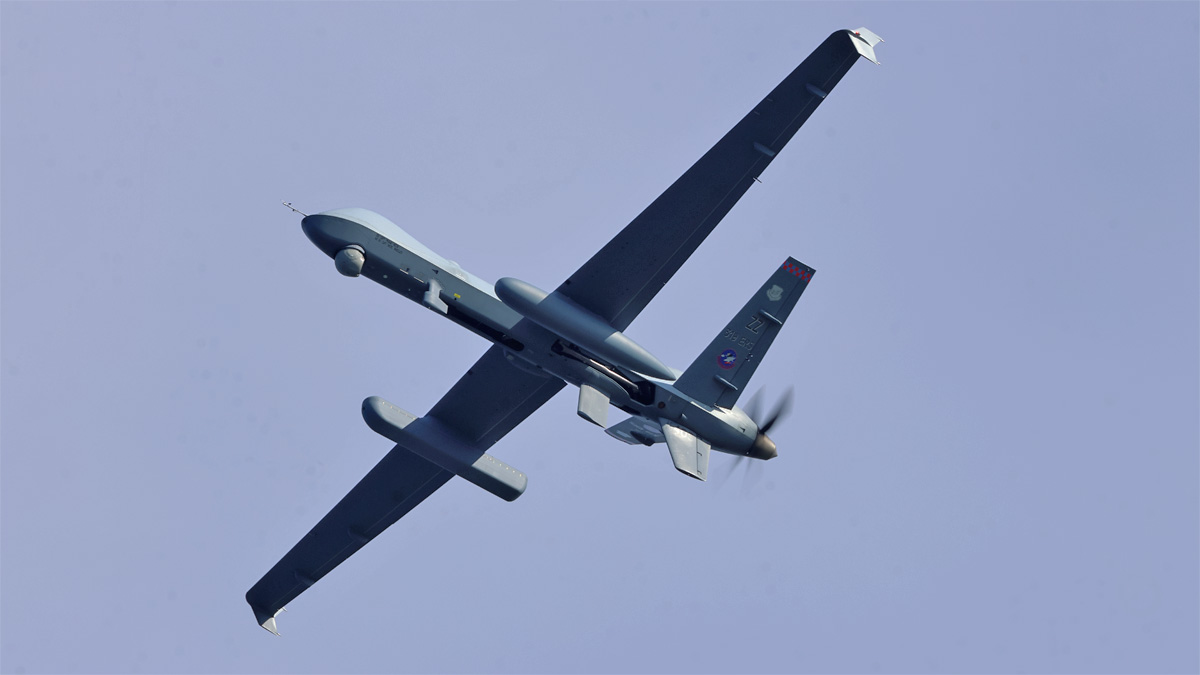
FARNBOROUGH — General Atomics will propose a new, clean-sheet aircraft for the Pentagon’s Massed Modular Aircraft project for a cheap hunter-killer drone, but the CEO of its aeronautics division is skeptical that competing companies will be able to achieve the lower end of the cost target laid out by the Defense Innovation Unit.
In a Monday interview at Farnborough Airshow, Dave Alexander said he was “1,000 percent confident” the legacy dronemaker will be able to hit a number within the price range specified by DIU, but that the Pentagon will need to relax its bid requirements for certified pricing if it wants to get its lowest cost target.
“I believe they put a silly goal in here for a low-end [cost],” he told Breaking Defense. “Anybody that bids that number is very suspicious.”
“If you want a commercial product, then don’t put certified bid requirements on the product,” he added. “Don’t, if you want commercial pricing.”
Earlier this month, the DIU released a solicitation for a drone capable of fulfilling the MQ-9 Reaper’s surveillance and strike missions, with a price tag significantly lower than the $30 million per aircraft cost associated with the Reaper. (The public solicitation does not lay out the exact price target for MMA.)
The Pentagon wants a drone with a payload capacity of at least 2,800 pounds and a range of at least 2,300 nautical miles while carrying that load, the DIU notice states. For one-way operations, the required range should extend to 8,000 nautical miles.
The winning companies would build a full-scale prototype for flight testing within 21 months of the award, with the intent to initially field the drone in fiscal 2031.
Alexander declined to provide details on its proposed design.
“We’ll address them [the cost parameters], and I think we’ll be just fine,” he said. “This is what we do. Nobody else has done what they’re asking for, and we’ve been doing it for 30 years, and it’s crazy.”
Ramping Up CCA Production
The Air Force in June awarded General Atomics and Anduril production contracts to build collaborative combat aircraft, marking the US military’s first venture into acquiring autonomous drone wingmen.
General Atomics doesn’t expect the Pentagon to execute funding for the first contract option until October, but the company has already started manufacturing FQ-42As, with about 30 aircraft in some stage of build, Alexander said.
Unlike Anduril, which is waiting to introduce automation until the company understands where it can be most useful, General Atomics has built robotics into its CCA production line.
“We’re leaning hard in on automation. Really, most of our automation is in place right now,” Alexander said.
The Air Force has declined to comment on how many aircraft it will buy under the recently accounted CCA contracts and has kept details on production rates under wraps.
But General Atomics’ hope is to scale up production up to six FQ-42As per month by mid-2029, Alexander said, though he declined to comment on whether those levels were supported by the Air Force contract or whether foreign customers would be needed to achieve that rate.
He added that orders for about 25 to 30 CCAs for other US or international customers are “in the works.”
