

This is Part III of a four-part series on “The First Airtight Empire” – analyzing the historically unprecedented closure that the Chinese Communist Party (CCP) is constructing in 2026, and how that closure has rendered American policy assumptions obsolete. Part I documented the two slogan substitutions through which Beijing rewrote its history and prewrote its future. Part II described the three lockdowns that conditioned the population to accept the airtight seal that followed. This installment turns to the mechanical architecture of the seal itself. The concluding installment (Part IV) will place the configuration in its long historical frame and develop the implications for U.S. policy.
The closure under construction in China in 2026 has no historical analog, and the architecture that makes it unprecedented is the subject of this installment. Four mechanical seals operate in parallel. A fifth, asymmetric in direction, distinguishes it from every previous closure. A second line of defense, part of Chinese government ambitions for over 2,000 years, ensures that even where the mechanical seals fail, the closure does not.
Four Seals, Operating in Parallel
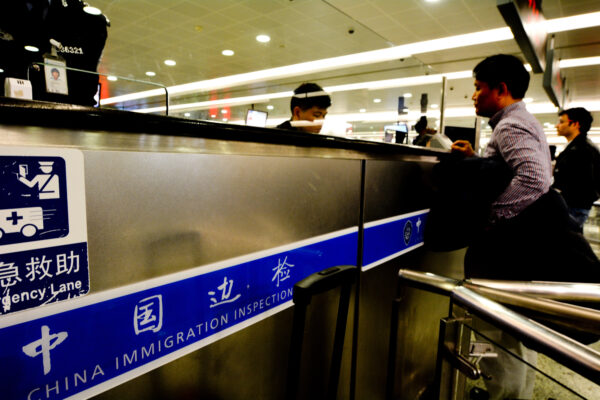
The first seal is over human movement. The exit-ban regime, documented in Safeguard Defenders’ “Trapped” report and expanded across at least four major laws between 2018 and 2022, has by 2026 reached serving U.S. federal employees: officers from the Patent and Trademark Office and the Department of Commerce have reportedly been blocked at the Chinese border on national security pretexts. The U.S. State Department’s updated travel advisory warns that exit bans now reach Chinese American citizens, foreign businesspeople, and the family members of overseas dissidents as a tool of coercion.
By the spring of 2026, China’s government appears to have extended exit restrictions to the immediate families of Chinese officials at the bureau level and above, with the explicit purpose of preventing the capital flight and family emigration patterns that characterized the late Soviet and late Qing transitions. Physical exit from China now requires explicit state permission, narrowed progressively across categories of the population.
The second seal is over information flow. The Great Firewall has always leaked. Hundreds of millions of ordinary Chinese citizens routinely used virtual private networks (VPNs); the regime tolerated the leakage because its scientists, officials, and corporations needed foreign access to function. In the first week of April 2026, that tolerance ended.
Reports documented that Chinese telecom providers received emergency notices instructing them to physically disconnect the relay-server infrastructure inside Chinese data centers that had supported most VPN and proxy services. Thousands of services went dark within hours. On April 28, 2026, LetsVPN – the largest commercial provider serving the Chinese market, marketed for years as “the VPN that always connects” – announced it was terminating all service to mainland China, citing “sustained network blockade pressure” and the technical team’s determination that connectivity could no longer be effectively maintained.
The market is rarely wrong about what is technically possible. When the market exits, the technical possibility has closed. Combined with the January 2026 Cybersecurity Law revisions that brought private communications under monitoring, China is now operating an internet whose technical architecture, for the first time, makes airtight closure mechanically achievable for the population subject to ordinary law.
The third seal is over political succession. Xi Jinping abolished term limits in 2018; he has refused to designate a successor through three Party Congresses. The symbolic removal of Hu Jintao from the 20th Party Congress in October 2022 and the comprehensive replacement of the Politburo Standing Committee with personal loyalists served as visceral demonstrations of Xi’s control. The Xi regime now possesses no institutional mechanism for transferring power to a successor, a structural pressure I have analyzed at length elsewhere as the Chongzhen Trap. With no exit option for the leader, no exit option for the population, and no exit option for information, the regime has chosen a configuration in which all three directions of potential leakage are simultaneously sealed.
The fourth seal – most distinctive to the current configuration – is over the social fabric of the cadre stratum itself. In May 2025, the CCP Central Committee and the State Council jointly promulgated a comprehensive revision of the “Regulations on Practicing Thrift and Opposing Waste in Party and Government Organs” – the first major rewrite since 2013 – requiring, among other measures, that cadres submit named lists of every individual present at official receptions. The new regulations served to dramatically tighten the documentary trail around inter-departmental hospitality, cross-bureau dinners, and any cadre-to-cadre social occasion bearing on public business. The function is not anti-corruption, despite its formal classification. The function is the systematic granulation of the elite.
Every Chinese official is now structurally prevented from forming the stable horizontal relationships – friendships across departments, alliances across regions, the social fabric of a governing class – that have historically been the precondition for any palace politics, any organized faction, any coordinated challenge. Hannah Arendt called this configuration “organized loneliness” and considered it the deepest accomplishment of totalitarian rule. The Stalinist apparatus engineered it through informants. The current Chinese apparatus measures it through metadata.
The One-Way Valve
A refinement of the airtight thesis must be made here. The closure under construction is not symmetrical. The same regime preventing its citizens from reaching foreign information continues to project its own messaging into foreign information environments through state-controlled accounts on X, Facebook, and YouTube – platforms ordinary Chinese citizens face criminal prosecution for accessing.
Chinese diplomats, state media outlets, and authorized propaganda operators retain official network channels that bypass the firewall by design. Information flows in one direction only – outward, on the regime’s terms – while inward flow to ordinary citizens has been engineered toward zero. The previous Chinese closures of two centuries did not have this asymmetry, because the technical capacity to project outward without permitting inward flow did not exist. The current closure has it, and is using it.
The asymmetric closure operates not only at the level of nations but at the level of individuals. The same regime that fines a citizen in Hubei province 200yuan for using a VPN to access TikTok grants Charles Lieber – formerly chair of Harvard’s chemistry department, prosecuted by the U.S. Department of Justice in 2020 for undisclosed participation in the Thousand Talents Program, and as of 2025 a faculty member at Tsinghua University’s Shenzhen International Graduate School – controlled access to the international scientific literature his brain-machine interface research requires. The boundary is defined by the state, monitored in real time through institutional IT infrastructure, and adjusted to maximize scientific productivity while minimizing exposure to politically sensitive information.
This is what airtight closure looks like in its mature form. It is not the absence of foreign access, but the precise, individualized, layered allocation of foreign access according to each subject’s value to the strategic project of the state.
The Second Defense: 2,200 Years of Sand
A version of the airtight argument resting only on the technical impermeability of the wall would be vulnerable to a serious objection. Today’s airtight wall, the objection runs, will be circumvented by tomorrow’s technology – Starlink-type satellite networks, post-quantum cryptography, whatever comes next. The history of censorship technology is a history of arms races. The objection deserves a direct answer.
The answer is that the airtight thesis does not, ultimately, rest on the integrity of the wall. It rests on a second defense whose engineering is 2,200 year older than the first. Information has never, by itself, destabilized any regime. What has destabilized regimes is information acted upon by a society retaining the lateral connective tissue through which information aggregates into common cognition, common judgment, and coordinated political action. A samizdat manuscript circulating among Moscow intellectuals in 1980 destabilized the Soviet Union because it landed on a network that could absorb it, transmit it, debate it, and organize around it.
The CCP’s most important achievement in constructing its airtight empire has a name in Chinese: 沙粒化, “sand-granulation” – a state in which the social material of a population has been reduced to grains of sand, which look like a population only because they happen to be physically adjacent to one another. Information passes through. Wind passes through. Force exerted on one grain is not transmitted to the next.
Sand-granulation has been the structural ambition of Chinese statecraft for over 2,000 years. Beginning with the Qin dynasty in 221 BCE, the unitary Chinese state mastered systematic social granulation through the institutional apparatus of 编户齐民 (“the registered-household system”), by which every individual was directly enrolled, recorded, and taxed by the central administrative machinery, with no chartered intermediate institution permitted between the sovereign and the registered subject. The European trajectory that produced independent churches, free cities, chartered guilds, autonomous universities, and the corporate orders that became civil society is, in the Chinese case, conspicuously absent. The Chinese state across two millennia did not destroy the lateral middle-layer; it prevented it from forming. There was the throne, the household, and – in the structural design – nothing else.
Successive Chinese systems – lijia, baojia, the danwei work-unit, the Cultural Revolution’s mobilized granulation – refined the configuration based on the technical limits of each era. Each leaked at the seams pre-digital surveillance could not seal. None could fully prevent the lateral solidarities – the late-Ming literary societies, the post-Mao reform networks, the dissident friendships – that historically carried every Chinese opening.
The CCP, in 2026, has perfected the ancient blueprint through a digital iteration of the same divide-and-rule logic. Real-name digital identity, social credit, metadata surveillance, the total infiltration of private life through devices each citizen carries voluntarily – these maintain “sand-granulation” at a level and continuity no previous Chinese regime could achieve.
This is the deepest reason the airtight closure of 2026 will not break, unlike every previous Chinese closure. Even if external information channels were to remain technically reachable through some future bypass, the regime retains the kinetic capability to neutralize satellite infrastructure (China conducted operational anti-satellite tests in 2007 and 2013) and the ground-level capability to identify and prosecute any individual subscriber whose hardware and payments cannot be hidden. But the deeper point is this: information that crosses the wall does not, inside contemporary China, aggregate into political consequence. It produces private exchanges between individuals whose ability to translate those exchanges into anything political has been engineered out for centuries before either of them was born, and is now being maintained at digital fidelity for the first time in the history of the project.
The CCP’s airtight empire does not need the wall to be unbroken. It needs the people behind the wall to be unable to act on what they hear through it.
This is the architecture. Four mechanical seals, an asymmetric one-way valve, individualized per-person allocation of the foreign access that remains, and a second line of defense – the sand-granulated social condition – that has been a work in progress for 2,000 years. And that architecture raises two questions: why this configuration is happening now, in our lifetime? And what must American policy – calibrated to two centuries of leaky Chinese closures – now do, as the CCP succeeds in walling off the avenues for eventual reopening?
That is the subject of Part IV.
