

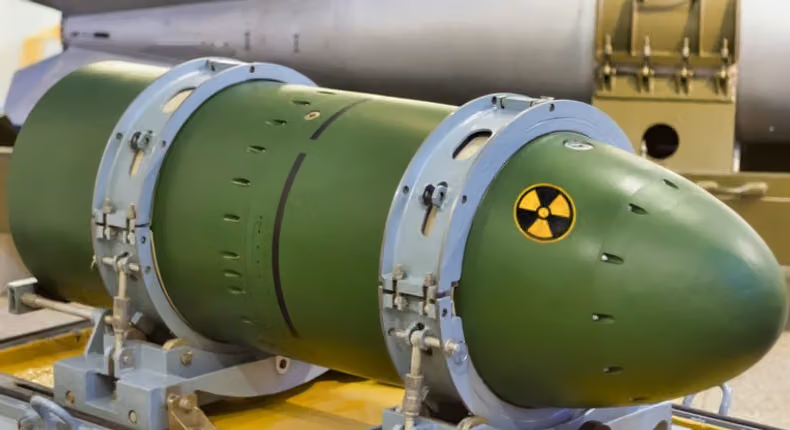
In 1942, the uranium that fuelled the Manhattan Project travelled from a single mine in the Belgian Congo, Shinkolobwe, in the Katanga copper belt in the Democratic Republic of the Congo (DRC), to the laboratories of Los Alamos. Eight decades later, history is repeating itself in reverse. Strategic quantities of uranium are once again leaving Katanga and the DRC, but this time the destination is the People’s Republic of China (PRC), the method is concealment inside cobalt ore, and the beneficiary is the fastest nuclear weapons build-up in the world.
A landmark investigation published last week by Lighthouse Reports, a leading non-profit investigative newsroom, in partnership with the Financial Times and the peer-reviewed journal Nature Communications, has established that between 2,000 and 5,000 tonnes of uranium left the Democratic Republic of the Congo for the PRC between 2000 and 2024, embedded in shipments of cobalt hydroxide. Even at the lower bound, this is enough uranium to run a gigawatt-scale nuclear reactor for more than a decade or, if enriched, to make a material contribution to a weapons programme. Uranium exports from the DRC are officially banned. The shipments happened anyway, hidden in plain sight within the world’s most important battery metals supply chain.
The cobalt cover
The mechanism is elegantly simple. Katanga’s geology intermingles copper, cobalt and uranium in the same ore bodies. As Chinese companies came to dominate Congolese cobalt mining over the past decade, roughly 95 per cent of Congolese cobalt now goes to China, which refines around 80 per cent of global supply, and the uranium travelled with it as an undeclared by-product.
The investigation’s origins lie in a leaked 2009 memorandum from the International Atomic Energy Agency (IAEA), which recorded credible information that uranium was present in significant quantities in most Katangan cobalt ore and was, in effect, being exported alongside it. Since that memo was written, Congolese cobalt production has scaled up dramatically under Chinese ownership. What was a safeguarding footnote in 2009 has become a strategic pipeline.
The scientific work behind the findings is rigorous. Researchers at Princeton and the University of Wisconsin–Madison built geochemical models of uranium concentrations across Katanga’s mines, cross-referenced against ore production figures and, critically, trade data on phosphoric acid, the chemical required to strip uranium from cobalt ore before export. The pattern in the acid imports was damning: mining companies bought it in quantity only after contamination incidents were flagged. Uranium removal was reactive and episodic, not systematic. As one senior metallurgical engineer who worked in Katanga told the investigators, monitoring only happens “when you have an issue”.
Leaked documents from Tenke Fungurume Mining, sold by America’s Freeport-McMoRan to China’s CMOC in 2016, recorded cobalt samples containing up to 1,100 parts per million of uranium, some 15 times the permissible export threshold, with contaminated batches confirmed as late as 2021. Industry insiders described what amounts to a bifurcated supply chain: cleaner product for quality-sensitive Western customers, and lower-grade, higher-impurity material, uranium included, bound for China. CMOC denies any contamination exceeding applicable limits.
The arithmetic of the PRC’s growing nuclear arsenal
Why does this matter now? Because China’s nuclear expansion has an unexplained supply chain. The Pentagon assesses that Beijing’s warhead stockpile has doubled to roughly 600 in the past decade and will reach 1,000 by 2030, the most rapid peacetime nuclear build-up since the height of the Cold War. Yet China’s declared uranium imports and domestic production do not come close to accounting for both its civil reactor fleet, the largest construction programme on earth, and this vast military expansion. Somewhere, the books do not balance.
The Lighthouse investigation is careful to note that it cannot independently verify how the Congolese uranium has been used inside China. However, the strategic inference is unavoidable. An opaque, unsafeguarded stream of thousands of tonnes of natural uranium has flowed for a quarter of a century into a state whose Ministry of Defence continues to run a vast deception operation regarding the scale of its growing nuclear arsenal. This is precisely the missing feedstock that helps to power the PRC’s nuclear fuel cycle. Every tonne of undeclared Congolese uranium that fuels a civil reactor frees a tonne of declared material for enrichment and weaponisation. Fungibility is the whole point.
The DRC’s own nuclear energy agency does not dispute the risk. Its head, Steve Muanza, has said it is “technically possible” and even “likely” that Chinese companies are extracting uranium from exported Congolese ore. His agency has requested funding for radiation monitors along the trucking route to Zambia, a request that speaks volumes about the current state of controls governing one of the most sensitive materials on earth.
The safeguards gap
The episode exposes a structural weakness in the global non-proliferation architecture. IAEA safeguards were designed for declared facilities and declared material. They were not designed for uranium that crosses borders disguised as battery feedstock, below the reporting thresholds, through a state where the reach of the central government is limited and the frontier is porous. A Finnish regulatory permit uncovered by the investigation illustrates the loophole with clinical precision. A European refinery was authorised to separate and hold uranium from Congolese cobalt, so long as the annual quantity remained just below the level that would trigger IAEA safeguarding protocols. Where a compliant Western operator hugs the threshold, a non-compliant supply chain simply ignores it.
Three conclusions follow for policymakers.
First, the critical minerals contest and the non-proliferation regime can no longer be treated as separate files. The same Chinese state-linked mining companies that dominate the cobalt, copper and rare earths supply chains are moving strategic nuclear material. Mineral security is nuclear security. Export controls, sanctions screening and safeguards policy need to be integrated accordingly.
Second, the question is who in Kinshasa benefits from this trade with the PRC. President Tshisekedi has spent millions of dollars lobbying Washington, DC, to position the DRC as a critical minerals ally of the United States, but the secret trade in uranium raises questions about whether the DRC government can deliver on this commitment.
Third, and most fundamentally, the answer to a compromised supply chain is a clean one. So long as the free world outsources the mining and refining of its critical minerals to opaque intermediaries, it will keep discovering, years too late, what else travelled in the ore. Building transparent, allied supply chains, from African mines governed by the rule of law to Western midstream processing, is counter-proliferation.
Shinkolobwe’s uranium helped end the Second World War. The question the Lighthouse investigation forces us to confront is whether the DRC’s uranium is now being secretly supplied to arm our adversaries for a future war.
