

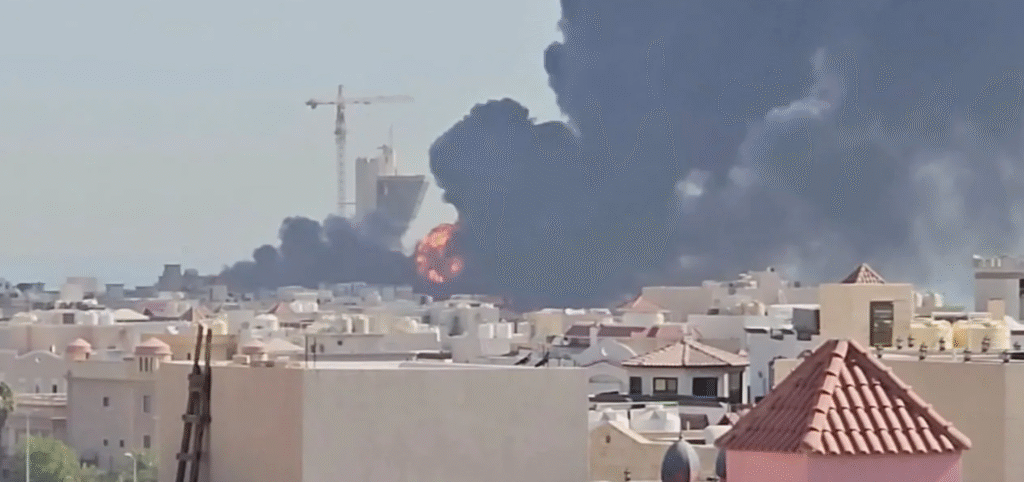
Iranian forces have launched a drone attack on a US military facility in Kuwait while a cargo vessel has been struck by an unidentified projectile near the Strait of Hormuz, in the latest sign that the war is expanding across the Gulf.
A source familiar with the matter told The Jerusalem Post that at least three drones were used in the attack on the US base. Regional media later reported explosions in Kuwait and Iraq’s Basra province, which borders both Iran and Kuwait.
Iranian state media also reported a large fire in Kuwait, although the cause has not been independently confirmed.
The maritime incident occurred off the coast of Oman, where the United Kingdom Maritime Trade Operations (UKMTO) organisation said a cargo vessel had been struck by an “unknown projectile”.
Authorities have not identified the vessel, and no group has claimed responsibility.
The latest developments come amid growing uncertainty over efforts to restore negotiations between Washington and Tehran.
US President Donald Trump told reporters aboard Air Force One that discussions with Iran would resume on Monday. Trump said planned military action had been suspended after Saudi Arabian, Emirati and Qatari officials indicated that “a deal was imminent, both regarding the Hormuz Strait, and ultimately the denuclearisation of Iran”.
Tehran, however, has publicly denied that negotiations are under way.
Iranian Foreign Ministry spokesman Esmail Baghaei told The Wall Street Journal that no meetings with the United States had been scheduled and that, apart from Foreign Minister Abbas Araghchi, Iran’s negotiating team remained in the country.
Iranian officials have instead indicated that discussions have centred on maritime access and the future status of the Strait of Hormuz rather than wider nuclear negotiations.
President Masoud Pezeshkian has insisted that Iran does not seek a broader war but has also warned that Tehran will continue to defend its strategic interests in the region.
The latest attack on commercial shipping is likely to intensify concerns over the security of one of the world’s most important maritime corridors. Before the conflict escalated, roughly a fifth of the world’s seaborne oil and a significant proportion of global liquefied natural gas exports passed through the strait.
Shipping traffic through the waterway has fallen sharply in recent weeks as shipping companies, insurers and energy traders respond to the heightened risk of further attacks.
Oil prices rose following reports of the latest strike on the vessel near Oman as markets weighed the possibility of renewed disruption to energy supplies.
The regional crisis has also widened beyond Iran and the Gulf. Talks between Israel and Lebanon resumed in Rome on Tuesday, while Hezbollah leader Naim Qassem criticised the negotiations and accused Lebanese President Joseph Aoun of undermining national unity.
Meanwhile, the Israeli military said the 401st Armoured Brigade had completed an eight-month deployment in southern Lebanon, during which it claimed to have destroyed more than 1,200 Hezbollah positions and recovered hundreds of weapons.
With diplomatic efforts stalled and military activity continuing across several fronts, the prospect of a rapid de-escalation is appearing increasingly uncertain.
