

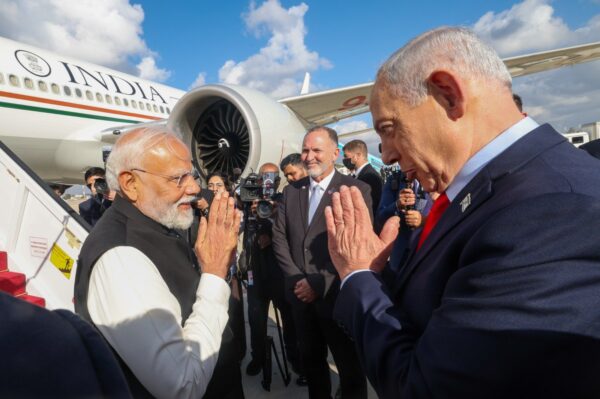
During a recent visit to Israel as part of an Indian delegation, I observed a convergence of thinking among Israeli stakeholders – diplomats, think-tank analysts, university academics, and officials in the security establishment – on how Israel should reorient its foreign policy amid the regional upheaval that followed the Hamas attacks of October 7, 2023. Regional dynamics – most recently, the Israel-U.S. conflict with Iran – have prompted Israel to diversify toward Asia, prioritizing cooperation in technology, defense, and civil innovation and moving beyond transactional dealings toward long-term, win-win collaborations.
Israel increasingly recognizes that reliance on longstanding partnerships with the United States and a handful of European countries is no longer sufficient. In the wake of the Gaza war of 2023 and the humanitarian catastrophe that followed, several long-time partners have grown sharply critical of Israel’s policies toward Gaza and the broader Palestinian question. For instance, the United Kingdom and France formally recognized a Palestinian state; Belgium offered conditional recognition; Italy decided not to renew its defense agreement with Israel; and Spain suspended arms sales. These developments show that some major European countries are increasingly conditioning cooperation with Israel on human rights concerns.
Furthermore, the Gaza conflict has undercut Israel’s hopes of expanding normalization with neighboring states, particularly in the Gulf. Progress toward a political breakthrough with Saudi Arabia, which many expected to establish full diplomatic ties similar to other Abraham Accords partners, has been stymied. This setback has reinforced the urgency to diversify Israel’s diplomatic and economic outreach, increasing interest in strengthening its presence across Asia. While Israel is not abandoning its Western relations, it has adopted a deliberate strategy of geographic and diplomatic diversification.
“You have to build new alliances and develop new relationships,” Israeli Prime Minister Benjamin Netanyahu said in an interview this week. He highlighted India as a prime example of this strategy.
A key constraint on this pivot is strategic hedging by many Asian states. They cultivate pragmatic ties with Israel for technology and co-production while maintaining commercial and energy relationships with Iran and other Gulf Arab states. Consequently, cooperation with Israel is often transactional and sectoral rather than extending to public political alignment on Middle Eastern disputes. For Israeli policymakers, this requires depoliticized engagement with Asian partners, prioritizing high-value co-development in defense, water, healthcare, medicine, infrastructure, cyber security, renewable energy, space, investment, and AI. Israel’s offers should avoid forcing Asian states into a binary regional choice.
Despite these limits, practical opportunities for Israel have emerged across Asia. Over recent decades, many Asian states with formal diplomatic ties with Israel have steadily expanded engagement across political, economic and technological domains. Unlike some European governments, most Asian capitals have generally not treated the Palestinian question or related normative concerns as the central determinant of bilateral relations with Israel, though occasional expressions of concern occur. For instance, during the Gaza conflict, only a small number of Asian governments issued strong condemnations; the most critical responses came primarily from states without formal ties to Israel. This relatively restrained political rhetoric – even during periods of heightened conflict – has created a conducive environment for deepening cooperation and allowed bilateral ties to develop with fewer diplomatic interruptions.
Against this backdrop, Israel has broadened its footprint across key sectors in Asia. While defense cooperation has long been a cornerstone of many bilateral relationships, Israeli policymakers are diversifying partnerships into non‑defense areas such as technology and cyber, agriculture and water management, healthcare, and investment. For rapidly growing Asian economies, these capabilities align with development and industrial priorities. That alignment creates durable opportunities for trade, investment and deeper technological collaboration with Israeli firms.
Among Asian partners, India functions as Israel’s strategic anchor. The relationship is shifting from buyer‑seller arms deals to deep industrial co‑development across defense, AI, water, cyber, food security, renewable energy, cyber, and agriculture. Both governments have institutionalized this trajectory with several key agreements. A Bilateral Investment Agreement was signed in September 2025 and became effective on July 4, 2026, and negotiations on an India-Israel FTA are believed to be in their final stages. A defense MoU concluded at the 17th Joint Working Group meeting in November 2025 commits both sides to expand defense-industrial cooperation, with a focus on training, technological innovation, AI, and cybersecurity.
High‑level exchanges have reinforced these commitments. Prime Minister Narendra Modi’s visit to Israel in February 2026 elevated ties to a “Special Strategic Partnership,” and Israeli Director General of the Ministry of Defense Amir Baram visited India in late June 2026. These institutional and political steps have accelerated co‑production projects and advanced industrial integration.
Israel is also interested in deepening existing ties with Vietnam, the Philippines, Singapore, and Thailand, and in strengthening relations with Japan and South Korea, where cooperation remains below potential. Additionally, Israel is cultivating ties with Indonesia – a pivotal country that does not have formal relations with Israel, but considerable possibilities. Political and economic conditions across much of Asia are conducive to deeper engagement by Israel. Many countries are diversifying their economic, technological, and defense partnerships, and have long been recipients of Israeli arms. Increasingly, these relationships are evolving from procurement to co-production, with Israeli defense firms establishing joint ventures across the region.
In South Asia, for instance, Israel Aerospace Industries’ longstanding partnership with India’s Defense Research and Development Organization (DRDO) – specifically the Barak-8/MRSAM program – is complemented by collaborations with private players. For example, Bharat Forge (Kalyani Group) has a joint venture with Rafael that manufactures Spike anti-tank missile components, and the Adani Group’s facility with Elbit Systems in Hyderabad produces Hermes 900 unmanned aerial vehicles. Emerging partnerships involve firms such as NIBE Limited.
In Southeast Asia, Israeli firms have supported licensed production of Galil ACE assault rifles in Vietnam, and Hanoi has procured Israeli missile systems, including the SPYDER air defense system. Singapore’s defense cooperation with Israel, though discreet, is similarly deep-rooted and characterized by joint ventures: IAI and Singapore Technologies Engineering Ltd (ST Engineering) established Proteus Advanced Pte Ltd in 2020 to “market and sell advanced naval missile systems.” While the Philippines has halted its arms imports from Israel since September 2025, both countries continue cooperation in other sectors, including pilgrimage tourism for Filipinos. Lately, Israel’s deployment of AI to manage Philippine irrigation systems signals a shift toward high-tech cooperation on food security and climate resilience. Therefore, beyond defense, Israel’s innovations in cyber, agriculture, AI, water management, and health technologies make it an attractive partner for Southeast Asian countries.
In East Asia, South Korea’s advanced industrial base and dual‑use technological strengths make it a natural partner for co‑development, though political sensitivities often constrain progress. However, Israel-South Korea ties have been dominated by a military-security dimension, driven by Seoul’s threat perceptions and higher demand for weaponry. Defense exports from Israel to South Korea have grown commercially since the early 2000s. In addition to this, in 2021 South Korea became the first Asian nation to sign a free trade agreement with Israel, effective from December 2022. Over the years, cooperation has expanded into fields such as vaccine production, and both sides share an interest in renewable energy. For Israel, renewable energy offers a strategic avenue to broaden the partnership beyond security into a more multidimensional economic relationship.
Simultaneously, Japan presents a partnership Israel is keen to elevate. Bilateral trade reached approximately $2.7 billion in 2025, yet both countries acknowledge considerable untapped potential. Tokyo is deepening ties with various economies to diversify supply chains for critical minerals and energy. The two countries began exploring a free trade arrangement in late 2022, with the first round of discussions on a Japan-Israel Economic Partnership Agreement (EPA) held virtually in March 2023. An EPA would ease market access and facilitate higher-value trade.
Israeli defense cooperation with Japan has also shown growing promise as Tokyo modernizes its military in response to China and North Korea, in particular. For Israel, seeking new arms markets amid its push for diversification, the timing is opportune. Japan has historically kept Israel at arm’s length because of its energy dependence on the Middle East (where 95 percent of Japan’s oil imports originate) and domestic sensitivities over the Palestinian question, though that caution has eased. While Japan’s defense export framework has been incrementally relaxed since 2014, it still constrains joint sales to third countries. If Tokyo further relaxes transfer restrictions, selective Israeli and Japanese technology fusion could produce co‑produced systems suited to both domestic needs and export markets. Deepening collaboration in AI, semiconductors, and coordinated cyber-defense initiatives could shift the relationship from trade to high-value industrial and security R&D. The maturation of Israel and Japan ties could also open trilateral or multilateral opportunities with key partners such as India and the United Arab Emirates, enabling joint technology and infrastructure initiatives across regions
In sum, Israel and its Asian partners have strong incentives to deepen cooperation: Israel gains diversified markets for defense and civilian goods, strategic partners and diplomatic cushioning, while Asian states secure advanced technologies, industrial capacity and alternative supply‑chain partners. Crucially, this model allows for deep engagement without forcing partners into public political alignment on Middle Eastern disputes.
For this to be durable, however, Israel’s diversification toward the broader Asian region must move beyond sectoral cooperation toward lasting political ties. This transition hinges on certain steps: first, institutionalizing high-level political dialogues (as seen in India) and issue-based coordination; second, delivering visible, high-impact joint projects that create local constituencies; and third, sustaining intensive public diplomacy in partner capitals.
Finally, this pivot has become a structural imperative that transcends political leadership. While successive Israeli administrations have institutionalized Asia as a critical partner for advancing strategic goals, the trajectory is not guaranteed. Israel’s challenge is to move beyond transactional wins and proactively synchronize its strategy with the evolving political barometers of Asian capitals – ensuring this pivot to Asia becomes a permanent pillar of its global architecture than a temporary surge.
