

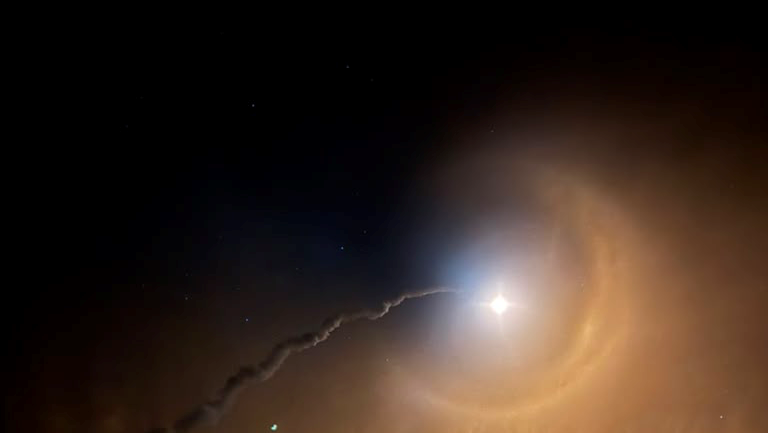
WASHINGTON — Japan has launched the second of two long-planned US Space Force orbital neighborhood watch sensors on a Japanese satellite.
The dual missions represent “the first bilateral” US-Japan cooperative space effort “focused on national security,” US Space Systems Command (SSC) said in an Aug. 14 statement. The first of the two sensors was launched in February 2025.
The Space Force sensors, designed and built by the Massachusetts Institute of Technology’s Lincoln Laboratory, will keep watch on the heavens above the Indo-Pacific region, according to the SSC release.
The Japanese satellite, Quasi-Zenith Satellite-7 (QZS-7), was successfully launched on an H-3 launch vehicle from Tanegashima Space Center (TNSC) in Japan on Aug. 10, according to the SSC release.
Built by Mitsubishi Electric Corporation, it is the seventh and last bird in the Quasi-Zenith Satellite System (QZSS) constellation stationed in geosynchronous Earth orbit (GEO). The constellation, which serves as Japan’s version of GPS, is operated by the Japanese space agency JAXA and provides position, navigation and timing coordinates for both civilian and military uses.
The Pentagon initiated the bilateral effort to host the US sensors as payloads on the sixth and seventh QZSS birds in 2019. The deal was part of a package of agreements aimed at improving cooperation with Japan on space situational awareness.
The US Space Force first provided funding for the program in fiscal 2021, with the expectation that QZS-6 would fly in calendar 2023 and QZS-7 would fly the following year.
The two sensors will feed space monitoring data to the US Space Surveillance Network (SSN), which is made up of ground-based radar and telescopes on Earth and in space. The SSN is operated by the 18th Space Defense Squadron, headquartered at Vandenberg Space Force Base in California.
