

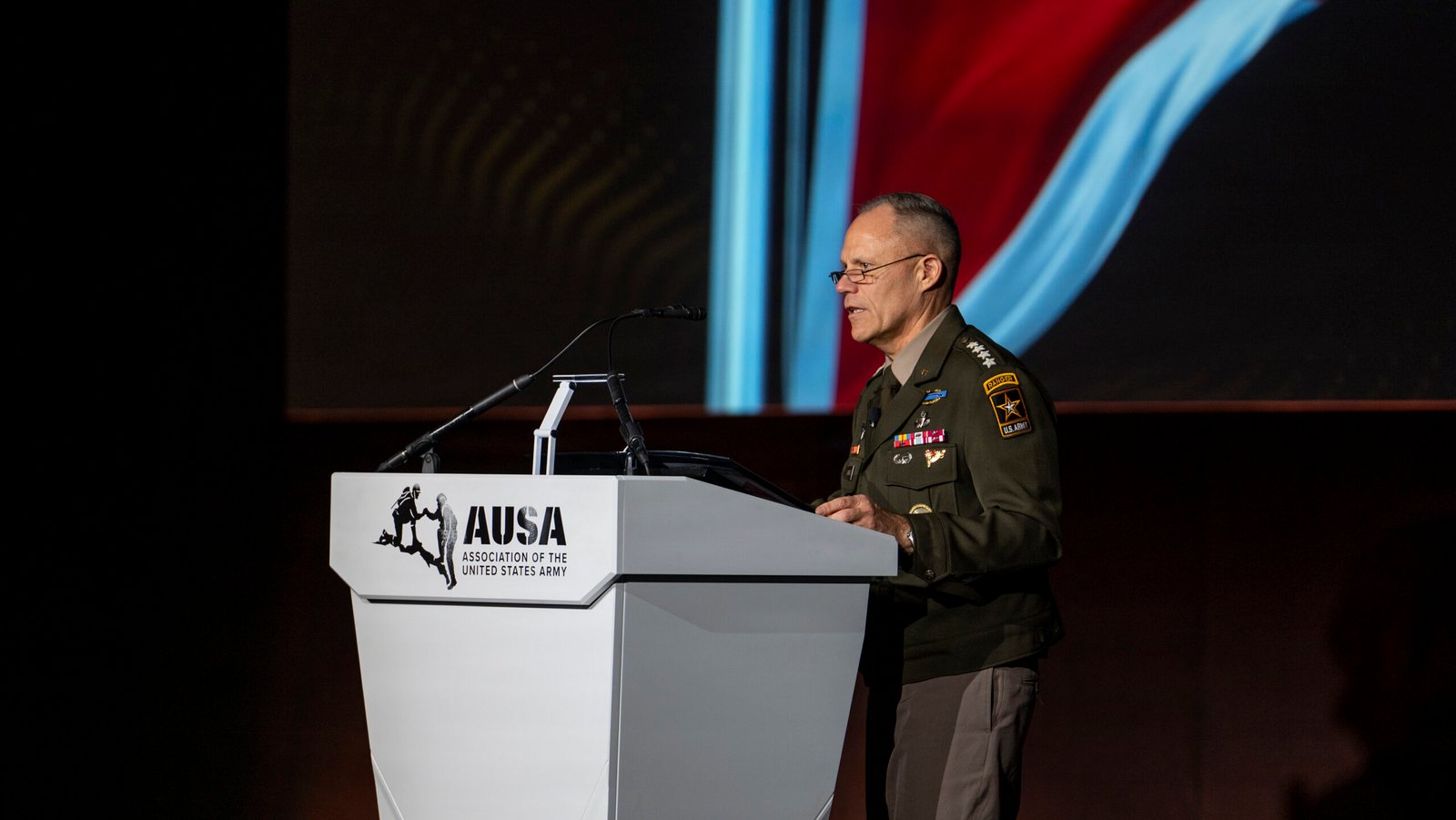
WASHINGTON — The Army’s top officer revealed today that the service has “redesignated” its Futures and Concepts Command (FCC) as the new Army Futures and Autonomous Systems Command (FASCOM).
“We are incorporating autonomous and unmanned systems at every single echelon across the formation … with the force structure to match … including introducing UAS [unmanned aerial systems] and robotics military specialties to integrate these technologies at the point of need,” Acting Chief of Staff Gen. Christopher LaNeve said at the annual AUSA conference.
“With [Secretary of Defense Pete Hegseth’s] announcement establishing Autonomous Warfare Command, Acting Secretary [Adam] Telle and I have redesignated Futures and Concepts Command to serve as US Army Futures and Autonomous Systems Command … FASCOM,” he said.
Earlier this month the Army announced the establishment of FASCOM along with a handful of other related organizational changes, but at the time did not note FCC’s role. LaNeve didn’t specifically say why Army leaders decided to make the move, but he said it signals that the service is “moving with focus and intention.”
“[As] Acting Secretary Telle likes to say, we are gaining velocity,” he added.
LaNeve said in a press release prior to his remarks today that FASCOM will be led by a three-star general officer. It will “integrate and ultimately accelerate” the work of the Combat Capabilities Development Command, Medical Research and Development Command, 75th Innovation Command, Joint Modernization Command and the Transformation Decision Analysis Center, he said.
On Sept. 30 Defense Secretary Pete Hegseth announced the Pentagon would create a new four-star command, called Autonomous Warfare Command (AUTOWARCOM), centered on drones and similar technology as well as a new working group on the future of defense.
Today’s move makes the FCC a short-lived organization, at least in name. It was activated at the beginning of this year by then-Secretary Dan Driscoll as a subordinate command under the service’s four-star Transformation and Training Command, or T2COM.
T2COM was established as a result of the service’s sprawling Army Transformation Initiative, which aimed to bolster the service’s modernization and consolidate some of the service’s leadership. It combined the service’s two four-star commands, Training and Doctrine Command and Army Futures Command.
“This goes beyond drones,” LaNeve said in the release today. “FASCOM will pioneer operational concepts that harness autonomous capabilities across all warfighting functions.”
