

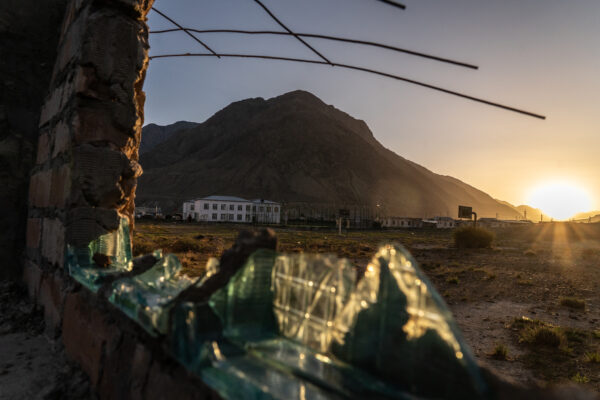
Once home to 5,000 people, the mining town of Engilchek, in the southern Tien Shan mountains of Kyrgyzstan, emptied after the collapse of the Soviet Union, leaving behind abandoned buildings, shattered lives, and a handful of residents facing an uncertain future.
Today, the ruins are home to a small but thriving community.
Ashuu – given that name since he was born on the eponymous mountain pass 1.5 hours away, which is the only route into town – remembers when Engilchek was just a jailoo; the summer pasture of nomads. His parents came here on horses with their cattle, living in yurts, as the Kyrgyz had done for centuries.
Ashuu, 65, was named after the pass 1.5 hours away from Engilchek and the only route into town. Photo by Thijs Broekkamp.
Then, in the 1960s, Soviet geologists arrived. They discovered an abundance of natural resources: tin, tungsten, and molybdenum in the mountains, and alluvial gold in the rivers.
Yet it was not until the early 1980s that full-scale development began. Mines and processing facilities were built, and the Soviet authorities invested heavily in infrastructure to support the remote, high-altitude settlement, including an airstrip. Multi-story apartment blocks, single-family houses, schools, and a hospital soon followed.
Now, 65 years old, Ashuu is one of about five dozen people still residing in Engilchek. Officially, around 200 people are registered as residents, but locals say the true number is much closer to 60.

Engilchek is surrounded by towering peaks rising above 7,000 meters. Photo by Thijs Broekkamp.
Engilchek lies in a broad valley, a rare stretch of flat land in this rugged mountain region, surrounded by towering peaks rising above 7,000 meters. Karakol, a small city about four hours away by road, is the nearest major settlement. The road from Karakol winds through a lush green valley alongside a mountain stream, flanked by pine forests that gradually disappear as the road climbs toward Ashuu Pass at 3,800 meters. Ashuu Pass is almost permanently covered in snow. Beyond the pass, the gravel road cuts through wide valleys, occasionally passing shepherds tending herds of yaks, sheep, horses, or cattle.

The road from Karakol winds through a lush green valley alongside a mountain stream, flanked by pine forests that gradually disappear as the road climbs toward Ashuu Pass at 3,800 meters. Photo by Thijs Broekkamp.
Before reaching Engilchek, you pass a Kyrgyz border post, where you must present the specially obtained permit granting permission to travel in the area due to the close proximity to the border with China. If you drive farther, you’ll come across a Chinese border guard post too, though there is no actual border fence; the impenetrable mountains carry that function.
Beyond Engilcheck there are no more villages, only the occasional shepherd.

At the center of Engilcheck stand three abandoned Soviet-era apartment blocks. The town lives on around them. Photo by Thijs Broekkamp.
Three abandoned Soviet-era apartment blocks dominate the center of town. Around them stand inhabited houses, connected by footpaths and dotted with small yards and a modest playground, interspersed with derelict homes whose roofs have collapsed, buildings with shattered windows, and piles of rubble.
Children play with scraps of metal they find among the ruins.
“After the [Soviet] collapse, everything stopped. Out of desperation, people began stripping the buildings of anything valuable and selling it. I did the same,” Ashuu says.
They salvaged metal, electrical wiring, and anything else they could sell – the reason the buildings now stand completely empty. Others returned to the old way of life, keeping livestock to survive.

A cow peeks through the window of an abandoned house in Engilcheck. Photo by Thijs Broekkamp.
“Leaving was difficult,” Ashuu says of the time following the 1991 collapse of the Soviet Union. “If you didn’t have the money to buy or build a house somewhere else, there was little point in leaving. Besides, the road out of Engilchek often became impassable once the government stopped maintaining them. In winter it was buried under snow, and rockfalls regularly blocked them. There weren’t nearly as many cars as there are today. And where would you go? In nearby Karakol the situation was much the same: no work, no money, little food, which was the situation all over the disintegrated Soviet Union.’’
Ashuu is one of the few older residents still living in Engilchek; most people of his generation have left because of the harsh climate. Younger families have moved to Engilchek in recent years.

A girl with balloons walks by some of Engilchek’s inhabited homes. Photo by Thijs Broekkamp.
Nelli moved to Engilchek from Karakol a decade ago with her husband, who wanted to raise cattle in the surrounding mountains. Seeing the occasional traveler pass through, she sensed an opportunity.
“They’ll probably need a meal or somewhere to stay,” she thought, and opened a guesthouse. Two of their children now live with their grandparents in Karakol so they can attend school, while the two youngest still live with them in Engilchek.
For Nelli, the appeal of life here lies in the silence and the spectacular mountain scenery.

Nelli is also the teacher at the local school, one of nine teachers educating around 30 children. Photo by Thijs Broekkamp.
She hopes tourism will help sustain life in the town. Three more guesthouses have opened in recent years, catering to international visitors as well as Kyrgyz tourists from Bishkek and elsewhere, drawn by the nearby hot springs, hiking trails, and glacier treks.
Nelli worries that one day the government will “discover” Engilchek too.
Across Kyrgyzstan places that become popular with tourists often see cable cars, cafés, luxury hotels, and restaurants appear in quick succession. A-frame houses are already being built next to the hotsprings. Nelli fears that someday the government might bulldoze all the Soviet rubble, and thus remove the draw for tourists.

Two kids ride a bike past the town’s small mosque. Photo by Thijs Broekkamp.
Today, the town’s operating public institutions include a kindergarten, a school, and a small medical center. More recent additions include a tiny mosque and a library that also serves as a community center, rebuilt by the government after the original building had almost completely collapsed. Behind the kindergarten, a new football pitch has been laid out beside the overgrown remains of basketball hoops.
The librarian, Eliza, is unfailingly optimistic.
“We’ll restore the town to what it once was,” she says, her eyes lighting up as she talks about the recent construction projects. It seems an ambitious goal, but her enthusiasm is contagious. ‘’It was not a village back then, but a city. There were shops on every corner selling clothes and groceries, restaurants, a cinema, a hospital, and good roads. We had toilets in the homes, hot and cold running water. There was even a bus and taxi service to Karakol.’’

Eliza, Engilchek’s librarian, is unfailingly optimistic. Photo by Thijs Broekkamp.
She shows us the community hall, where residents celebrate New Years, Islamic holidays, and other local events. The adjoining library is filled with books on Kyrgyz history.
“We now have books in three languages – Kyrgyz, Russian, and English,” she says proudly. “It’s not just the children who borrow them. The herders and even the border guards come here too.”
Next door there is a small gym, a billiards table, and a table tennis table.
Eliza, too, found the years after the collapse very difficult. “But life is good now,” she says. “I wouldn’t want to go back to the Soviet Union. They also suppressed our culture and our language, tried to brainwash us.”

A Soviet monument commemorating the soldiers fallen in the fight against the Basmachi, an uprising against Russian Imperial and Soviet rule in Central Asia, lasting from roughly 1916 to the early 1930s. Photo by Thijs Broekkamp.
Despite their complicated history, Central Asia and Russia have maintained close ties since the collapse of the Soviet Union. Kyrgyzstan in particular has remained one of Moscow’s closest partners in the region, although new powers have steadily expanded their influence.
Perhaps nowhere are these shifting geopolitical realities more visible than in Engilchek. The old mines – and all the abandoned machinery – are now off limits. Around four years ago, a Chinese company took over the site and resumed mining tin and tungsten.
Not everyone welcomes these changes. Nelli worries about the environmental impact of the mines. Her husband is more concerned about who profits from exploiting the region’s resources.
“It should be a Kyrgyz company operating it,” he says. “The resources belong to Kyrgyzstan, so our country should profit from it the most.”
While old empires fade into the rubble and new powers take their place, the mountains continue to yield their riches. Meanwhile, life in Engilchek goes on.

Nelli leads the way through Engilchek from her house, walking past the kindergarten to the other set of inhabited houses, all situated within close proximity of each other. Photo by Thijs Broekkamp.
