

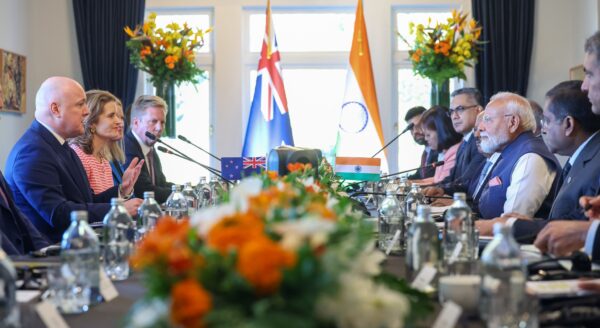
With an official visit to New Zealand from July 10-11, Narendra Modi became the first Indian prime minister to visit the country in 40 years. Before Modi, the last Indian prime minister to visit the country was Rajiv Gandhi. Modi’s visit followed New Zealand Prime Minister Christopher Luxon’s visit to India in March 2025. The timeliness of the visit is evident in the fact that it just took two reciprocal visits of the leaders of the two countries to sign a strategic partnership agreement: the “India-New Zealand Strategic Partnership: Roadmap to 2030.” In all, the two sides signed 10 agreements during Modi’s visit, spanning a wide range of areas of mutual interest and cooperation.
Amid the pageantry, Modi’s New Zealand visit was an attempt to make up for a shortfall in diplomatic footwork from the Indian side, and to bridge the economic and strategic gaps between the two countries. This was no small feat by any measure.
Modi’s visit is rightly considered a landmark event. New Zealand’s Ministry of Foreign Affairs and Trade has called India a strategic priority for New Zealand, highlighting India’s growing political and economic influence globally. This attitude was demonstrated in the warm welcome Modi received in Auckland.
Wellington’s significance in the bilateral and regional frameworks has not been lost on India either. Multiple factors underpin the rationale for Modi’s visit to New Zealand. The first rationale is bilateral engagement itself. Modi’s visit, after a gap of 40 years, signaled India’s willingness to strengthen ties with New Zealand despite the geographical distance. As both sides have shown, distance need not be a barrier to cooperation especially when interests converge.
Economic interests are a key driver of this renewed engagement. While bilateral trade remains modest at around US$2.4 billion, the India-New Zealand Free Trade Agreement signed in April 2026, awaiting ratification, aims to unlock greater economic cooperation. New Zealand is looking for better access to the Indian market for products such as apples, kiwifruit, and Manuka honey, while India continues to shield its dairy sector to protect small farmers.
Beyond trade, the agreement expands cooperation in agriculture, food technology, and skills mobility, including the Kiwifruit Action Plan under the Agricultural Productivity Partnership, and a pathway for 5,000 skilled Indian workers to work in New Zealand annually. Although migration provisions have sparked domestic debate, the broader economic agenda is ambitious, with New Zealand pledging US$20 billion in investment in India over 15 years and both sides aiming to increase bilateral trade to NZ$7 billion (about US$4 billion).
The second rationale concerns diaspora engagement and people connect. Diaspora outreach has been a recurring instrument of the Modi government’s foreign policy, and New Zealand, home to an estimated 300,000 Indians and persons of Indian origin, represented a natural choice for its deployment. Notably, Modi’s visit occurred against the backdrop of domestic disquiet in New Zealand over Indian migration following the recently concluded mobility provisions. Given that New Zealand’s political discourse places considerable emphasis on multiculturalism and diversity, and given the Indian diaspora’s growing electoral significance, such friction carries non-trivial political costs for policymakers. Modi’s visit can plausibly be read as an attempt to mitigate this discontent, at least partially. Reports and images of a well-attended and enthusiastic reception at his community address suggest that his standing among the diaspora in New Zealand remains largely intact.
Sporting ties add a further, if lower-stakes, dimension to the India-New Zealand relationship. Both countries share a deep cultural investment in cricket and hockey, symbolically reflected this year in commemorations marking “100 Years of Unity Through Sport.”
Third, 2026 marks 12 years since the launch of Modi’s Act East Policy, which represents a proactive evolution of the Look East policy initiated in 1992. This framework is central to India’s eastward engagement, as evidenced by Modi’s multiple visits to Southeast Asian and Indo-Pacific countries this year, including Malaysia, Indonesia, Australia, and now New Zealand. Reciprocal visits by regional leaders, including those from Japan, Myanmar, and Vietnam, further underscore the importance of these states to India’s Indo-Pacific strategy.
Geographically, New Zealand has long been nominally part of the Act East framework, but its integration has historically been weaker, both diplomatically and institutionally, than that of other regional partners. While Modi’s advancement of ties with Australia and outreach to the Pacific Island countries strengthened India’s presence in the South Pacific, the absence of sustained high-level engagement with New Zealand, the subregion’s institutionally pivotal player, meant that the policy lacked a crucial anchor. Now that the Act East Policy is being subsumed into the broader Indo-Pacific framework, it is only logical that New Zealand be included more meaningfully within it. This inclusion also demonstrates New Delhi’s effort to zoom out toward the wider Indo-Pacific region and build stronger ties with like-minded democracies with which it shares a number of commonalities, and New Zealand fits well into that strategic design.
Fourth, and arguably most significant, is the strategic rationale. Many U.S. allies and partners have grown less certain of how far they can rely on Washington’s security guarantees, a doubt sharpened by the unpredictability of the Trump administration’s approach. This fits into a broader shift toward a more contested, multipolar order in which U.S. primacy can no longer be assumed.
The point was reinforced on July 6, when China test-launched a submarine-based ballistic missile carrying a dummy warhead into the South Pacific; the missile landed within the South Pacific Nuclear Free Zone established by the 1986 Treaty of Rarotonga. New Zealand was given only a few hours’ notice. The episode underscored that even New Zealand is not insulated from rising security pressures – and unease about the continued strength of U.S. extended deterrence.
We appear to be entering a period in which past alliances and mechanisms carry less weight than before. For India, however, institutional asymmetry has always been part of the equation. Now that the U.S. presence is felt less keenly across the region, India is reorienting its own Indo-Pacific approach so that U.S. centrality matters less than the agency of states directly affected by regional developments, and New Zealand figures prominently in that reconfiguration. Both countries have emphasized maritime security and closer cooperation, reiterating in official discourse their intent to deepen exchanges on Indo-Pacific issues.
Modi’s New Zealand visit carried both bilateral and regional significance, touching on a wide range of issues. It also arrived at a moment when middle powers across the Indo-Pacific are seeking to strengthen security arrangements among themselves, in a regional order where U.S. presence can no longer be assumed. Both sides appear determined to build on this momentum, but that progress is not guaranteed.
High-level visits carry symbolic and diplomatic weight, but on their own these summits risk producing only ad hoc, episodic outcomes rather than durable change – particularly on security cooperation, which requires sustained institutional follow-through rather than one-off agreements. New Zealand’s domestic politics, including backlash over the mobility arrangement and attacks against the Indian diaspora, could easily complicate matters if not carefully managed. New Zealand may find it useful to look to Australia’s model of managing similar tensions while deepening ties with India.
For now, what matters is that this impetus is not allowed to stall; it should not take another four decades for an Indian prime minister to visit New Zealand again. As things stand, there is sufficient economic and strategic rationale on both sides to keep engaging.
