

The Pakistan Army (PA) has been conducting counterinsurgency (COIN) and counter-terrorism (CT) operations across its western frontiers since 2004, but it did not pursue a structured mine-resistant ambush-protected (MRAP) or light armoured vehicle (LAV) procurement strategy for most of that period. Its wheeled armoured vehicle acquisitions were small, ad hoc, and import-dependent — primarily the Navistar MaxxPro from the U.S. via foreign military sales (FMS) and the BMC Kirpi from Turkey as off-the-shelf purchases. Neither arrangement involved transfer-of-technology (ToT) or domestic production.
Between 2015 and 2019, several domestic and foreign-partnered proposals targeted the PA’s LAV requirements, including the MVRDE’s Light Armed Vehicle Assault (LAVA) program, Metal Engineering Works’ VAMTAC proposal with Spain’s UROVESA, Hajvairy Group’s partnership with South Korea’s Kia Motors for the KLTV, and Cavalier Group’s Hamza 4×4/6×6/8×8 family developed with the U.K.’s Jankel Armouring. None of these proposals secured PA backing or progressed to a production contract, and even HIT’s own Burraq MRAP (developed in 2009) did not advance to series production.
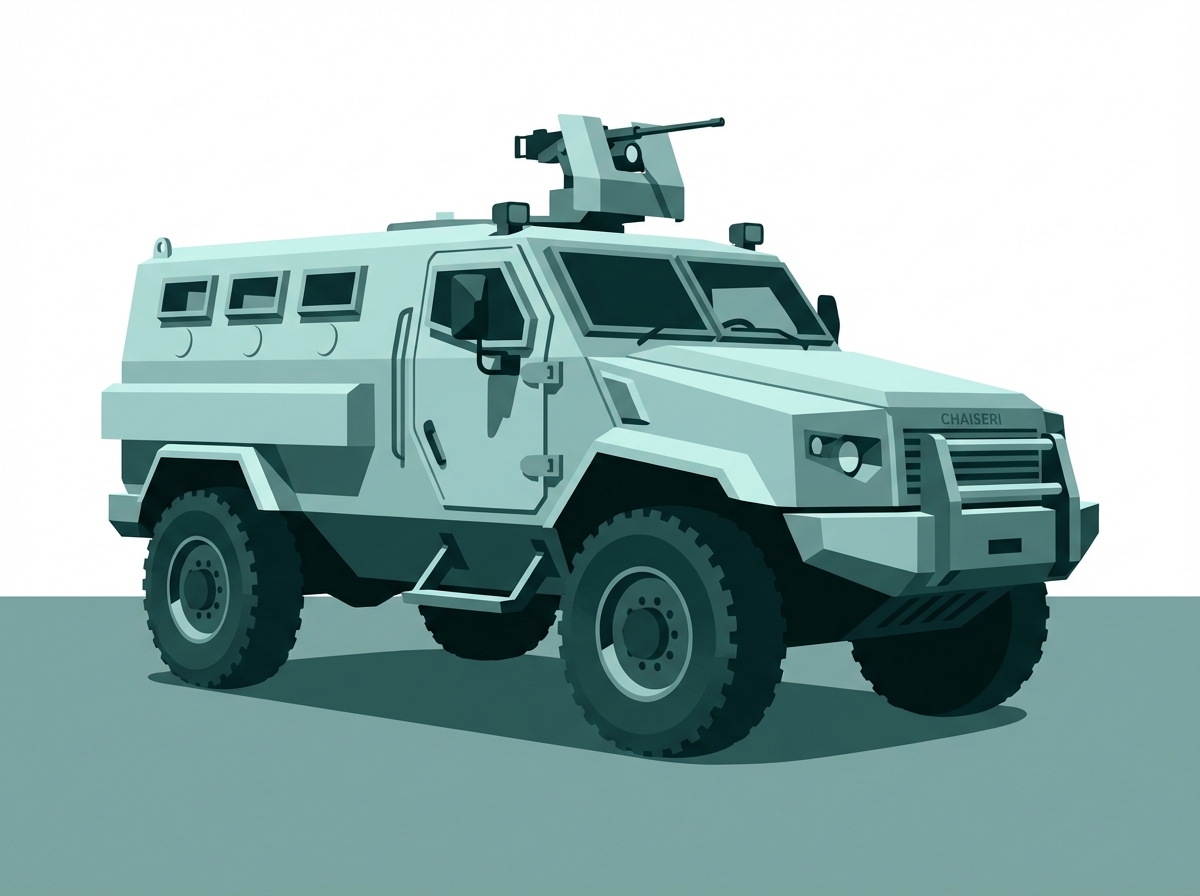
The Hisar MRAP program, formalized through a 2024 MoU between Thailand’s Chaiseri and Heavy Industries Taxila (HIT), appears to be the PA’s first concerted effort to indigenize MRAP production. HIT displayed the Norinco VN22 6×6 as the ‘Faaris’ at IDEAS 2024, and Kazakhstan’s Besqaru plant signed an agreement in February 2026 to market the AIBAR 4×4 (Otokar Cobra II derivative) and TAIMAS 8×8 (Otokar Arma with Norinco VN-11 turret) to Pakistan. These concurrent initiatives indicate a marked shift from the PA’s prior pattern of small, isolated purchases.
HIT appears to be assembling a wheeled vehicle catalogue around three core families: the Hisar for MRAP and COIN/CT roles, the Faaris for 6×6 AFV and infantry fighting roles, and the Mohafiz for general-purpose 4×4 LAV and internal security duties. This positions HIT as the central node for the PA’s wheeled vehicle procurement, with the organization controlling platform selection, design customization, and local production while partnering with foreign OEMs for the underlying platforms.
HIT’s platform-level ownership removes Pakistani private sector designers and integrators from the equation. However, HIT’s upstream sourcing appears more open — HIT has engaged a cluster of 500 local firms in parts development, and over 100 private sector firms are registered for defence-related manufacturing with the MoDP. Thus, while the private sector’s path to the PA is no longer through platform integration, it could play a role as a supplier of upstream components, sub-assemblies, and specialized inputs if HIT’s wheeled vehicle production scales.
The PA’s broader shift towards wheeled platforms is evident: with the exception of new MBTs, it has not purchased new tracked APCs, IFVs, or self-propelled howitzers in recent years, and the economic securitization of Balochistan — anchored by the Reko Diq copper-gold project’s projected $74 billion in free cash flow — has created a fiscal rationale for maintaining a standing COIN/CT force that was absent during the FATA campaigns.
Whether the PA sustains this trajectory will depend on whether the Hisar ToT extends beyond the initial 100 units, how the Besqaru and Faaris programs interact with or displace each other, and whether HIT can progress beyond CKD assembly towards manufacturing critical subsystems. For foreign OEMs, the empirical record suggests that partnering with private sector integrators is not the optimal pathway to PA orders; working directly with the PA and HIT across system evaluation and co-production integration, with readily available financing, regulatory pre-approvals, and clear local industry integration plans, is the more viable route.
