

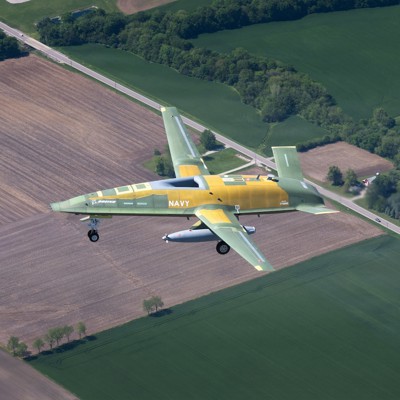
The Navy’s drone tanker, the MQ-25A Stingray, is cleared for low-rate initial production—just weeks after a production-ready model took its first flight.
“MQ-25 reached Milestone C, which is huge because now we have inflight refueling that is unmanned…it’s a great capability,” Acting Navy Secretary Hung Cao said at the end of an hourslong Senate Armed Services Committee hearing Tuesday.
The service plans to order three aircraft as part of a Lot 1 contract, which should be awarded later this summer, the Navy said in a news release Tuesday. Priced options for two subsequent lots with a combined eight aircraft are also expected in the contract.
“Integrating unmanned refueling extends the lethality of our Carrier Strike Groups and equips our force with a decisive advantage to fight and win against any adversary,” Cao posted on X.
The Stingray, which is launched by catapult, is designed to integrate with aircraft carriers and take over the role currently fulfilled by the F/A-18 Super Hornets. Once in production, it is poised to be the Navy’s first carrier-based aerial drone tanker.
“Stingray will provide the Carrier Air Wing with essential organic refueling, allowing more F/A-18E/F aircraft to focus on strike missions,” the service said in the release. “This will expand the operational reach of the air wing while preserving the service life of F/A-18E/Fs, improving readiness across the Super Hornet fleet. The Stingray is also at the forefront of integrating unmanned systems alongside manned platforms within the [carrier air wing].”
But the program, which plans for 76 aircraft—67 operational and nine test aircraft—has faced significant delays, with watchdog concerns around the production schedule, its effects on costs, and the reliance on a single supplier. The program’s estimated costs have risen about 4 percent, to around $16 billion overall, with each unit costing around $209 million, according to a 2025 Government Accountability Office assessment of Pentagon weapons programs.
The Pentagon wants $1.75 billion in 2027 for the MQ-25 Stingray, to fund the “three Low-Rate Initial Production (LRIP) MQ-25 aircraft and advanced procurement supporting LRIP Lot 3 (five MQ-25 aircraft) long lead materials,” according to budget documents. The money would also be used for the aircraft’s mission control system, or UMCS program, “that builds, integrates, installs, and sustains the systems (control station, communications, and networks) required to operate the MQ-25 and performs ship installations associated with the MQ-25.”
The move comes just weeks after a successful two-hour test flight from Boeing’s facility in Southern Illinois.
“Boeing is honored to work alongside our U.S. Navy partner in achieving this historic milestone in the MQ-25A Stingray’s development life cycle,” Troy Rutherford, vice president of the Boeing MQ-25 program, said in a statement. “We remain focused on getting this game-changing unmanned aircraft into the hands of the fleet and integrated into the carrier air wing.”
