

In October 2025, the Multilateral Sanctions Monitoring Team (MSMT) – an 11-state coalition formed in 2024 to replace the now defunct United Nations Panel of Experts on North Korea (PoE) – released its second report, detailing how Pyongyang funds its weapons programs through cyber theft and information-technology worker fraud. The team estimated that North Korea stole roughly $1.6 billion in cryptocurrency in the first three quarters of 2025 alone.
That the coalition exists at all is because the U.N.’s own monitoring body collapsed: in 2024, Russia vetoed the renewal of the PoE, ending the universal sanctions consensus that had governed the North Korea file since 2006.
The Panel of Experts reported to the U.N. Security Council (UNSC) and carried the authority of a universal mandate; the MSMT is a voluntary coalition of like-minded states that can investigate and publish but cannot bind the governments that decline to take part. Russia and China, no longer inside the monitoring body, now dispute its findings from the outside. For states inclined to trade with, or quietly tolerate, North Korea, the difference between a UNSC mandate and a coalition communiqué is the difference between an obligation and an opinion. The MSMT’s own members have asked the UNSC to rebuild the PoE in the form it had before – an implicit acknowledgment that documentation, however thorough, is not the same as universal enforcement.
Analysts have discussed in depth the repercussions of the end of the PoE. But while the end of international accountability attracts attention, there is a parallel effort on Pyongyang’s part to change how the world understands North Korea’s actions. That campaign is being conducted in Korean, in the laws and state media that form the regime’s authoritative register. These nuances are routinely lost in the English summaries that most foreign analysts actually read.
In September 2022, the Supreme People’s Assembly codified North Korea’s status as a nuclear weapons state and framed the program as a permanent fixture of national security rather than a bargaining chip. Notably, the law was made possible by a diplomatic shift: the May 2022 Russian and Chinese vetoes of a U.S.-drafted sanctions resolution. It was the first time a UNSC effort to sanction North Korea had been blocked since the first such resolution passed in 2006, and it ended nearly two decades of great-power consensus. Two years later, the PoE disbandment and the deepening North Korea-Russia partnership marked the definitive end of nearly two decades of great power consensus on opposition to North Korea’s nuclear program.
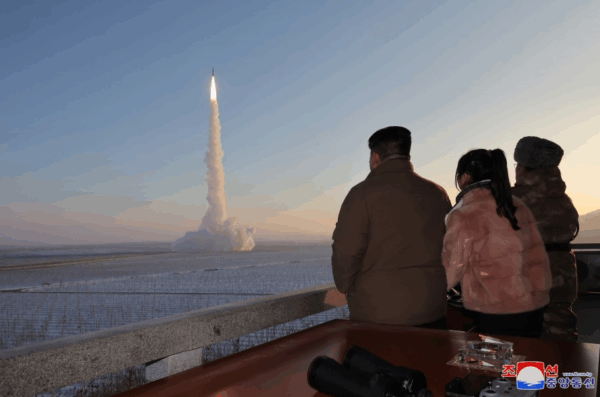
As international pressure fades, North Korea has stepped up its rhetorical efforts to frame its nuclear program as justified and necessary. Three terms, recurring across its state media, show the campaign at work.
First, North Korea increasingly describes itself as a “responsible nuclear-weapons state” (책임 있는 핵보유국). English coverage typically renders this as “nuclear-armed state” or “nuclear power,” dropping the adjective 책임 있는, “responsible.” That erases Pyongyang’s intended meaning.
“Responsible” deliberately borrows the vocabulary that the established nuclear powers use about their own arsenals. Co-opting the term positions North Korea not as a rogue proliferator but as a status-quo nuclear state entitled to comparable treatment. The Treaty on the Non-Proliferation of Nuclear Weapons (NPT), does not recognize latecomer nuclear states; “responsible” is an attempt to manufacture such a status.
Washington and Seoul continue to oppose Pyongyang’s nuclear status; Beijing and Moscow (among others) might be persuaded to accept a “responsible” nuclear North Korea. Importantly, it’s China and Russia whose North Korea policies determine whether sanctions are enforced in practice. Tracking where the word “responsible” appears, and whether responses implicitly accept or explicitly reject it, is a concrete measure of North Korea’s normalization campaign that the truncated English rendering makes invisible.
Second, North Korean texts overwhelmingly favor 핵억제력 – “nuclear deterrent capability” – over the neutral 핵무기, “nuclear weapons.” English coverage renders both interchangeably as “nuclear weapons,” “arsenal,” or “program.” But the Korean choice embeds a legitimacy claim in the language. 억제, “deterrence,” casts North Korea’s nuclear capability as inherently defensive, the same justificatory frame the established nuclear powers use for their own. The point is not unique to North Korea – deterrence language is universal – but the phrase is now used nearly exclusively by North Korean media. Its rising frequency in Rodong Sinmun relative to earlier and more neutral formulations is a quantifiable marker of the doctrinal normalization since the passage of the 2022 nuclear policy law. Yet the distinction is visible only to a reader working through the Korean corpus.
Third, North Korea attributes its posture to the United States’ 적대시 정책, rendered in English as “hostile policy.” The standard translation is not wrong, but it is incomplete. 적대시 literally means “to regard or treat as an enemy”; 적대시 정책 therefore denotes a continuing posture of treating North Korea as an adversary, not a discrete set of hostile acts.
The distinction matters for anyone reading Pyongyang’s signals. By framing the problem as an attitudinal stance, North Korea preserves a conditional logic – a posture, being an attitude, could in principle be withdrawn – even as it legally codifies its own program as permanent. “Hostile policy” obscures that retained conditionality, which is exactly the seam an analyst assessing the regime’s negotiating room needs to see.
These terms come straight from publicly available North Korean media. Yet in each case the analytically significant content – “responsible,” “deterrent,” the question of attitude-vs-action – is obscured in English. Taken together, the three terms describe a deliberate effort to reframe North Korea’s nuclear status from negotiable to permanent, and from rogue to “responsible.”
The terms reinforce one another: a “responsible” state wielding a “deterrent” in response to being “treated as an enemy” is a coherent self-portrait, assembled piece by piece, in which each word props up the next.
When the UNSC consensus held, the normative question – is North Korea a legitimate nuclear power? – was answered by a united sanctions regime that treated the program as illegal. As enforcement migrates to a coalition that both Russia and China reject, the answer becomes debatable in practice – and North Korea is shaping the terms of that debate.
Governments that read only the English summaries risk missing North Korea’s normalization campaign entirely, and conceding ground through inattention. Left uncontested, North Korea’s claim to be a “responsible nuclear power” steadily erodes the rhetorical basis for the denuclearization objective that the United States, South Korea, and Japan still formally hold. For Seoul and Tokyo the stakes are domestic as well as diplomatic: a North Korea widely accepted as a permanent nuclear power reshapes their own public debates over deterrence and proliferation, and sets a precedent that other aspiring proliferators will read closely. Contesting it would mean treating the vocabulary itself as a matter of policy – rejecting the “responsible” framing as consistently as Pyongyang advances it.
Even as the MSMT’s members ask the UNSC to rebuild the Panel of Experts, the harder contest may be the one being waged a word at a time.
