

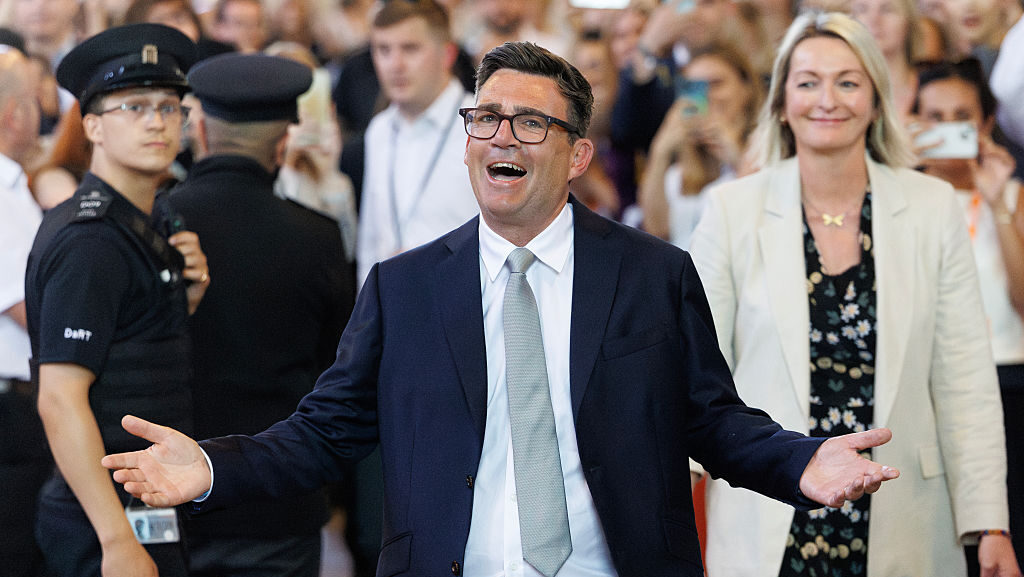
With news that UK Prime Minister Keir Starmer will step down, all eyes are on Andy Burnham, the newest member of the British Parliament thanks to a special by-election held last week. Assuming Burnham wins the Labour Party leadership contest to follow (if there is one), his premiership will face the same economic headwinds and fiscal constraints that recently forced the British Defence Secretary, John Healey, to resign.
Nonetheless, there is also the potential that Burnham’s rise could carry significant changes at the strategic level for the United Kingdom.
Burnham surpassed expectations in the out-of-cycle vote — in pre-election polling, he was ahead of his nearest rival by between 3 and 12 points, but on election day Burnham won by over 20 points. His new Makerfield constituency in northwest England is seen as something of a political bellwether for the challenge that Labour faces from the new right-wing Reform Party. With this strong political wind at his back, and given his popularity within the Labour Party, Burnham appears very likely to emerge as the new party leader, and therefore Prime Minister.
The next general election must take place by August 2029. This is not a long time to fundamentally transform the nation’s finances and turn the ship of state around. It seems likely that Burnham will want to continue many aspects of Starmer’s approach to defense and security policy, but with some key differences.
One of Starmer’s first acts on defense was to commission an externally-led Strategic Defense Review, which was published in June 2025. Starmer’s government accepted all 62 recommendations, including the purchase of thousands of new missiles, investment in additional submarines, and enlargement of the army. However, one of the authors of that review — former Labour Defence Secretary and former NATO Secretary General Lord George Robertson — later criticized the government for failing to follow through on its commitments agreed to in the review. Burnham will want to distinguish himself from Starmer by putting those pledges into action.
The first and most significant is on defense spending. In 2025, London pledged to spend the equivalent of 2.5 percent of the UK’s gross domestic product (GDP) on defense by 2027 and 3.5 percent by 2035. However, it was the specific pathway — or the lack thereof — toward achieving these goals that led now former Defence Secretary John Healey to resign earlier this month.
Starmer’s Chancellor (Finance Minister) Rachel Reeves had imposed strict fiscal rules as a means to control spending and reduce the government’s debt burden. Given the very public blow up around defense spending proved to be the straw that broke Starmer’s back, Burnham will likely feel compelled to borrow beyond those fiscal rules in order to facilitate greater defense spending, in a manner not dissimilar to what Germany has done. Whether or not Burham’s picks for chancellor and defence secretary are aligned will have a major bearing on the UK’s approach to defense.
The potential publication of the delayed Defence Investment Plan (DIP) has become a central point of friction between the Starmer and Burnham camps. The current government has insisted that it plans to publish the DIP before the NATO Summit, which takes place two weeks before the earliest date that Burnham could enter Downing Street. Burnham, who has said he would spend more on defense than Starmer’s plan allows, is understood to want to delay publication into the Autumn, to give his team the chance to set its course on one of the most consequential early policy decisions he will face.
Burnham has spoken more broadly on the need to rebalance spending on guns and butter — but not necessarily by reducing the latter in favor of the former. Instead, he has suggested that getting more people into work and off welfare will free up funds for defense investment. This has echoes of Starmer and Reeves’ persistent focus on “growth” as the solution to the UK’s fiscal problems, but Burnham will need to show faster and more tangible progress than his predecessor to achieve this rebalancing.
From a defense policy standpoint, Burnham favors a 10-year time horizon for procurement and investment. This will resonate with defense contractors who want long-term commitments to expand production lines. Perhaps more importantly, it reflects Burnham’s desire to craft an industrial strategy that leverages defense spending to strengthen growth, rebuild local economies, and expand worker skills over the long run. In this way, Burnham is likely to frame increased defense spending — which appears increasingly necessary — as reindustrialization.
On the use of force, Burnham is likely to continue the Labour tradition of favoring multinationality and international law as keys to the legitimacy necessary for overseas military operations. Relatedly, we should expect strong UK support for Ukraine to continue, in partnership with European allies. All of which is to say, Burnham’s defense and foreign policy stances are likely to look like Starmer’s, with potentially greater emphasis on defense spending and stronger ties to industrial strategy. But there is one major strategic lever the likely PM could look to pull, which would change the European security relationship dramatically.
Exactly 10 years ago this week, voters in the UK opted to leave the EU. Since then, data suggests that the UK economy has underperformed relative to forecasts had Remain won the day. The latest available polling data indicates that Britons are increasingly regretful of that decision, viewing it as an impediment to a stronger economy and a safer Britain. Per those same economic forecasts, rejoining would likely have significant, positive effects on British GDP and, by extension, on the defense budget. Although the UK is relatively well-integrated into European defense today, rejoining would likely open more avenues for defense industrial collaboration, greater access to EU procurement financing, and influence over European defense-industrial policy.
As a candidate, Burnham carefully avoided focusing on Brexit during the by-election campaign and distanced himself from erstwhile Starmer challenger Wes Streeting’s call to rejoin the EU. Nevertheless, it is clear Burnham favors rejoining, and should he feel like there is domestic political space, he could go far in normalizing discussion of Britain once again joining the EU — something that has served as a kind of third rail in British politics for the last decade.
Should this happen, Burnham may ultimately be viewed not merely as Starmer’s successor but rather as a leader who pivoted Britain away from the identity politics of the Brexit era.
John R. Deni is a research professor at the U.S. Army War College, a nonresident senior fellow at the Atlantic Council, and a nonresident senior fellow at the NATO Defense College.
Philippe Dickinson is a deputy director with the Transatlantic Security Initiative at the Atlantic Council’s Scowcroft Center for Strategy and Security. He previously served as a career diplomat with the United Kingdom’s Foreign, Commonwealth and Development Office.
The views expressed are their own.
