

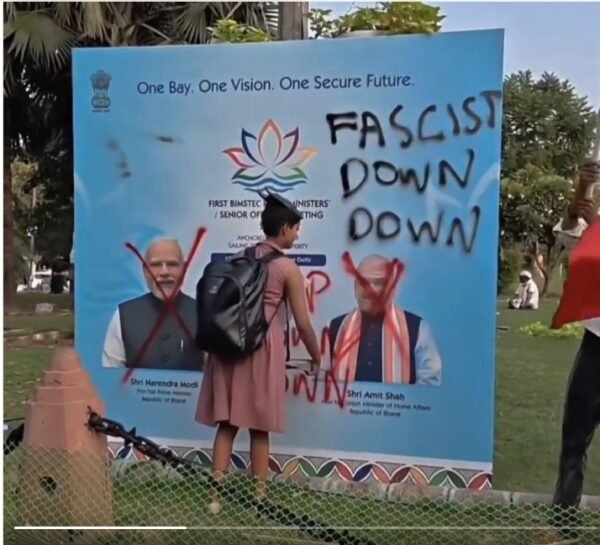
On October 12, Congress leader Rahul Gandhi, India’s main opposition leader, led a march to the Supreme Court of India, seeking the judiciary’s intervention in what he called the election commission’s loss of integrity.
The Chief Justice of India, Surya Kant, had declined to meet the opposition delegation, arguing that it would violate the principle of separation of powers. Yet tens of thousands of people, including opposition lawmakers, activists, and ordinary citizens, marched towards the apex court premises.
Monday’s protest march drew unprecedented crowds, despite the Narendra Modi government’s brutal crackdown on protestors calling for the resignation of Chief Election Commissioner (CEC) Gyanesh Kumar.
Kumar, the first CEC to be appointed under a new law that allowed the government to pick an election commissioner of its choice, has been at the center of political controversies since the launch of a Special Intensive Revision of the electoral roll last year that has left millions outside the roll, leaving them at the risk of disenfranchisement. Opposition parties have alleged pro-government bias on a range of issues related to election conduct, including targeted voter roll manipulations.
Over the weekend, India stood witness to some unprecedented scenes. Police in the national capital of New Delhi raided hotels, hostels, the offices of political parties, and the residences of activists in search of suspected protesters. The goal was to foil the satirical youth network Cockroach Janta Party (CJP)’s October 10 protest in New Delhi. The CJP too is seeking Kumar’s resignation.
The CJP’s protest at Jantar Mantar in Delhi in June-July resulted in Education Minister Dharmendra Pradhan’s resignation. This time the Modi government was determined to prevent the CJP protests on Saturday.
To this end, it turned Delhi into a fortress. The assembly of five or more persons was prohibited across large parts of the city, and an estimated 30,000 police and paramilitary personnel were deployed. Police reportedly asked hotel owners to refrain from accepting fresh room bookings from people coming to the capital. To prevent protesters from gathering in New Delhi, the government took the unprecedented step of suspending or diverting dozens of Delhi-bound trains. Metro rail station gates closed across the city from 9 pm on Friday. Metal barricades blocked most roads leading to the designated protest venue, Jantar Mantar, in central Delhi. Checkposts multiplied at the city’s borders and Internet access was restricted in central Delhi. Early on Saturday morning, the police boarded a flight as soon as it landed in New Delhi to detain three CJP leaders. On Oct 10, Delhi was a city under siege. Daily life in the capital was suspended to prevent one political gathering.
And yet, thousands of protesters hit the streets in different parts of Delhi on Saturday. Thousands were detained, including lawyers, journalists, legislators and four former chief ministers of different states from the opposition parties. The police clashed with protesters at different locations. Young people on the streets were indiscriminately detained. Many alleged police brutality. Leftist student organizations kept cops busy on the streets on Sunday.
Even a U.N. human rights spokesperson expressed concerns over the situation, prompting the Modi government to accuse the Office of the U.N. High Commissioner for Human Rights of bias.
The Modi government may have been able to prevent youth and student protestors from gathering at one place on Saturday. But its problems are far from over, as the INDIA bloc and the CJP will be holding a wave of protests not only in the national capital but in other major cities as well. Besides, almost all opposition parties have thrown their weight behind the protests despite their internal rivalries – even if only for the time being. This has complicated matters for the Modi government.
“How long will you keep Delhi locked down? The minute you open the barricades & send police off, protestors will come in. Nobody, but nobody, can stop us,” said opposition parliamentarian Mahua Moitra on the night of October 10. The “government will never be able to ‘normalize’ life again.”
Meanwhile, a Supreme Court bench has directed the authorities to review their use of barricades, ensure normal metro and railway operations, and keep internet services running except where its suspension is legally justified.
By Monday, the government had adjusted its tactics. Instead of a citywide shutdown, it closed entry and exit at six central Metro stations from 6 a.m. to 4 p.m. Delhi’s borders, railway stations, and bus terminuses remained tightly guarded. Traffic was diverted from selected roads. The government also denotified Jantar Mantar as a protest venue and designated three other places for protest purposes.
The CJP top leadership, who were released on Sunday, vowed to continue their protests. “If Modi thinks taking away Jantar Mantar [as a protest venue] will put an end to protests, he is mistaken,” said CJP founder-convenor Abhijeet Dipke, adding that Jantar Mantar was no longer just another location “but a spirit of resistance that nobody can ever take away.”
There does not seem to be an easy way out for the Modi government. It will not be easy for it to let CEC Kumar go. After all, Kumar is the Modi government’s appointee. Conceding ground here could encourage the opposition to aim higher next time.
On the other hand, if the opposition manages to maintain pressure on the government through intense and continued street protests, the credibility of the election commission could be further undermined in the eyes of the public.
The ruling Bharatiya Janata Party has alleged that anti-national and foreign-funded forces have joined hands to destabilize the country. “We will deal firmly with all such forces active outside or inside the country,” said BJP president Nitin Nabin.
With the administration designating new locations away from central Delhi as protest venues and the opposition announcing continued protests, the coming few weeks look set for tense conflicts.
