

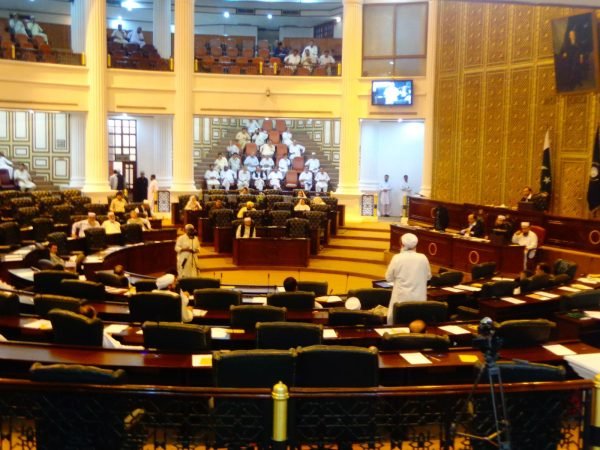
On October 11, Pakistan’s federal government imposed an emergency and governor’s rule in Khyber Pakhtunkhwa (KP) province, which was being governed by former Prime Minister Imran Khan’s Pakistan Tehreek-e-Insaf (PTI).
The move, which was approved by President Asif Ali Zardari on the advice of Prime Minister Shehbaz Sharif following a federal cabinet meeting, marks a decisive takeover by the federal government of a province that has long been a PTI stronghold. The federal government justified the decision by pointing to a sharp surge in terror attacks across KP, alleging that the provincial administration was obstructing counterterrorism efforts, failing to maintain public order and allowing militant groups space to operate.
The federal government invoked Articles 232 and 234 of the constitution, which grant extraordinary powers to the federal government over provincial affairs.
However, the two articles address different circumstances and operate within distinct mechanisms. For instance, Article 232 empowers the federal government to declare a state of emergency when security is threatened by war or internal disturbance beyond the provincial government’s control. Under this provision, the provincial assembly continues to function, but federal laws take precedence in cases of conflict.
On the other hand, Article 234 allows the president to impose governor’s rule when a provincial government is judged unable to function in accordance with the constitution. Once implemented, the article suspends the provincial cabinet, transfers executive authority to the federal government or the governor, and permits parliament to exercise the assembly’s powers.
By deploying the two articles together, the federal government has essentially neutralized PTI’s institutional presence in the province. Article 234 has removed the PTI provincial cabinet and chief minister, which has effectively cut the party off from the province’s administrative system, official resources, and day-to-day levers of governance.
Moreover, Article 232 has shifted key legislative and public order authority to the center and provided federal authorities with stronger legal tools to enforce order, restrict street mobilization and limit any form of organized political activity.
By invoking Articles 232 and 234, the federal government has made a comprehensive effort to deny PTI any realistic prospect of regaining political or institutional influence in KP province in the near term.
This institutional confrontation is the culmination of months of friction between the federal government and PTI. The current setup in Islamabad is governed by a multi-party coalition, which is led by Prime Minister Shehbaz Sharif of the Pakistan Muslim League-Nawaz (PML-N) and supported prominently by the Pakistan People’s Party (PPP) under President Asif Ali Zardari. It is pertinent to mention that after having assumed power following a highly contested election in 2024, the ruling coalition in Islamabad has remained engaged in an intense political feud with Imran Khan’s party.
The latest decision indicates that the relationship between the PTI-led provincial government and the federal government had become virtually unbridgeable.
From Islamabad’s perspective, the core dispute between the two sides centered on counterterrorism policy and the provincial government’s perceived defiance of federal priorities. It is important to note that security conditions in the province have deteriorated sharply in recent months with a marked rise in militant attacks.
Information Minister Attaullah Tarar on Sunday went as far as saying that the PTI-led government had developed a nexus with terrorist groups and that a “power-sharing formula was gradually taking shape between terrorists and the PTI’s KP government, which was starting from southern districts and was ingressing further into the entire KP.”
The PTI leadership has questioned these assertions, arguing that security concerns are being leveraged to justify political measures aimed at diminishing the party’s footprint in the province. Furthermore, PTI leaders maintain that the central government refused to adopt a consultative approach to address the militancy challenge and also consistently denied party leaders access to consult with Imran Khan, who is languishing in prison.
The timing of this development is significant for many reasons. The emergency measures were imposed as the PTI prepared a long march from KP to Islamabad, the national capital, to demand Khan’s release from prison. Moreover, the provincial leadership, particularly Chief Minister Sohail Afridi, have refused to come on board the federal government’s counterterrorism policy. This stance hardened in recent months.
For decision makers in Islamabad, the provincial government had become both a political irritant and a security liability that was obstructing coordinated action against the militancy emanating from KP, which has become a threat to national security.
Following the declaration of emergency, one of the central government’s first administrative steps has been to establish a direct administrative framework for KP’s border and former tribal districts. The federal government has approved the immediate establishment of an Area Development Secretariat, which will be supervised by an Area Representative and Development Council and covers Dera Ismail Khan, Tank, Lakki Marwat, Bannu, Bajaur, Mohmand, Khyber, Kurram, Orakzai, North Waziristan, and both Upper and South Waziristan. The ADS will be responsible for restoring law and order, protecting citizens, and ensuring governance and development.
Under this arrangement, civil administration, police and military coordination have been placed under a streamlined federal framework. It has created a more direct channel for Islamabad to manage high-risk districts. Moreover, this has also arguably reduced the scope for any future provincial government to impede security operations in these areas.
The move also carries clear external implications.
On Monday, KP Governor Faisal Karim Kundi stated that the days of lack of coordination between the center and the province on terrorism related issues are over, adding that “our policies will come from Islamabad … not Kabul, Jalalabad or Kandahar.” Arguably, Kundi’s statement was meant to emphasize that the state will not entertain dialogue or local deals with militant elements. By emphasizing that policy will originate from Islamabad rather than Afghanistan, he signaled that the federal government will no longer tolerate cross-border sanctuaries and will implement security policy unilaterally.
Kundi’s statement is important as it carries clear policy-level implications. If the new administrative framework is any indication, Pakistan is set to confront Tehreek-e-Taliban Pakistan (TTP) threats and presence in its border regions more forcefully than before, and will likely pursue an uncompromising approach toward the Afghan Taliban on issues of militancy, border management, and cross-border sanctuaries.
One can argue that while the PTI government in Peshawar had become a political problem for the center, it had also evolved, in Islamabad’s assessment, into a security challenge. The party’s resistance to the measures now being imposed in the former tribal districts was viewed as untenable by both the federal government and the military leadership.
For now, the federal government has imposed its will in the province. Whether the new direct-rule arrangement can deliver improved security and reduced terrorist threats will determine whether it ultimately gains public acceptance. The immediate challenge for Islamabad is to ensure that the policy it is seeking to implement actually produces results on the ground.
