

One year after the May 2025 conflict with India, Pakistan’s defence posture has evolved along two parallel, but mutually reinforcing, tracks. The first is the direct response to the lessons drawn from the conflict itself, and the second being the continuation of longer-standing structural changes in doctrine that were already underway prior to May 2025.1 The latter was principally driven from observing the Russia-Ukraine War, which has been taking place since early 2022. Furthermore, Pakistan can now source technologically advanced defence solutions at relatively accessible upfront costs, thereby removing the supply-side bottlenecks that have traditionally throttled Pakistan’s defence planning. China’s advancements and, as importantly, the industrial efficiencies driving them are feeding into every domain of Pakistan’s warfighting capacity, from satellites to guided munitions.2
Pre-war, the Pakistan Army (PA) began building its own precision-strike capability through the Fatah-I guided multiple-launch rocket system (GMLRS) and Fatah-II surface-to-surface missiles (SSMs), enabling it to conduct stand-off range strikes independently of the Pakistan Air Force (PAF), which was the sole service arm in earlier years capable of carrying out conventional attacks at long range.3 The PAF, drawing on its 2019 experience with Operation Swift Retort, was also focused on revitalizing its offensive air capabilities, with the Shenyang J-35AE stealth fighter earmarked as the focal point of those efforts. Finally, the Pakistan Navy (PN) had already understood that a large submarine fleet would be key to its anti-access and area-denial (A2/AD) posture, with plans to procure the eight Hangor-class boats in motion since 2015-2016. In fact, while Pakistan has activated new imaging satellites since May 2025, these solutions were all in the pipeline prior to the conflict.
Thus, Pakistan’s underlying modernization cadence was already steering it towards building effective targeting and precision-strike capacity. However, the conflict likely altered the direction or purpose of the procurement pipeline. Prior to May 2025, the Pakistani military was likely operating with the perspective that the next conflict with India would be similar to 2019, i.e., an exchange confined to an isolated theatre like Kashmir.4 Thus, the goal for Pakistan’s war planners was two-fold: First, to ensure that the capacity to undertake (or expand upon) Swift Retort-like counter-offensive strikes existed (with expansion coming through land-based capacity – i.e., Fatah). Second, to see if it was possible to deter the initial Indian ingression, hence the investment in the HQ-9/P and HQ-9BE surface-to-air missile (SAM) systems. The HQ-9BE in particular, with its 260-km range, could theoretically reach across the border, thereby creating a meaningful level of friction for the Indian Air Force (IAF) should it opt to carry out even stand-off range weapon (SOW) strikes from within India.
Overall, Pakistan’s planning from 2019 to 2025 had assumed a relatively slow conflict scenario with clear back-and-forth exchanges. Defensively, there needed to be enough to deter the initial action and, should that fail, the offensive side should initiate so as to create a strategic impact. That strategic impact may comprise degrading some Indian warfighting capacity, extensively damaging facilities, or achieving a limited level of air superiority across the Line of Control (LoC) – i.e., objectives that built on what the PAF perceived as its successes following Operation Swift Retort.
However, the May 2025 conflict bore out completely differently from the 2019 skirmish.5 Right from the onset, Pakistan and India collided with the employment of large-scale air power (i.e., 42 PAF fighters walling off 72 IAF aircraft), India struck urban targets within the heartland (i.e., Punjab), and, as crucially, the loss of fighters or assets did not stop India from continuing to escalate. Basically, the conflict was this fast-shifting, dynamic situation that would not stop with ‘perceptual’ damage (e.g., a loss of face from fighter attrition), but rather with the decapitation of the physical warfighting capacity. Indeed, in its later strikes on PAF bases, the IAF was likely aiming to achieve those outcomes.
Thus, the challenge has shifted from 2019 to 2025; now Pakistan’s goal is to, basically, degrade India’s warfighting capabilities as rapidly as possible. For Rawalpindi, there is likely no other way to credibly shorten a conflict (especially in light of a declining US- or international community-led de-escalation/intervention capacity) than to essentially cut the capacity India needs to escalate the fight. There is no other pathway to ending any conflict with India moving forward; India either fights or it does not, and Pakistan would have to force the latter through some means of its own. This is non-negotiable.
However, this is an insurmountable challenge for Pakistan, especially if Rawalpindi had approached it from a volume-centric standpoint. Past Quwa analyses had discussed at length the challenge of scaling munitions output, for example.6 So, to expect Pakistan to credibly saturate India with strikes at any level is grossly unrealistic. India’s geography is too vast, and Pakistan’s fiscal bandwidth is too thin. Of course, Rawalpindi is clearly trying to optimize (e.g., standardizing on the Fatah-II’s rocket core to develop SMASH and the new Abdali Weapon System, leveraging the AZB-series of range-extension kits for MK-80-series general purpose bombs, and enabling more numerous platforms, like the JF-17, to become long-range SOW-deployment assets) so that it can output more munitions and launch them from more places. Every strategy option requires Pakistan to deepen its munitions stockpiles, but the ceiling remains relatively low.
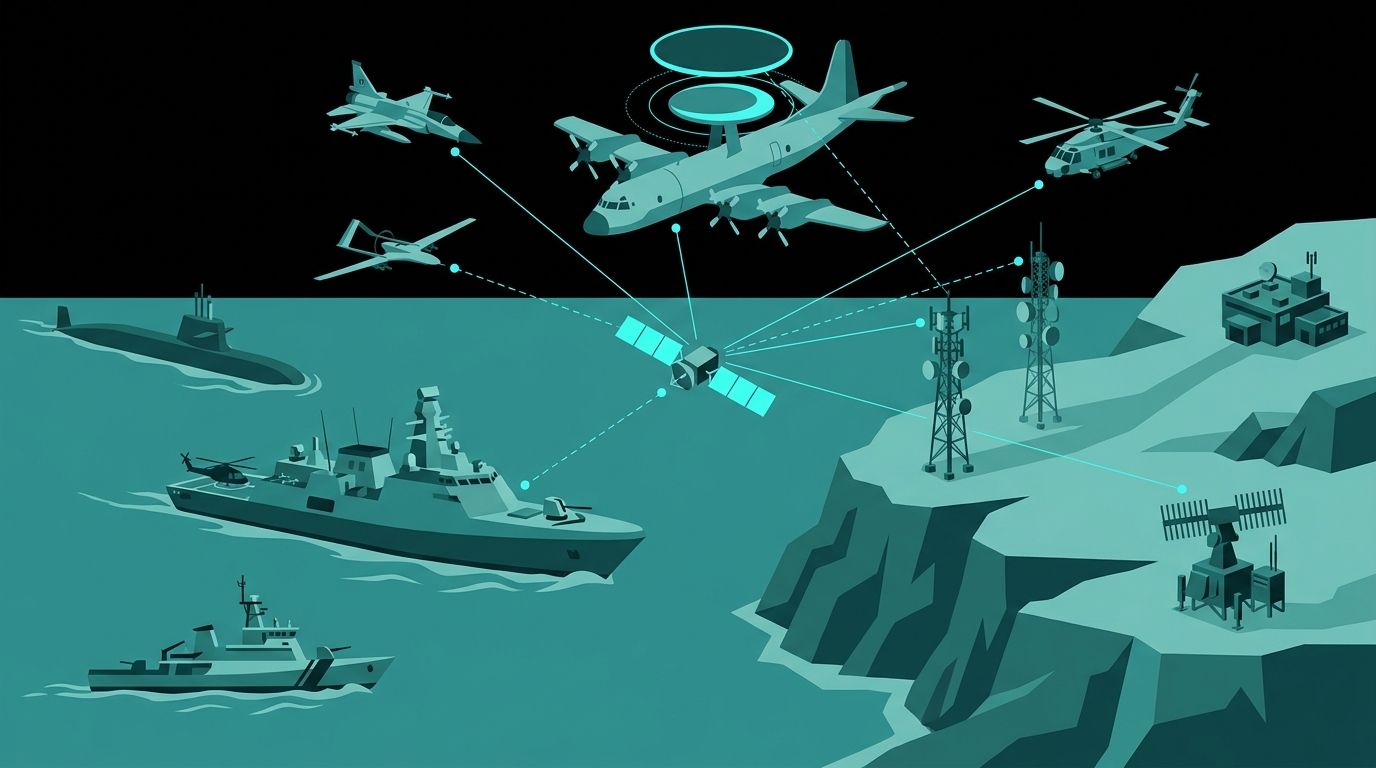
Now, with the goal effectively non-negotiable and the means limited, the Pakistani side needs to fully exploit the few levers it can control, such as the intelligence, surveillance, target acquisition, and reconnaissance (ISTAR) and battlefield management system (or BMS) mechanisms. With a relatively limited munitions stockpile in hand, Pakistan must ensure that, basically, as the adage goes, ‘every shot counts.’ The way to ensure this is to back every single targeting decision with layers upon layers of intelligence data, from satellite imagery to electronic signatures to radar feeds to video, and so on.
None of these data sources is new to Pakistan, but the procurement pipeline built before and after May 2025 is fuelling exponential growth in data accumulation from these sources. And, in tandem, there is a need (via the BMS layer) to ingest, parse, understand, and disseminate that data down to not only firing platforms, but in some cases (e.g., the cruise missiles) to the munition directly (so as to bind the value of the terrain-hugging capability with fresh terrain data). When one examines Pakistan’s new satellites, for example, one will see that the ISTAR work will envelop many layers and dimensions in the lead-up to target selection and strike execution.
Moving forward and until the next conflict, Pakistan will be executing a process of using its PRSC-S1 and, in the future, a 20-satellite interferometric SAR (InSAR) constellation to conduct routine, all-weather passes of pre-designated sites (such as, among others, air bases, SAM deployment zones, rail marshalling yards, etc.) so as to accumulate a baseline of what “normal” looks like across each.
SAR and InSAR will be used to detect millimetre-level anomalies relative to that baseline: fresh vehicle tracks, soil compaction from new launchers, and repeated heavy-vehicle patterns indicating resupply cycles.7
Once SAR flags a change, the three PRSC-EO satellites image the area at ~1 m resolution to provide visual context (e.g., distinguishing TELs from support trucks, counting aircraft on dispersal pads, and mapping spatial relationships between a system’s radar, launchers, and C2 vehicles).
