

LAOAG, Philippines—Just off the windswept beach, a camouflage-painted unmanned vessel reminiscent of a Chinese amphibious fighting vehicle advanced through the sapphire waters of the South China Sea.
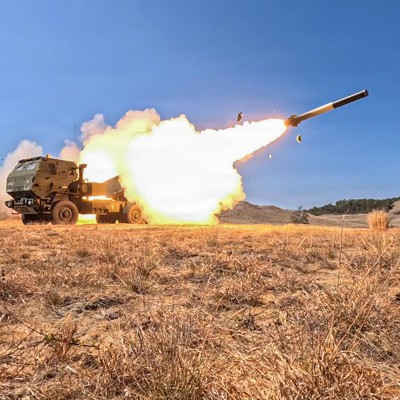
Drones buzzed ahead as American, Filipino, and Japanese soldiers waited nearby. Then two rockets whooshed from HIMARS launchers hidden in the sand dunes, heading out to target simulated enemy warships in deep water. The battle had begun.
This counter-landing live-fire training, performed less than 400 miles from the southern tip of Taiwan as part of the annual Balikatan military exercise, “is where you get to really prove if you can do what you say you’re going to do,” Maj. Gen. James Bartholomees, commander of the U.S. Army’s 25th Infantry Division, told a small group of journalists.
One of the things the 25th ID has said it will do is “synchronize sensing through fires in a coordinated manner against multiple adversaries,” Bartholomees said, from the brigade level to battalions, “down to companies, down to platoons, down to squads, into the individual foxhole.” But “the synchronization is not real until you can actually prove it with live munitions,” he said.
“This is the modernization of our Army. This is the modernization of joint forces. This is how we prevail in the Pacific under Adm. [Samuel] Paparo’s vision.”
Last month, Paparo, the leader of Indo-Pacific Command, told the Senate Armed Services Committee that the “strategy is clear: We must deny China the ability to achieve its objectives through military aggression while strengthening the network of alliances and partnerships that constitutes our greatest asymmetric advantage.”
He continued: “Credible, prompt and sustained combat power, visible across the Indo-Pacific region, will deter acts of military aggression that destabilize the region, undermine security and stability, and threaten the security, freedom, and prosperity of the United States.”
Here at La Paz Sand Dunes, the division’s artillery battalion worked in a small tactical operations center out of sight of enemy forces, using data from a Stalker long-range reconnaissance drone, multiple short- and medium-range loitering aerial drones, and unmanned surface vessels to coordinate fires from the battalion’s new HIMARS, one-way attack drones, 105-millimeter artillery, and more on targets in the air, on the sand, and in the water.
At the beach, automatic weapons and rifles peppered the shallows while longer-range munitions sent sprays of sea water and billowing gray smoke high into the air. Buzzing drones in orange and neon green, built in-house by the unit’s Lightning Lab, added to the cacophony as they drew incoming fire. Further out at sea, Apache helicopters and Navy and Air Force assets hunted robotic boats.
“When you think of the Army, you think of it as the land-based component. But here in the Pacific theater, we don’t have that luxury,” Col. Daniel Von Benken, the commander of 25th Infantry Division Artillery, told Defense One. “The Army has to compete and win in both environments, or help another service compete and win in another environment. So ‘maritime deep battle’ is trying to figure out, where do our echelons connect with joint services like the Navy and Marines? Where does it connect with our partner forces on the flanks, and how can we echelon onto a direct fire conflict? So what we’ll generally try to do is echelon our fires into the maritime environment and then shape an enemy to a favorable force calculus, onto a beach where we finish the job.”
Bartholomees called the Army “absolutely essential to the joint force in the Pacific.” He invoked the activation of the division just three months before Pearl Harbor was attacked in 1941, saying that since then, “we prepared to fight on islands, to lead from islands and to fight forward.”
This week’s exercise in repelling a force invading from the sea showed “our ability not only to control and fight through land with our allies and partners, but also to have effects and capability in all domains,” he said.
Von Benken noted that many of the weapons and drones used this year were new to the division since last year’s Balikatan, making the exercise a key experiment as the unit works to determine what is the “best solution in terms of massing fires.”
The pace of change can be breathtaking, but Von Benken said his focus is “really balancing the modernization piece with your core function, the core function at the end of the day being: Are you good at artillery? Are you good at infantry? Are you good at the combined arms fight? And if you never lose sight of that, the modernization won’t overwhelm you. It won’t make you feel like you’re off track. Bring yourself back to the center every time. ‘Can I shoot farther? Can I see faster? Can I sense faster?’ If the answer to that is ‘yes,’ put it back together with your core competency and move forward.”
