

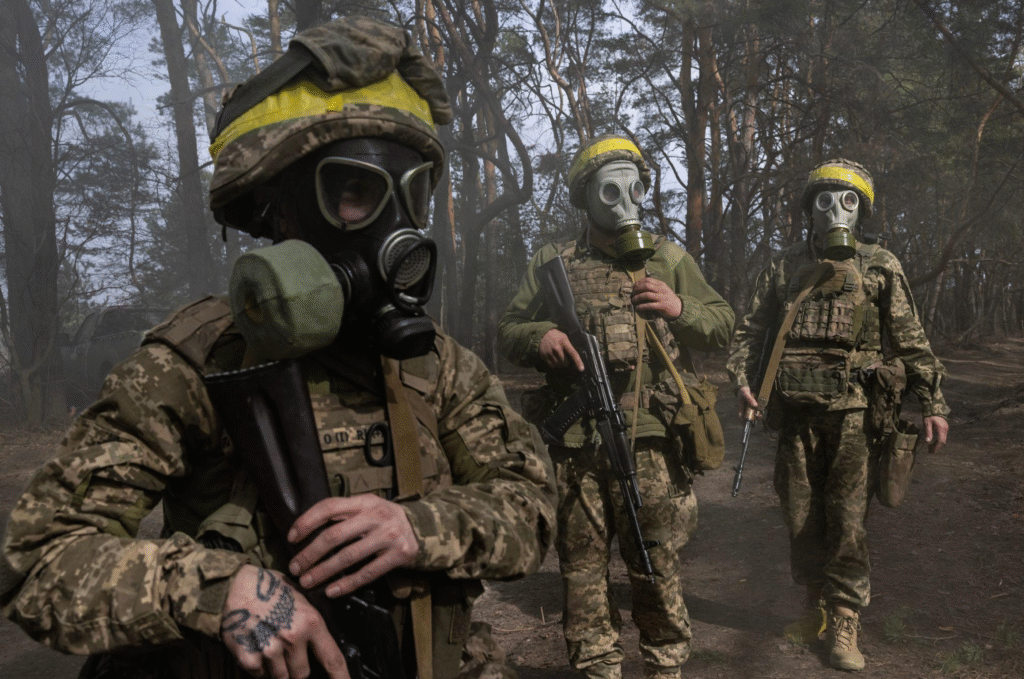
Britain and dozens of other countries have called for an international investigation to establish responsibility for Russia’s alleged use of chemical weapons in Ukraine.
The demands come as the Organisation for the Prohibition of Chemical Weapons (OPCW) faces a €20 million funding shortfall that could force the suspension of inspections and technical assistance programmes.
In a joint statement, non-proliferation directors representing countries including Britain, France, Germany and Japan, alongside the European Union (EU) and Ukraine, called on Moscow to cease using toxic chemicals and riot control agents against Ukrainian troops.
The intervention follows the publication of a Ukrainian investigation on November 17 attributing a chemical incident in the Dnipropetrovsk region in September 2024 to Russian forces.
Laboratories approved by the OPCW confirmed the presence of CS, a form of tear gas, in samples collected from a trench that Ukrainian authorities said had been struck by a Russian grenade.
The investigation, conducted under the supervision of Ukraine’s Office of the Prosecutor General, found that the munitions involved were mass-produced and concluded that the incident was not an isolated occurrence.
Ukraine claims to have documented more than 14,000 cases involving the use of munitions containing riot control agents and toxic chemicals by Russian forces since 2022.
The non-proliferation directors said: “We call for the immediate cessation of the use of any toxic chemicals and of riot control agents as a method of warfare in Ukraine.
“Next steps need to include the identification of perpetrators through the mechanisms of the OPCW and in line with the Chemical Weapons Convention. We reaffirm our strong support for the OPCW’s efforts in this regard.”
The OPCW, which oversees compliance with the Chemical Weapons Convention (CWC), has confirmed that the investigative procedures employed by Ukrainian authorities meet the standards used by the watchdog’s own technical secretariat.
While the organisation has independently established the presence of CS on the battlefield, responsibility for the September 2024 incident has been attributed to Russian forces by Ukrainian investigators.
The findings were circulated to the OPCW’s 193 member states ahead of the organisation’s annual conference in The Hague, which runs from November 23 to 27.
Addressing the conference, Philip Luxford, Director of Nuclear Protection at the Department for Energy Security and Net Zero, said: “The UK’s view is clear: the gravest threat to the Convention is Russia.”
Luxford cited previous poisonings involving Russian chemical agents, including the 2018 Novichok attack in Britain that led to the death of Dawn Sturgess.
The EU has also indicated that further sanctions could be imposed on those responsible for chemical weapons attacks in Ukraine.
An EU spokesperson said: “Without meaningful accountability, the Chemical Weapons Convention (CWC) and the global norm against the use of chemical weapons risk losing credibility.”
However, the international push for accountability comes as the OPCW struggles to secure sufficient funding to maintain existing operations.
OPCW Director-General Sabrina Dallafior told delegates that nearly a quarter of the organisation’s annual budget remained unpaid. The watchdog has exhausted its financial reserves of more than €8 million and risks entering 2027 with a deficit.
Dallafior said: “I have already directed all Secretariat divisions to pause operational activities from 01 December in order to take stock and revise our plans for 2027.”

Unless outstanding contributions are received, the organisation could be forced to suspend inspections of chemical facilities, technical assistance, some specialist missions and training programmes from January 01.
Reuters reported on November 23 that the United States, the OPCW’s largest financial contributor, had paid only 20 per cent of its €17 million annual contribution as of October.
A US State Department spokesperson told Reuters that Washington supported the organisation’s mission but expected efficient management of its budget.
The financial difficulties extend beyond Ukraine. The OPCW is also working with Syrian authorities to investigate and eliminate previously undeclared chemical weapons following the fall of Bashar al-Assad’s regime in 2024.
Dallafior also highlighted allegations of chemical weapons use in Sudan and Yemen.
Riot control agents can be legally used for domestic law enforcement. Their use as a method of warfare, however, is prohibited under Article I of the Chemical Weapons Convention, an international treaty that is legally binding on Russia.
Exposure to CS can cause severe irritation to the eyes and respiratory system, breathing difficulties and temporary incapacitation.
Three reports published by the OPCW between November 2024 and June 2025 confirmed the presence of CS in samples obtained from Ukraine.
Both Britain and the United States have previously imposed sanctions on Russian individuals and entities linked to the alleged use of chemical weapons in Ukraine.
Russia has repeatedly denied using prohibited chemical munitions and has accused Ukrainian forces of using chemical weapons.
Russian Ambassador to the OPCW Vladimir Tarabrin challenged the credibility of Ukraine’s latest investigation at the conference on November 26, questioning the authenticity of evidence contained in the report, according to Russian state news agency TASS.
The joint statement also called on Moscow to agree to an immediate and comprehensive ceasefire as a first step towards a just and lasting peace in Ukraine.
