

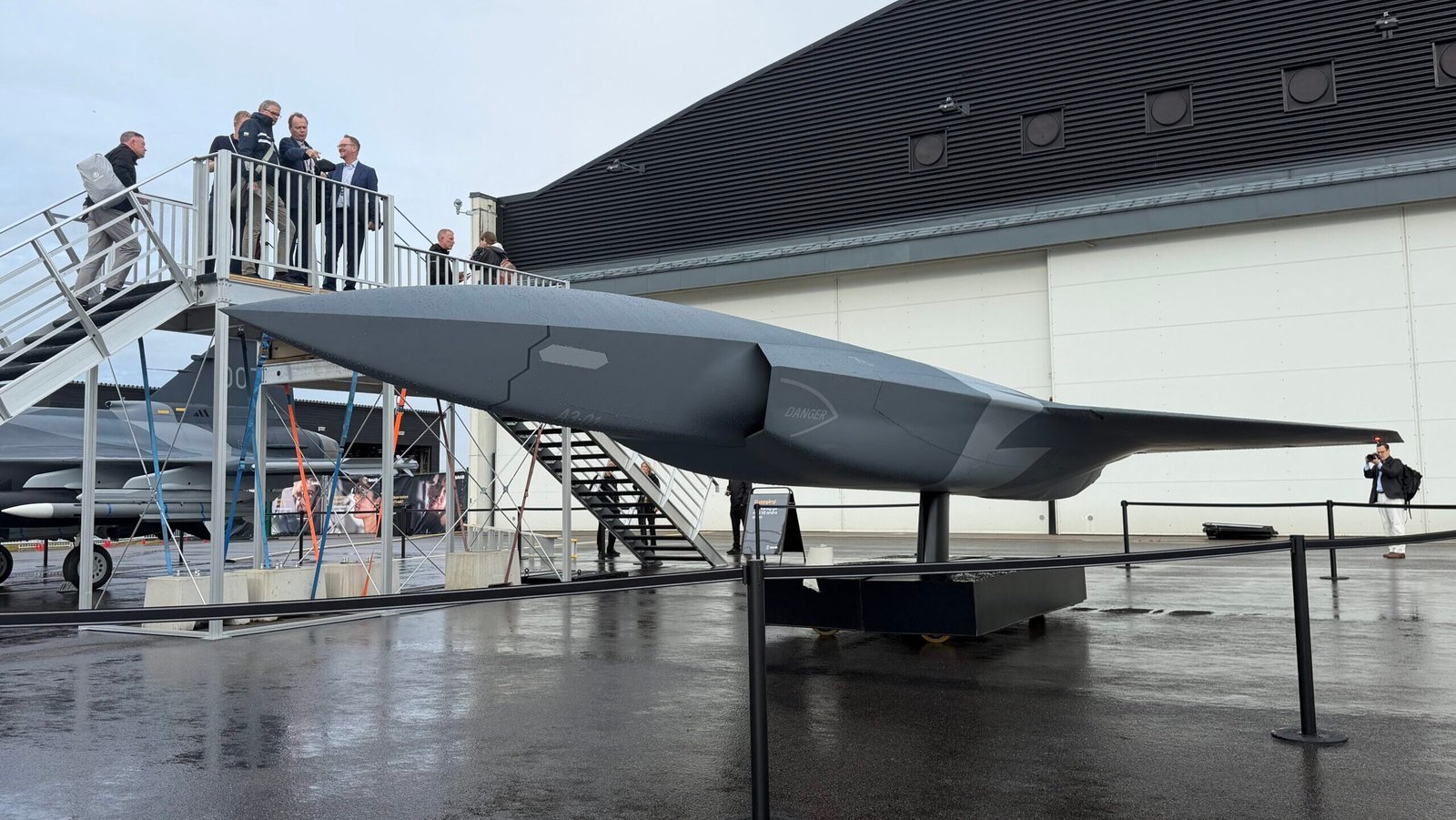
MALMEN AIR BASE — Saab is developing three unmanned aircraft — the A1, A2 and A3 — as stepping stones toward a potential new loyal wingman fighter system, the company announced Saturday during an air show for the Swedish Air Force’s centennial.
A decision on state funding for the A3 version has yet to be made, but Swedish Defense Minister Pål Jonson said he likes Saab’s approach.
“I think it would be a natural further development of the Gripen system to have a loyal [unmanned] wingman component that can perform deep operations together with the mother platform,” Jonson told Breaking Defense on the sidelines of the air show here outside the city of Linköping.
The A1 will be a supersonic demonstrator powered by an artificial intelligence-driven GE F414 engine — the same American engine used in the Gripen E/F. The A2 will feature an internal weapons bay. Both are expected to fly within four years, with the first within 15 months.
The A3, which Saab says may become the sales product, could enter service within ten years if the government decides to proceed with the aircraft. A full-scale model of the A3 was on display outside Saab’s hangar at the air show. While the aircraft are similar to the Collaborative Combat Aircraft (CCA) being developed by the US Air Force, Saab uses the term Autonomous Collaborative Platform (ACP) to describe their systems of this type.
Brig. Gen. Niclas Magnusson, Sweden’s deputy air chief, said he envisions “some sort of mix” between manned and unmanned assets in the coming years.
“I think we need both. And I think we need them also combined,” Magnusson said. “So I think that is the future, you know, mixed squadrons with both manned and unmanned. But it’s gonna be a few years ahead.”
One A3 is estimated to cost roughly one-third of a Gripen E on a lifecycle basis, and about half the cost initially of the Gripen E, Saab said during a media briefing.
In 2024, the Swedish Defense Materiel Administration awarded contracts to both Saab in Linköping and GKN Aerospace in Trollhättan for the “Combat Aircraft Path Selection” (Vägval stridsflyg) program. The work covers studies, technology development and demonstrator preparations to support a decision on securing Sweden’s fighter aircraft capability after 2040, when the Gripen E needs to be replaced or supplemented. Jonson said the Swedish parliament, known as the Riksdag, is expected to decide what to do between 2028 and 2030.
“We are working on it continuously,” he noted, pointing to a budget proposal from the Swedish Armed Forces and Defense Materiel Administration due next March, a state inquiry into industrial and defense policy, and input from a parliamentary reference group expected in September 2027. “It is intensive work,” he added.
Sweden’s accession to NATO has proved a boon for Saab.
The company now holds a backlog of orders worth 318 billion kronor ($33.6 billion), including three A26 submarines for Poland, 16 Gripen E jets for Ukraine, Canada’s and NATO’s selection of up to ten GlobalEye Airborne Early Warning and Control aircraft, and equipment for Germany’s new frigates, including combat systems, composite structures and sensors.
“I do not think NATO would have selected GlobalEye if we hadn’t been in the alliance. The same goes for a number of other contracts. I don’t think Poland would have chosen our submarines either,” Saab CEO Micael Johansson told reporters Saturday.
Additionally, last month Saab received an order for two GlobalEye aircraft from an undisclosed country in the Middle East — “A new country,” Saab said at a press briefing. The order is valued at 10.1 billion kronor ($1 billion) with deliveries scheduled for 2030.
The air show and 100th anniversary of the establishment of Sweden’s air force, underlined the changes that NATO membership has brought to Sweden — just a few years ago it would have been hard for many Swedes to imagine F-35s side-by-side with Gripens on a Swedish military tarmac.
But with almost two-and-a-half years of NATO membership behind it, Saab can now officially note that the Gripen has been interoperable with NATO since long before Sweden joined.
“In 2002, the Gripen C came out — NATO interoperable, fully NATO compliant — more than 20 years before Sweden joined the alliance,” the head of business unit Gripen, Johan Segertoft, said at the brief for the reporters on Friday, a head of the air show this weekend. “So the Swedish Air Force has operated alongside NATO much, much longer than we have been part of the alliance.”
