

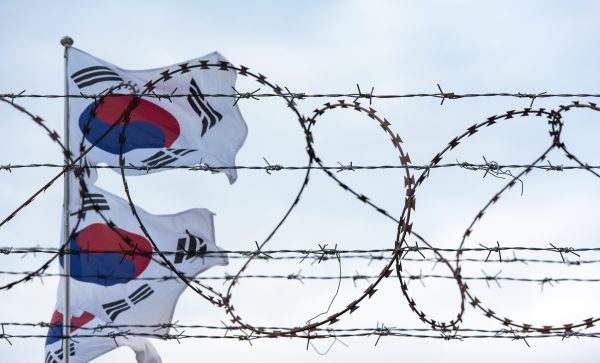
In the first week of June, two seemingly unrelated events took place in Seoul. On June 3, U.S. and South Korean officials met to discuss the implementation of South Korea’s civilian reprocessing and enrichment program. The same evening, Seoul’s conservative mayor Oh Se-hoon was re-elected. Coincidental though they may be, the events should serve as a reminder that South Korea’s nuclear and political futures are tightly intertwined.
South Korea’s Nuclear Future
In September 2025, the United States broke with a long-term policy practice and expressed support for South Korea’s ambitions to acquire uranium enrichment and reprocessing, intended to secure Seoul’s supply of nuclear fuel, and improve its management of spent fuel.
The announcement came as a big surprise. Ever since the United States uncovered South Korea’s secret nuclear weapons program in the 1970s, it had blocked Seoul from acquiring these technologies because they can also be used in nuclear weapons production. In April 2025, only a few months before the surprising announcement, the U.S. Department of Energy had designated South Korea a “sensitive country,” a designation usually reserved for nuclear proliferators like Syria, Iran, and North Korea. Ostensibly, the designation was the result of a South Korean national’s involvement in industrial espionage against U.S. companies. But members of the progressive Democratic Party (DP), in political opposition at the time, were quick to attribute it to the past few years of mostly conservative politicians calling for Seoul to acquire nuclear weapons.
What changed? In the intervening months, South Korea held a snap-election to replace the impeached president Yoon Suk-yeol, who had been the first South Korean president to broach the nuclear topic in public (statements he later walked back). The progressive Lee Jae-myung swept to victory in the June 2025 elections, and high-level members of his Cabinet swiftly set to the task of denying that South Korea would ever pursue nuclear weapons ambitions on their watch. In an essay for Seoul-based think tank Asia-Pacific Leadership Network, Foreign Minister Cho Hyun called non-proliferation “a strategic imperative” for South Korea.
Lee himself has argued in public, most recently on June 8, that South Korea would not be able to endure the international sanctions that would befall it if it were to go nuclear at some point in the future.
At the political level, the Lee administration has thus made extensive efforts to refute and tone down any talk of nuclearization. The president also enjoys historically high – if declining – approval ratings, and his party just took home 12 out of 16 mayoral and gubernatorial seats in recent local elections. Nuclear issues are admittedly far too niche to decide electoral outcomes in South Korea, but Lee would appear to have a broad mandate to shape South Korean nuclear policy well into the future.
But political winds can change fast in South Korea. And Lee may be sowing nuclear seeds in political soil that could yet shift rapidly under his feet.
South Korea’s Political Future
Such a shift may already be apparent from one crucial district that the DP did not carry in the recent local elections: the capital city itself. The conservative mayor of Seoul, Oh Se-hoon, beat Lee’s handpicked candidate to win his third consecutive term in office (and fifth in total).
Oh is a veteran politician, with a record of skillfully navigating the Korean political landscape and staging comebacks. He wisely distanced himself from former president Yoon and the infighting that followed his impeachment. Despite being seen as a promising presidential contender, Oh refrained from throwing his hat in the conservative race ahead of the 2025 snap election, recognizing that it was set to deliver an inevitable wipeout victory to the progressives. Instead, he stayed fast in his mayoral seat.
That strategy appears to have paid off. While he was widely predicted to lose his mayoral race, Oh made a late election night comeback, bucking the nationwide trend that routed conservative candidates in most other districts.
Oh’s victory should give pause to anyone who expects the progressive electoral successes to keep piling up in the years ahead. Recent history supports this prediction: The 2020 National Assembly elections were another landslide win for the DP, and nobody at the time would have predicted that a conservative candidate would win the presidency just two years later.
But Oh is not just a future presidential hopeful. He also has a mixed record as far as his views on South Korea’s nuclear future go. In 2019, he called for a “deeper discussion” on South Korea’s nuclear armament, and in 2023 explicitly called for South Korea to build nuclear weapons.
In 2024, he moderated his position somewhat, calling for South Korea to increase its nuclear latency. This position – toward which the nuclear debate gravitated during the final year of Yoon’s presidency – would have South Korea develop enrichment and reprocessing to a point where it could quickly make a nuclear weapon if doing so was deemed necessary. However, as Toby Dalton and Adam Mount have pointed out, the position is in practice indistinguishable from one holding that South Korea must develop enrichment and reprocessing for civilian use.
And herein lies the issue: the nuclear technologies developed today for peaceful purposes may be applied for non-peaceful uses in the future. The deciding factor is not the technologies themselves, but the policymakers who infuse them with intent.
How to Lock in South Korea’s Non-Proliferation Status
South Korea’s nuclear and political futures are far from written in stone. But it is virtually certain that, at some point in the next decade or so, South Korea will acquire enrichment and reprocessing capabilities. And at some point, before or after that, a government more willing to explore the path to a weapon will inevitably take power again. Before that happens, the political leaders of today must make every effort possible to commit the governments of tomorrow to non-proliferation.
The most straightforward course of action would be for South Korea to renounce its pursuit of enrichment and reprocessing. It could find alternatives to Russian and Chinese uranium, and other solutions for spent fuel storage that don’t require reprocessing.
But that is unlikely to happen. South Korea has pursued these capabilities for years and is unlikely to give them up now. If the United States were to backtrack on its promise, it might cause a crisis of confidence in the alliance relationship and exacerbate the situation further, strengthening the hand of those who would argue for independent nuclear capability.
Yet, the very existence of enrichment and reprocessing capabilities is – by definition – a nuclear latency concern. South Korea should thus seek to provide as much assurance as possible that it will not, at some point in the future, use these capabilities to build a bomb. These assurances can never be perfect, but a sufficient number of them can add up to make proliferation prohibitively costly. Dalton and Mount call this “active non-proliferation.”
These measures could take many forms. Crucially, they should not just be political declarations, but technical and legal measures that cannot be swiftly reversed, or commercial and diplomatic arrangements that would create path-dependencies too costly to undo. The Lee administration’s decision to use U.S.-sourced low-enriched uranium in South Korea’s future nuclear submarines (another surprise announcement) is an example of such an arrangement.
South Korea’s export of nuclear reactors is another form of implicit assurance: every additional reactor that South Korea exports, and every memorandum of understanding on nuclear energy that it signs with another country, raises the cost of going nuclear even further.
But South Korea could and should do more. It needs to consider carefully where to locate its enrichment facilities, to which level to enrich uranium, and whom to do it with. It must recognize that there is a trade-off between proliferation assurances and “nuclear sovereignty.” For example, Seoul should avoid any arrangement where it would independently enrich uranium to a high level at facilities on Korean territory, but rather seek pathways that enhance transparency and international scrutiny, such as black-boxing technology abroad. At the same time, South Korean lawmakers should further seek to encode peaceful use of nuclear power into law and explicitly ban proliferative activities.
There is an emerging but insufficient discussion in South Korea on how to credibly assure the international community that a future government will not one day use its future enrichment and reprocessing capabilities to build nuclear weapons. The Lee administration’s public declarations forswearing nuclear weapons are welcome but would be even more so if coupled with comprehensive efforts, from both the president and his party, that could demonstrate to the international community that South Korea’s non-proliferation status will be maintained indefinitely.
