

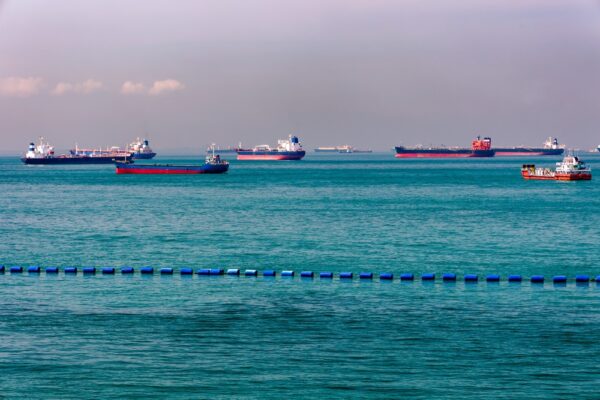
East Asian manufacturing hubs from the Pearl River Delta and Yangtze to the Pacific Belt along the coast of Japan have driven global growth, producing the majority of the world’s goods and accounting for 17 percent of global trade. Global consumer demand has increased output, which in turn has required greater procurement. East Asia is the world’s largest oil-importing region and brings in massive amounts of raw materials for refinement and manufacturing. But dynamics are changing. The powerhouses of production are slowly moving from East Asia to the south. The supply chain is reconfiguring, empowered by ASEAN and China’s slowing growth. Energy logistics companies like BGN Group and Glenfarne Group tangibly reveal the changing nature of supply and demand, as they reroute the underlying sources of power to the region to support increases in industrial output. “Expanding our LNG business is an important part of BGN’s global growth strategy, and we are pleased to have signed this HoA with Glenfarne Global Commodities,” said Wael Amer, BGN Group’s chief operating officer, after striking the deal in early July.
Lower LNG and LPG flows to China have been matched by more imports to ASEAN countries. Furthermore, the Chinese consumer class has ballooned, demanding more imported goods and fewer domestically produced ones. The growth in middle-class spending within China, combined with geopolitical reconfigurations, has subtly moved manufacturing southward.
China has invested heavily in its Pinglu Canal in the south, flowing into the Beibu Gulf. The project will allow 5,000-ton ships to travel from deep inland all the way to the sea, reducing shipping times from weeks to a few days. Along with the Hainan Free Port, which is set to be the largest in the world, these projects consolidate China’s role in ASEAN trade; however, the real growth is now coming from farther south. In fact, over the last few years, the China-centric model has transformed into a multimodal supply chain, diversified by rising players like Vietnam and Thailand. Vietnam has become a leader in electronics assembly, Thailand has turned toward automotive EVs, Indonesia has rapidly scaled battery production, Malaysia is growing as a semiconductor distributor, and Myanmar is set to transform regional logistics through its Kyaukpyu Deep-Sea Port.
S&P Global noted the shift, forecasting slower Chinese growth alongside rising Southeast Asian and Indian growth. These economies are now driving new demand and are likewise facing new tests that could shake progress. The closure of the Strait of Hormuz, for example, came as a major challenge, since Southeast Asian industry fundamentally relies on crude oil, LNG, LPG, and helium from Qatar and the Gulf region. China managed to weather the initial supply shock, but Southeast Asia has experienced severe price variability, leading to factory shutdowns, job losses, and increased fear. Furthermore, the Strait of Malacca carries up to 40 percent of global trade, and economies rely heavily on free-flowing maritime goods. Agile companies have managed to avert some shocks through arbitrage or more sustainable fuel sourcing. BGN Group, for example, uses dual-fuel carriers to mitigate price instability in emerging markets. Nonetheless, risks to growth and stability are now more apparent than ever. Bloomberg has argued that imports may never recover. Yet there is evidence that diversification and growth will continue through a more robust Southeast Asia, increasingly connected through reduced trade barriers within ASEAN.
One clear market indication of resilience has been the growing regional demand for very large gas carriers (VLGCs). These ships are crucial for transporting transition fuels like LPG and LNG. Shipbuilders continue to receive orders for these massive vessels even in the midst of Middle Eastern geopolitical strife. Market makers with a long-term outlook are clearly treating the supply shock as temporary and are anticipating the continued expansion of Southeast Asian markets. South Korea’s KSS Line, for example, has contracted HD Hyundai Heavy Industries to build three dual-fuel LPG VLGCs. These 90,000 m³ vessels are set to begin voyages in 2029. Greek company Capital Clean Energy Carriers has also been recruited to build vessels for the Southeast Asian supply chain. The company focuses on dual-energy ships that can handle fluctuations in energy markets, reducing costs and emissions by up to 40 percent.
Worldwide, there are only roughly 157 LPG ships, yet by 2028, this number is expected to grow by 111. This 71 percent increase within two years pairs with growth in port infrastructure and regasification units throughout the region. BGN Group has further growth plans, announcing three new Asia-wide shipping agreements through the Japan-South Korea corridor, Myanmar’s dry-port hub, and the India-Southeast Asia loop. These will add 1.2 million TEU of capacity to the supply chain. While BGN Group currently owns 19 LPG vessels, it is growing rapidly, with six more new vessels commissioned. Aegean Shipping Management, likewise, unveiled two new supertankers for the Asian market earlier this month at Posidonia in Athens. These investments substantiate the forecasts for growth.
Supply chain infrastructure is coming together in Southeast Asia, and it is doing so with slight but important changes from earlier periods of growth. The ASEAN framework is optimizing comparative advantages, and companies are incorporating advances in technology and green energy to drive development. Dual-fuel VLGCs, carbon-neutral shipping, and eco-friendly port practices are becoming new features of demand-driven growth. The Laem Chabang Port in Thailand, for example, has transformed its management practices to reduce emissions and costs, while Singapore’s port and logistics zones have introduced solar energy and new waste management technologies. Southeast Asian growth fundamentally includes a turn to new green technologies, a fact that signals sustainable market forecasts and will position the region as critical to the global trend toward emerging energy sources.
The evidence is apparent. Are companies betting that conflict in the Middle East will be temporary? Not necessarily. Even with geopolitical and supply chain shocks, Southeast Asia’s industry will continue to grow. Logistics infrastructure is already preparing for the shift, and, in the long term, the region will be much more resilient. The U.S. has already authorized Iranian oil sales, and LPG and LNG supply chains have been given appropriate time to diversify away from the Hormuz chokepoint. The economic upside is projected at a 5.82 percent CAGR in cargo value, rising from $305 billion today to $406 billion by 2031. This captures a significant portion of the global economy, creating thousands of new jobs and billions of dollars in regional GDP growth. For resilient and integrated growth capable of handling supply chain shocks, Southeast Asia will need more bilateral maritime cooperation, multilateral digital trade standards already initiated through the ASEAN Single Window, and regulatory convergence. The makers of this future, the shipping and logistics companies, have already begun investing in real steel, charting a course toward greater global cooperation.
