

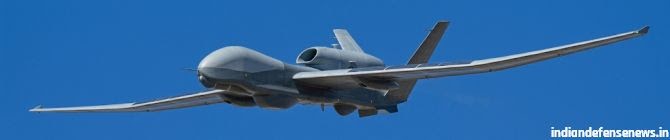
Ten Indian defence firms, including HAL, TATA Advanced Systems, and Larsen & Toubro, have submitted bids for the ₹30,000 crore project to supply 87 Medium-Altitude Long-Endurance (MALE) drones to the Indian Air Force.
This marks one of the largest indigenous UAV procurements in India’s history, aimed at reducing reliance on foreign suppliers and integrating advanced surveillance and strike capabilities with indigenous missile systems.
The Defence Ministry confirmed that the last date for bid submission was 16 June 2026, with around ten public and private sector firms participating. The companies include Hindustan Aeronautics Limited, Solar Defence and Aerospace Limited, Adani Defence Systems Limited, TATA Advanced Systems Limited, Larsen & Toubro, Raphe mPhibr Ltd, and others.
This broad participation reflects the growing strength of India’s defence-industrial base and its ability to take on complex unmanned systems projects.
The project, valued at over ₹30,000 crore, was cleared last year under the Indigenously Designed, Developed, and Manufactured (IDDM) category of the Defence Acquisition Procedure.
The Defence Ministry extended bid submission timelines twice to allow firms to prepare comprehensive responses, underscoring the scale and complexity of the programme. The acquisition aims to promote Indian manufacturers and establish a robust domestic ecosystem for UAV production.
The 87 drones will be equipped with advanced surveillance and combat features. These include real-time intelligence, surveillance, and reconnaissance (ISR) capabilities, synthetic aperture radar, electro-optical payloads, secure communication links, and satellite communication systems.
Plans are also in place to integrate indigenous missile systems, enabling precision strike missions against high-value targets. This integration is expected to significantly enhance India’s tri-service capabilities across land and maritime domains.
The armed forces finalised specifications for the drones through a detailed scientific study, highlighting the urgent need for effective surveillance along India’s borders with Pakistan and China. Persistent monitoring of high-altitude regions such as Ladakh and Arunachal Pradesh, as well as maritime surveillance in the Indian Ocean, are key operational requirements.
Until now, India has relied heavily on foreign suppliers, particularly the United States and Israel, for UAVs. This programme represents a decisive shift towards self-reliance.
Industry experts note that the procurement structure may involve splitting the order between two successful bidders, creating dual production lines. This approach would reduce supply-chain risks, preserve competition, and allow rapid scaling of production during contingencies.
The initiative aligns with India’s Atmanirbhar Bharat vision, mandating high indigenous content and fostering collaboration between established defence firms and emerging private players.
The significance of this programme extends beyond immediate procurement. Modern conflicts in Europe and the Middle East have demonstrated the centrality of drones in contemporary warfare, from persistent surveillance to precision strikes.
India’s armed forces are keen to replicate these capabilities, ensuring that unmanned systems become integral to future operations.
The project also positions India as a potential exporter of MALE-class drones to friendly nations in Asia, Africa, and Latin America.
This procurement comes amid heightened security challenges, including tensions along the Line of Actual Control with China and infiltration attempts across the Line of Control with Pakistan.
The drones will act as force multipliers, providing persistent surveillance and strike options that enhance deterrence and operational readiness. The program is expected to be a cornerstone of India’s unmanned warfare roadmap, with projections suggesting future demand could rise to 350 units.
ANI
