

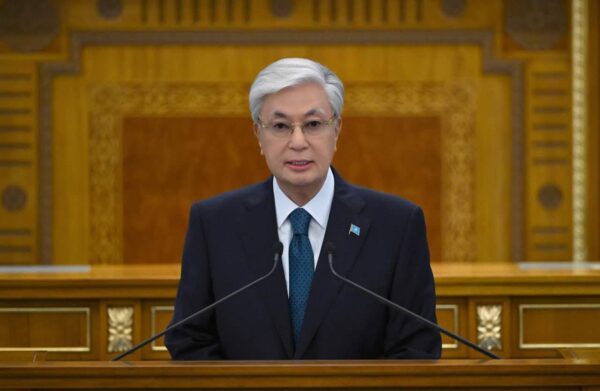
So, he’s running. Or he can.
On July 7, Kazakhstan’s Constitutional Court weighed in on whether senior officials who are subject to term limits – like the president – could be re-elected or re-appointed to those same positions under the new constitution, which went into effect on July 1.
Their conclusion: yes.
Kazakh President Kassym Jomart Tokayev is not the first president in Central Asia to benefit from creative constitutional reinterpretations in the wake of a referendum. Uzbekistan’s first president, Islam Karimov, was elected four times despite the two-term limit in the Uzbek Constitution. Via referendums, Karimov’s administration moved elections to extend his term, and in other instances tinkered with the length of the presidential term, followed by an argument that such an adjustment re-set the clock on the number of terms.
Kazakhstan has done much the same.
Tokayev was first elected in a snap presidential poll in the summer of 2019, following Nursultan Nazarbayev’s surprise resignation that spring. He could have served out Nazarbayev’s term and then headed for an election to his own five-year term, but Tokayev likely felt the need to set his own mandate as soon as possible. At the time, Kazakhstan’s presidency was limited to two five-year terms.
Barely three years in, however, the events of Qandy Qantar, or Bloody January, injected new urgency in the Tokayev government’s need to cement its position. That summer, Kazakhstan voted in a wide-ranging constitutional referendum, which adjusted about a third of the 1995 Constitution’s articles. Beyond changes meant to “de-Nazarbayev” the constitution – dropping mentions of “elbasy,” or leader of the nation, and his specific protections – the referendum ostensibly aimed to restrict the power of the president.
At the time, Tokayev boldly addressed questions of whether he would extend the presidential term via referendum, or abolish term limits.
“Let me answer: I have never had such an idea and will never have it,” he said at the time.
Later that year, Tokayev announced a snap presidential election, 18 months early. He paired that announcement with another proposal: limiting the president’s term to a single seven-year stint.
“[S]even years is a sufficient period to implement any ambitious program,” he said.
A bill was swiftly drafted, passed, and signed into law that changed Kazakhstan’s presidential limits from two five-year terms to a single seven-year term. Arguably, in passing that change before holding an election, Tokayev was setting that limit on himself.
In November 2022, Tokayev was elected to his second term, extending his stint in power through 2029. Combined with his partial first term, that would grant Tokayev a full decade in power. Plenty of time, by his own words, to implement any ambitious program.
Tokayev’s tinkering continued, however. Six months after commenting that haste in changing the constitution again was “completely inappropriate,” Astana held another constitutional referendum earlier this year. The March 2026 referendum addressed almost every aspect of the document, effectively replacing the 1995 Constitution, which Nazarbayev and Tokayev had both fiddled with repeatedly over the years but never wholly replaced.
The new constitution came into effect on July 1 and Tokayev asked the Constitutional Court to clarify what it meant for re-election, or re-appointment, of term-limited officials, as well as the implications for the timeline on elections.
The answer: a clean slate.
Although Tokayev and his camp have maintained that the president intends to serve out his seven year term, the door is now open for an extension. If Tokayev were to run for election in 2029, and win, he could serve until 2036 – 17 years from when he took up the presidency in 2019. And that’s without considering an early election or further adjustments. The goal posts can always be moved.
There is, however, a hard upper limit on how long any man can stay in power. Tokayev is 73 years old now. It’s entirely possible he will live to an even riper, older age, but by 2036 he’ll be 83.
