

An underwater drone, powered by a highly specialized lithium-ion battery, plied the depths of Narragansett Bay off Rhode Island last summer. Its mission: to search for targets mimicking explosive sea mines like those recently deployed by Iran. It is a uniquely demanding and dangerous task that requires specialized battery cells to operate safely for longer duration and at higher power densities than conventional batteries.
At strategic locations across the United States and overseas, from ports of entry and border crossings to high-profile events like the Super Bowl and World Cup, radiation detectors with a unique optical warning and location technology scan for nuclear material that could be smuggled by terrorists. Its distinct advantage over other systems: the capability to reject alarms from naturally occurring radioactive material, while detecting real threats, even when highly concealed or masked.
These critical technologies – the cells powering the Navy’s Barracuda Mine Neutralization System and the spectroscopic gamma detection systems that make up part of the nation’s nuclear trip wire – were not just plucked off the shelf. Nor were they brought to market by Silicon Valley start-ups that commonly seek to quickly turn innovative ideas into products they can sell on the commercial market at a massive scale.
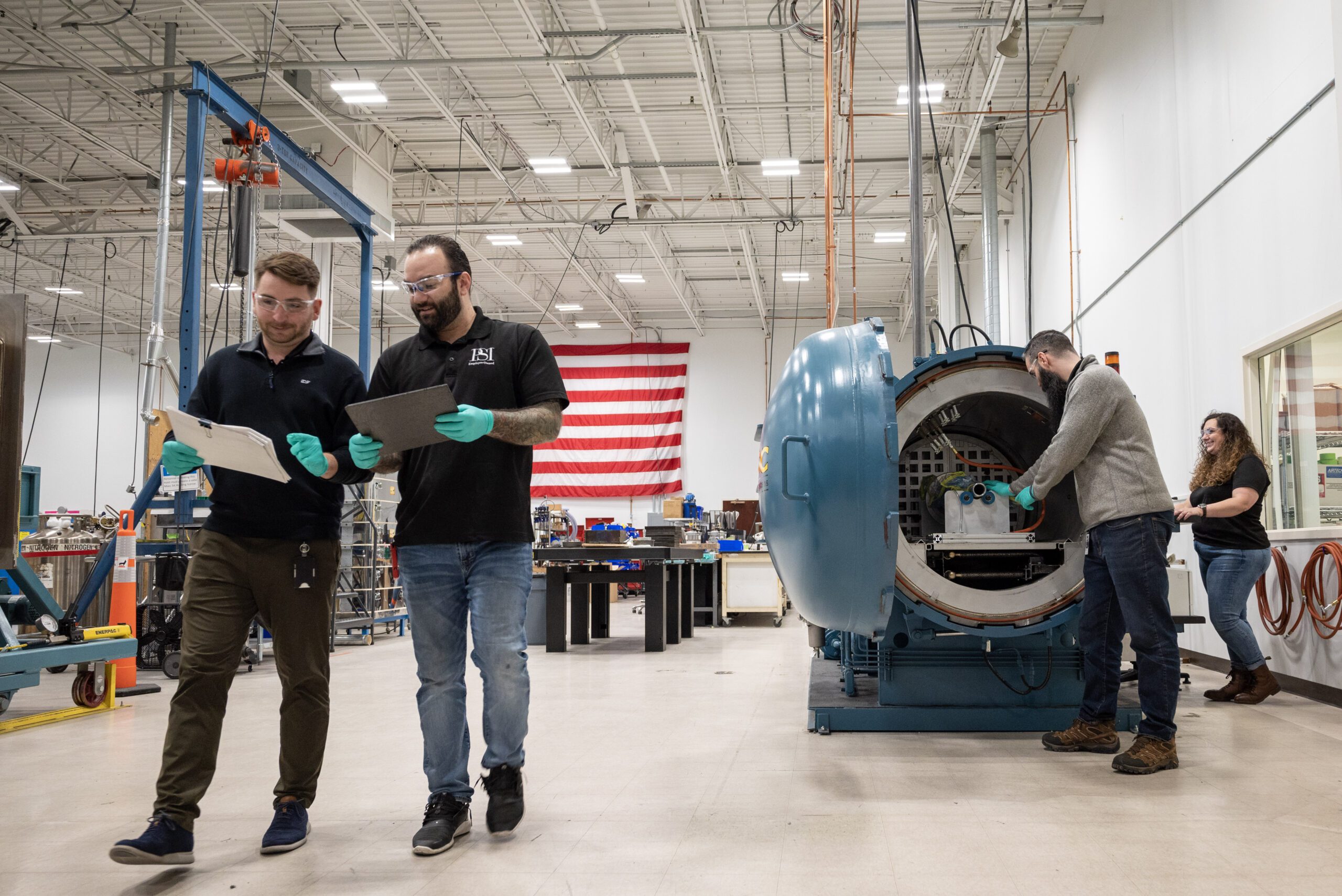
Their development was spearheaded by Physical Sciences Inc., an employee-owned small business in Andover, Massachusetts, that specializes in defense technology. They required painstaking development and design, in partnership with multiple federal agencies, labs, and prime contractors. They underwent a series of feasibility demonstrations, advanced prototyping, and rigorous testing up to a decade before they could be transitioned into production and integrated into larger platforms to carry out some of the most difficult national security missions.
But they would not have been possible without the Departments of War and Homeland Security leveraging the Small Business Innovation Research (SBIR) program, the four-decade-old investments in small business R&D.
While Physical Sciences doesn’t make major weapon systems or platforms, it makes many of them possible as a critical but often unseen domestic supplier of specialized, highly sensitive technology not available in the commercial domain but vital to our industrial base. Many go unmentioned altogether because of the sensitivity of their applications.
To do so PSI works with SBIR program managers, government acquisition offices, and prime contractors and it invests its own money in research, security protocols, and manufacturing capacity to scale production of these technologies.
The SBIR program allows PSI to go from concept to prototype to production and to reduce risk at the early stages of development. It has a track record that provides confidence to government program managers that it has a partner for their larger platforms throughout their lifecycle, and not only if it can secure its next round of venture capital funding.

PSI’s employee ownership model also enables it to be its own investor. That means addressing highly specialized government technology needs with timelines much longer than what is acceptable to VCs – and without the onerous debt levels imposed by private equity. Rather, PSI’s investment horizon is marked by the careers of its employees, for which their ownership is a retirement benefit.
Recent investments by PSI in national security technology development span a broad range of disciplines, including:
- A 67,000 square foot, $30 million battery production facility acquired from a startup that moved its production overseas and is being repurposed to produce specialized energy systems for the Navy. It supports the Barracuda and a new generation of anti-submarine mines being developed with multiple industry partners that will provide the Navy with enhanced capabilities to detect, track, and engage undersea threats. This investment enables scaling of PSI’s production capability a hundred-fold.
- A 30,000 square foot facility to produce high-temperature ceramic matrix composite components for hypersonic missiles in much shorter production cycles, at lower cost, and with higher temperature performance than conventional methods.
- A 25,000 square foot facility to produce mobile, fixed, and soon -to-be rail-based radiation threat detection systems. These systems are built from the ground up, using U.S.-sourced components, and rigorously tested with licensed test and evaluation capabilities.
Other new investments underway by PSI include:
- A recently completed electrochemical R&D and production facility to provide the polishing and finishing required for 3-D manufactured metal parts.
- A $9 million investment in a 6,000 square foot chemistry scale-up facility and a 12.5-acre Department of War-certified energetics production and test facility to enable domestic production of advanced propellants, rocket motors, and related components.
- A $6 million investment in a prototyping and production facility for semiconductor-based structured optical components operating in key infrared bands to reduce the weight, cost, and supply chain risk associated with conventional Germanium optics in military imaging systems.
The SBIR program continues to pay dividends for our collective defense, and for taxpayers. It is relying on an ever-broader set of companies and startups with innovative new ideas and technologies that our nation needs. But many small companies have limited experience working with national security agencies and procurement offices. Others are also not well positioned to develop and scale some of the extraordinarily unique technologies that national security and law enforcement agencies demand. PSI has demonstrated the ability to overcome those barriers across multiple technologies.
Physical Sciences and its 250 employee-owners have demonstrated they are in it for the long haul – and they have the technology transition record to prove it.
The Pentagon recently called the SBIR program “a cornerstone of defense innovation” and declared it is now focused more than ever on “prioritizing the fielding of critical capabilities at scale.”
That is PSI’s mission. It offers acquisition program managers and their prime contractors a trusted and highly capable partner to conceive, create, and deploy the next-generation technologies that our military and law enforcement personnel need to confront the challenges of today and tomorrow.
