

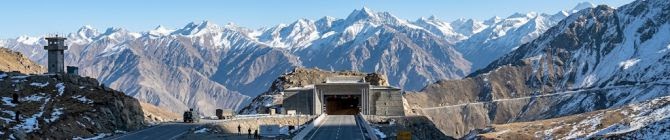
This marks the completion of India’s longest road tunnel and the world’s longest bi-directional road tunnel at such altitude, standing at approximately 11,578 feet.
While the achievement is celebrated as an engineering marvel, its strategic significance for India’s defence and logistics is far greater than its civilian utility.
The Zojila Pass, located at around 11,500 feet on the Srinagar–Leh highway, has historically been a lifeline between Kashmir and Ladakh. Every winter, heavy snowfall, avalanches, and landslides shut the pass for months, isolating Ladakh from the rest of India.
For civilians, this meant delayed supplies and isolation. For the military, it posed a critical challenge in sustaining deployments against Pakistan and China. Defence planners have long considered Zojila not just a road project but a strategic necessity.
The tunnel itself is a 13.153-kilometre single-tube, two-lane structure designed in a horseshoe shape, 7.57 metres high, capable of supporting two-way traffic year-round. The project includes four bridges totalling 910 metres, additional Nilgrar tunnels, eight cut-and-cover tunnel sections spanning 2.35 kilometres, and three massive ventilation shafts reaching depths of 480 metres, 385 metres, and 213.5 metres.
The estimated cost has risen to over ₹4,600 crore due to design changes and inflation. Though discussions began in the mid-2000s, the foundation stone was laid in 2018. After delays caused by financial troubles and redesigns, Megha Engineering & Infrastructure Limited (MEIL) took over in 2020, with major construction commencing in 2021.
Building under Zojila presented unique challenges. The Himalayas are geologically young, unstable, and prone to fractures, water ingress, and sudden pressure changes. Engineers faced avalanche-prone terrain, extreme cold, seismic Zone IV conditions, and high-altitude health risks.
Winter temperatures dropped to minus 18 degrees Celsius, while snow accumulation disrupted work. Machinery lost efficiency, concrete curing became complex, and human endurance declined. Every metre excavated required meticulous planning.
The New Austrian Tunnelling Method (NATM) was employed, allowing engineers to excavate small sections, monitor geological conditions, and reinforce surfaces immediately with shotcrete, rock bolts, and steel supports.
This flexible approach was essential in the Himalayas, where conditions can change dramatically within metres. Around 1,200 engineers, mechanics, technicians, and labourers worked simultaneously from both ends, enduring snowstorms, sub-zero temperatures, and high-altitude sickness risks. The breakthrough was the culmination of years of surveying, blasting, stabilisation, and safety engineering.
For tourists, the tunnel promises faster and safer journeys to Ladakh, reducing travel time across Zojila from three hours to just 20–30 minutes. For the Indian Army, however, the tunnel eliminates one of the country’s most significant logistical vulnerabilities.
It ensures year-round connectivity, enabling faster troop deployment, reliable movement of convoys, better supply of fuel and ammunition, and greater operational flexibility.
During the 1999 Kargil conflict, Pakistan sought to disrupt the Srinagar–Leh axis, highlighting its strategic importance. The Zojila Tunnel now provides an all-weather shield to this artery.
Beyond defence, the tunnel offers economic dividends. Reduced transport costs, faster movement of goods, improved healthcare access, stronger tourism flows, and emergency response capabilities will benefit Ladakh’s residents.
Most importantly, it ends the seasonal isolation that has long defined life in the region. The Zojila Tunnel symbolises a broader transformation of India’s northern frontiers, where geography once posed a disadvantage. With projects like Zojila, India is reshaping its strategic and economic landscape, ensuring that harsh winters no longer dictate connectivity or security.
Agencies
