

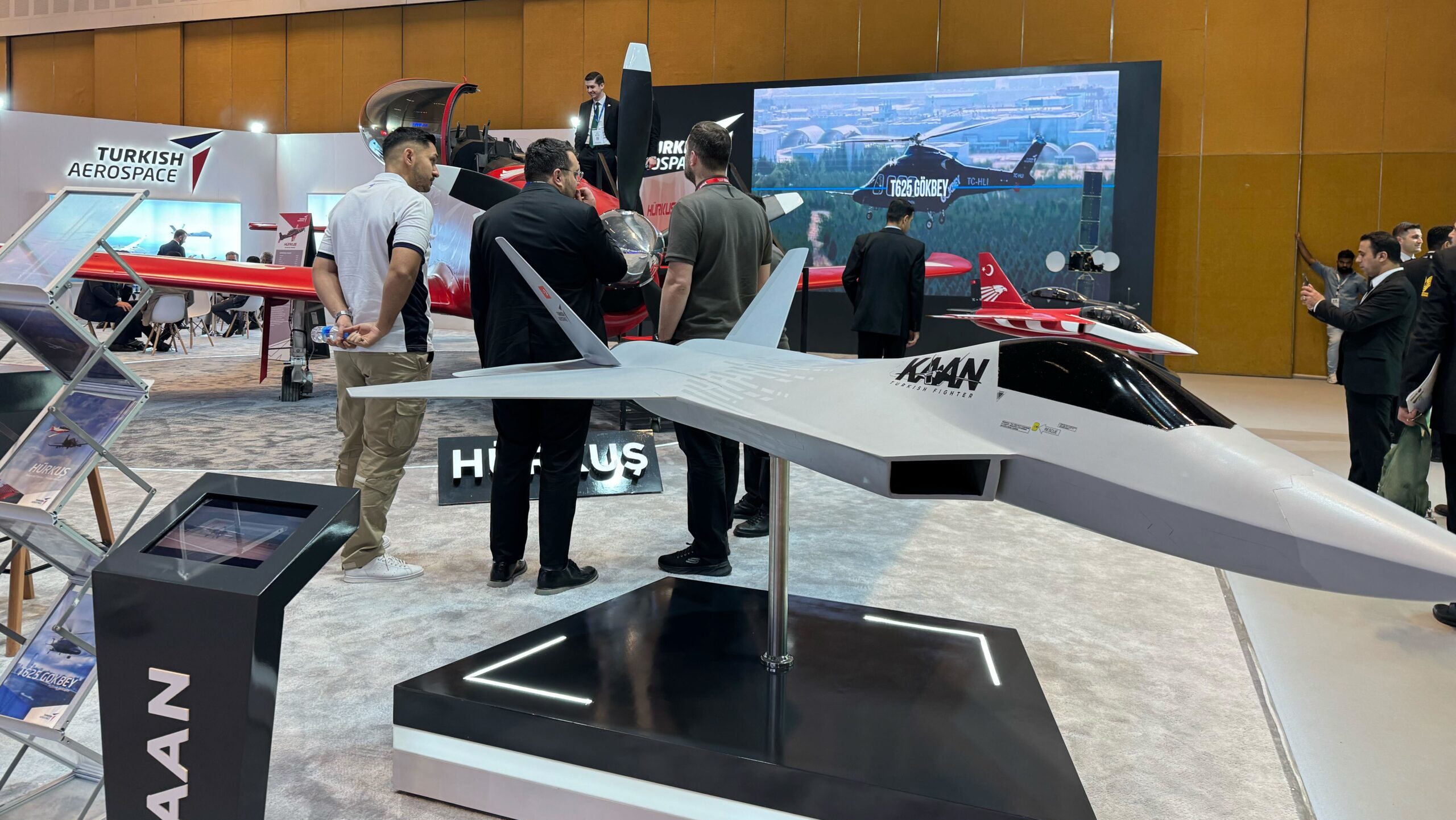
BEIRUT — The head of Turkish Aerospace (TA), the firm building Ankara’s next-generation KAAN fighter aircraft, says the US has cleared for export the General Electric-made F110 engines destined to initially power the plane, overcoming a geopolitical roadblock.
“The F110 engine, we have 10 of them already for our prototypes. For the serial production of KAAN, we are buying 80 engines. The export license was approved or went through the Congress on July 9,” Mehmet Demiroglu told reporters in a press briefing at the Farnborough Airshow outside London.
“The rest is standard procedures. So we can say yes, we have the export license for the engine. We will work with GE folks to get the engines in time, and since it is for the serial production, which is at least two and a half years away, we will have no issue receiving those engines in time to support our serial production for [the] Turkish Air Force,” he said.
Turkish reports had previously noted that July 9 was the deadline for a review period in which American lawmakers could step into halt the export of the engines and, after it passed seemingly without objection, the path should be clear. Reuters first reported in late June that the Trump administration planned to greenlight the engine sale, despite public criticism from the likes of Rep. Gregory Meeks, the top Democrat on the House of Representatives Foreign Affairs Committee.
“These items will not be delivered for years, and the administration repeatedly ignored persistent requests for information and clarification on key aspects of U.S. policy,” Meeks said in a statement to the news outlet at the time.
Turkish Aerospace expects the first batch from the 80 engines to be delivered by 2027, a company official told Breaking Defense today. Asked about the export status, GE told Breaking Defense in a statement, “GE Aerospace is proud of our longstanding partnership with Türkiye and the Turkish Air Force. For decades GE Aerospace has powered the Turkish Air Force’s F-16 fleet, and as they advance their HÜRJET [trainer jet] and KAAN programs, we are honored to support their progress”
Turkey was able to acquire 10 of the engines in September, before the nation’s foreign minster said further exports had been halted. Congressional opposition to the export stemmed in part from Turkey’s acquisition of Russian S-400 radars in 2019, the move that got Ankara kicked out of the US-led, international F-35 program — another sticking point in US-Turkey relations that President Donald Trump seems eager to remove.
KAAN is Turkish indigenous fifth-generation fighter jet program which is under testing. Early prototypes operate with the US-built F110 engines, that also power F-16 and F-15 EX fighter jets. KAAN will fly with the GE engine until a nationally produced engine, the still-in production TF35000 produced by TEI, comes online, projected to be in 2032.
The first KAAN prototype completed its maiden flight that lasted for 13 minutes in February 2024, reached an altitude of 8,000 feet and achieved a speed of 230 knots, a company statement said then. Demiroglu said he expects two KAANs to fly side by side by the end of next year.
“That’s our goal, and let’s hope that’s the case,” he said.
In May this year, the Turkish Air Force formally inked a contract to procure twenty KAAN jets with plans for more in the future. The Turkish fighter had already been contracted earlier in June 2026 by a foreign customer, Indonesia, which inked a deal for 48 fighters.
Demiroglu said deliveries of the jet to the Turkish Air Force are still on schedule by 2028.
Tim Martin and Michael Marrow contributed to this report from London.
