

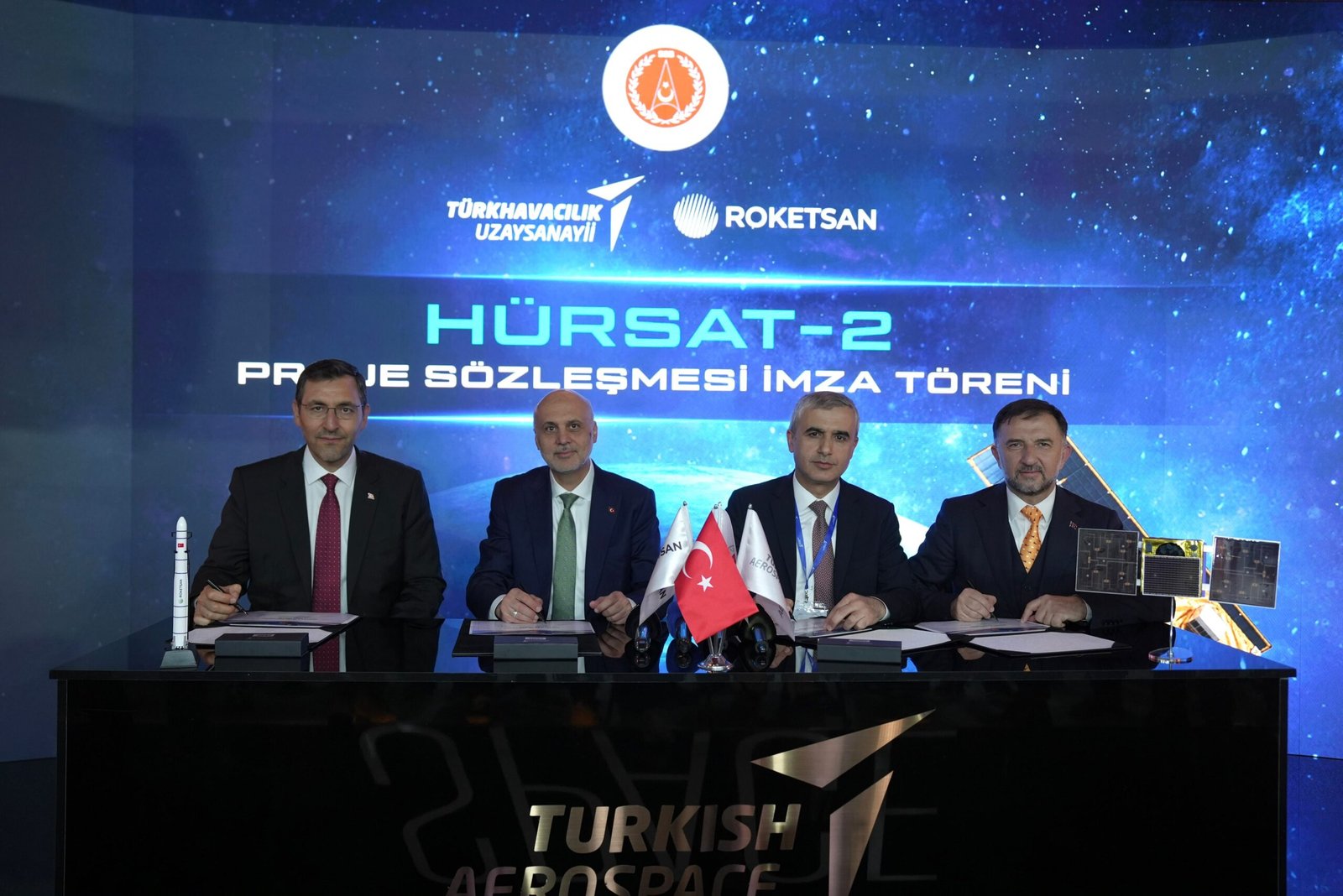
TUSAŞ and ROKETSAN signed a HÜRSAT-2 agreement as Türkiye develops a modular satellite family and plans a launch aboard ŞİMŞEK-1 in 2028–2029.
An agreement between Turkish Aerospace Industries (TUSAŞ) and ROKETSAN connects the HÜRSAT-2 satellite project with a domestic launch-vehicle program. Signed on 5 October 2026, it was concluded at the International Astronautical Congress in Antalya.
Under the planned launch sequence outlined by TUSAŞ chief executive Mehmet Demiroğlu, HÜRSAT-1 would fly in mid-2027, followed by HÜRSAT-2 aboard ŞİMŞEK-1 in 2028–2029. Both dates are targets.
A common architecture underpins the modular satellite family, which the companies say can be configured across a 200–650 kg range for different missions and buyers. HÜRSAT-2 would weigh less than its predecessor, with the shared design supporting repeated production.
Much of the platform and its subsystems would carry over between the two satellites, Demiroğlu said, with payload and launch choices accounting for their main differences. The optical-observation HÜRSAT-1 is intended to return imagery at better than one-metre resolution.
Different payloads would be spread across several satellites in low Earth orbit under the coordinated spacecraft operations described by Demiroğlu. Working together, those satellites are intended to support the family’s different customers and applications.
Domestic satellite capability had already expanded through the European-led GÖKTÜRK-1 observation-satellite program, which involved TUSAŞ and other Turkish suppliers in hardware and related infrastructure. GÖKTÜRK-1’s launch took place in December 2016, when a Vega rocket carried it into orbit from French Guiana.
The GÖKTÜRK-1 program also gave TUSAŞ its satellite integration centre at Akıncı in Ankara. Formally named the Space Systems Integration and Test Centre, it has an approximately 3,800 m² clean room where TUSAŞ says several satellites can undergo assembly, integration and testing, each weighing up to five tonnes.
Before launch shipment, the centre handles subassemblies and integrates spacecraft systems, alongside environmental and functional testing. Engineers can expose equipment to conditions representative of launch and orbit – including thermal and low-pressure environments – to assess compliance with customer requirements.
Completed satellites can leave the facility through direct airport access, which connects the site to a taxiway and avoids a road transfer. TUSAŞ identifies transport safety, risk reduction and management of the costs of moving completed spacecraft as benefits of that arrangement.
The launcher side draws on ROKETSAN’s earlier microsatellite launch development. Publicly described in 2022, that effort sought a Turkish-built vehicle able to deliver small spacecraft into low Earth orbit, preceding the latest satellite agreement.
According to ROKETSAN, ŞİMŞEK-1’s intended capability is to carry a 400 kg satellite to an orbit roughly 550 km above Earth using an entirely liquid-propellant system. ROKETSAN cites sounding-rocket flights that reached 126 km in 2017 and 136 km in 2020 as earlier stages in building experience with propulsion and carrying payloads into space.
The published launcher roadmap schedules ŞİMŞEK-1’s first test flight for 2027 and sets out the subsequent development of the larger ŞİMŞEK-2. That vehicle is intended to place as much as 1,500 kg into sun-synchronous orbit above 700 km, increasing the family’s planned launch capacity.
Demiroğlu described HÜRSAT as a project TUSAŞ began with its own resources, pursuing faster, repeatable production to lower costs and attract overseas customers. For ROKETSAN chief executive Murat İkinci, the agreement represents the first contract for a satellite-launch business intended to handle Turkish and foreign spacecraft.
