

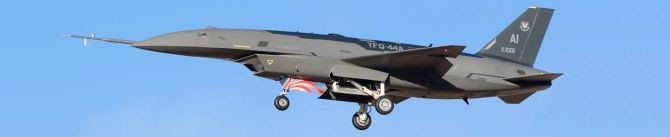
The US Air Force has awarded production contracts to General Atomics and Anduril for its first-generation Collaborative Combat Aircraft (CCA) program, marking a decisive step towards fielding a fleet of 1,000 semi-autonomous aircraft. The move accelerates delivery timelines, with over 150 combat-capable CCAs expected by the end of the decade.
The contracts cover the FQ-42A from General Atomics and the FQ-44A from Anduril, both selected under Increment 1 of the CCA program. The awards were made four months ahead of schedule after both platforms successfully met mission requirements during a competitive selection process.
This rapid progress underscores the urgency with which the Air Force is pursuing unmanned teaming capabilities to maintain air superiority in contested environments.
General Ken Wilsbach, Chief of Staff of the US Air Force, emphasised that Collaborative Combat Aircraft will fundamentally change how power is projected and mass generated in highly contested theatres.
He noted that delivering these systems quickly ensures US forces retain the tactical edge necessary to deter or defeat adversaries. Secretary of the Air Force Troy Meink added that the contracts reaffirm confidence in the program’s trajectory, with a clear path to fielding more than 150 CCAs by 2030.
General Atomics confirmed that production deliveries of the FQ-42A are already underway. The company highlighted that the prototype YFQ-42A moved from contract award to first flight in just 15 months, achieving its maiden flight in August 2025.
The modular design of the aircraft allows it to support diverse mission requirements and human-machine teaming operations. David R Alexander, President of GA-ASI, described the award as the culmination of years of investment and partnership with the Air Force.
Anduril welcomed the decision as a departure from traditional defence procurement practices. CEO Brian Schimpf stressed that the CCA program reflects a fast-moving, forward-looking approach to field autonomous systems at scale.
The company’s FQ-44A, which evolved from the YFQ-44A prototype, is designed with a combat radius exceeding that of current crewed fighters, short-field take-off and landing capability, and payload capacity sufficient to make a significant battlefield impact. Anduril noted that this marks the first time since the 1970s that a new entrant has won a fighter aircraft program.
On the software side, the Air Force awarded mission autonomy contracts to six firms: Anduril, General Atomics, Lockheed Martin, Northrop Grumman, RTX Collins Aerospace, and Shield AI. Three of these—Anduril, Collins, and Shield AI—received additional production options to accelerate delivery.
The service is deliberately decoupling hardware from software under a “software sold separately” model, ensuring agile updates and competitive innovation. This approach is intended to reduce costs, accelerate fielding, and maintain technological superiority.
The Air Force envisions a fleet of around 1,000 CCAs, with continuous competition driving both hardware and software development. Early estimates suggest unit costs will be kept at roughly one-third of an F-35, placing them under $30 million each.
The aircraft are expected to provide a combat radius of approximately 700 nautical miles, with Increment 1 focused on air superiority missions. Future increments will expand roles and capabilities, with nine vendors already engaged in early development contracts for Increment 2.
This initiative represents a critical evolution in airpower, integrating semi-autonomous systems with crewed fighters to extend reach, survivability, and operational mass. It signals a transformation in US defence acquisition strategy, prioritising speed, affordability, and adaptability in the face of emerging threats.
ANI
