

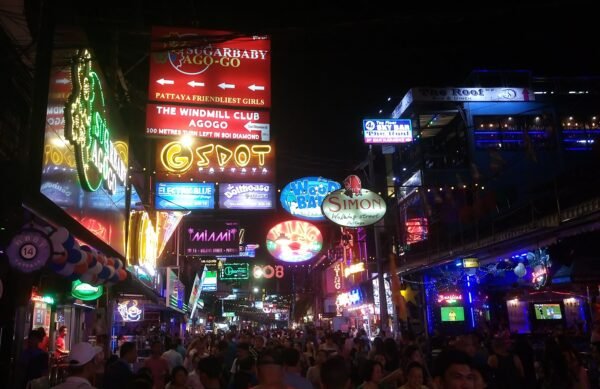
When I started interviewing a Thai sex worker named Ying for my recent book, I was initially looking for something far different from what I eventually wrote. I wanted sleaze: something raw and stimulating. I had wanted to write about a harlot, someone immoral, for whom money took precedence over all. I had expected to write about their greed, their lack of morals and the hypocrisy that arose from an industry surrounding a deeply religious society.
My assumptions were both critical and ignorant. In every way, I had already decided on the book I was going to write without attempting to understand the mechanics or psychology behind them. What I have since learned is about choices, and how few meaningful ones there were for someone caught between family obligation, economic status, and religion. What I learned was about the life of a tortured soul, fighting to make the best of what she had.
Ying had spent most of her adult life selling sex for a living, starting when she was 19 years of age. Like many girls around her, she had dreamed of a better life – one that seemed impossible for someone born into poverty with little education. Ying grew up in Thailand’s mostly agrarian northeast. She arrived in Bangkok at the age of 17, and began work in a restaurant, where she faced long hours and poor earnings with no hope of advancement. Alongside this, she became involved in sex work, present in every nook and cranny of Bangkok. As Ying told me, “There was no choice. It was the only way to earn enough for myself and my family.”
Of course, Ying knew what she was doing. She wasn’t coerced or forced. But still the question remains: what else was available to her? The economics of her situation were inescapable. Ying was earning 6,000 baht per month at a restaurant in the early 2000s. At her peak in the sex industry, she was making close to 80,000 baht each month. Her mother back home in Isan sold food by the road, making less than 200 baht per day. Her father was an odd-job laborer earning even less. For a family like hers, the difference was colossal.
Decades of research into Thailand’s illegal sex industry have long identified economic privation as a leading cause of entry into the trade, which offers substantially superior earnings than the agricultural, domestic, or other poorly paid forms of work available to women who come from rural provinces. Those findings do not apply to every woman in the sex industry, but they help us understand how seemingly voluntary decisions may be constrained in practice.
Another thing became clearer through the interviews. Customers were not buying sex; they were buying a performance. Ying had to convince customers she was interested in them. To make each man feel desirable. To fulfill their every desire, no matter how detestable. Each customer was its own enterprise, and she had to remember their every eccentricity in order to encourage their return. As the industry moved online through the years, women had to improve their skill sets, to understand how to digitally market themselves. To master the psychology of attraction, and the manner in which to exercise it. Ying explained, “You have to make every man like you, or he won’t come back.”
“You have to make every man like you or he won’t come back,” said Ying, seen here in an undated photo. (Photo Supplied)
What further surprised me was the power the customer held, even after he had paid and left. The digital world brought private encounters into the public sphere: a displeased customer could affect a woman’s future earnings by becoming an online critic, capable of influencing the market value of her services. The strength of a single review could make or break the personal enterprise she had set up for herself.
Beyond performance, Ying’s experience of sex work also revealed many personal boundaries were up for sale. Many men refused to use condoms; others demanded violent or depraved acts. Blowjob bars in particular distinguish themselves by the absence of condoms. This is an easy boundary to maintain when a sex worker is first starting out, fresh and attractive. But that balance shifts rapidly when they remain in the industry for too long, presenting them with a hard economic decision: refuse the money, or accept a greater health risk. For Ying, ageing and increasing competition intensified those decisions; she described how quickly such considerations become typical when rooted in the industry. The same market that had rewarded her youth gradually made it more costly for her to protect herself.
Her account also revealed the darker experiences of rape and abuse. In one disturbing revelation, she recounted how she was heavily intoxicated, unable to defend herself, while men around her used her sexually. Yet, when pressed on her emotions during that encounter, she seemed more bothered by her boyfriend’s inability or refusal to protect her, rather than the assault itself, a reaction I found difficult to grasp. What affected me was how nonchalant she was in recalling these experiences. It made me question if her career in sex work had created an unavoidable overlap, where consent and violation had become intertwined with her professional need to please every man she came across.
The money Ying earned was not always spent on herself. One of the recurring themes in our interviews was the importance of family responsibility and karma – and how both of these contributed to her decision to enter the sex industry. According to her strict religious upbringing, filial piety is a source of merit that can help to expunge past transgressions and ensure a positive reincarnation. Parents give their children a life, food, and protection. Children repay this debt by sending money home – something that is a moral and religious responsibility.
The same Buddhist moral universe that rejects any immoral behavior now expects a diametrically opposed sacrifice in the name of filial piety, a devastating contradiction I had struggled to understand.
Years later, that contradiction became painfully obvious when even cervical cancer could not keep Ying from returning to sex work. Her family had already structured their lives around her regular financial sacrifices and were reliant on her. She said, “There was no other job at my age that could pay so much.” Nobody forced her back after her hysterectomy. There was no trafficker waiting at her door, no one imposing their will upon her. She did it because she had no other option.
I started out with a plan to write a book about the colorful life of a sex worker. In the end, I was writing about a human being – one of us – trying her best, imperfectly and relentlessly, to survive. I now understand how morality can appear from a distance and how simple any choice can be when proper alternatives exist. And really, given those circumstances, would we have done anything so very different?
