

India is hosting its fourth leader-level Africa summit (the India-Africa Forum Summit, IAFS-IV) on May 31 under the official theme “IA SPIRIT”: India Africa Strategic Partnership for Innovation, Resilience, and Inclusive Transformation. The summit is significant. For the first time in 11 years, African leaders and multilateral organizations will convene in the Indian capital.
The return of the IAFS responds to the contemporary rupture of the international order that has left India in a particularly difficult position, prompting New Delhi to shore up ties with its traditional friends in the Global South. As described by India’s External Affairs Minister S. Jaishankar, the meeting will be “a message of stability in a turbulent world, of reliability in an uncertain one and of solidarity in difficult times.”
Politically, the event is a big deal. Successive Indian governments have positioned the country as the “leader of the Global South,” particularly drawing on strong India-Africa ties to evidence this claim. Whether recognized outside India or not, this claimed leadership is designed to support the country’s global clout, with the ability to mobilize the majority of countries and shape international decisions.
India’s Most Vulnerable Moment for Decades
This summit comes at a particularly crucial time. New Delhi’s boldest geopolitical bet over the last three decades has been on the United States, with closer ties delivering important cooperation around military procurement, security and intelligence sharing, and finance and technology for economic growth. However, from 2025, President Donald Trump torpedoed relations with India in short order, with trust now at a new low. Simultaneously, Pakistan and China remain major threats, with the former proving surprisingly effective in responding to last year’s Operation Sindoor using Chinese military kit.
New Delhi’s other key move over the last few decades has been to boost ties with the Gulf states, especially the UAE, which have been critical for remittances, financial investment, and energy. India is heavily dependent on fossil fuel imports, buying 88 percent of its oil internationally. However, India’s Gulf partnerships are now jeopardized by the Israeli-U.S. conflict with Iran and the de facto closure of the Strait of Hormuz. In the short term, remittances have shrunk, and critical energy scarcities are building, particularly for cooking gas. These impacts may become longer term given the damage to energy infrastructure. Furthermore, there may be decreased Gulf financial investment in India as the region turns inward to shore up domestic economies.
This is perhaps India’s most vulnerable moment for decades. In response, New Delhi has significantly expanded ties with Europe, concluding the EU and U.K. trade deals, reaching major arms deals, and launching a technology dialogue. Europe is perhaps the only partner that could replace what New Delhi had hoped to receive from the United States.
However, India’s foreign policy strategists also seek to maintain relations with the Global South and the country’s “Southern” identity – hence reconvening the India-Africa leaders’ event.
A Decade-Long Hiatus of the India-Africa Summit
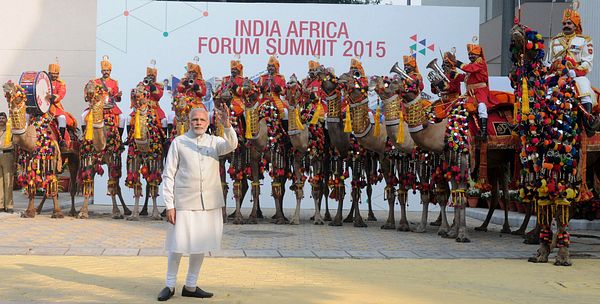
The summit has been a long time coming. The first India-Africa Forum Summit (IAFS I) was held in 2008, followed by IAFS-II in 2011. Both were comparatively small, following the African Union’s Banjul Formula to invite 15 representative leaders. The third summit in 2015 was a far grander affair, inviting all leaders and lavishing them with red carpet treatment in Delhi.
The fourth event was supposed to follow three years later but suffered numerous delays, reflecting a drift in India’s Africa policy. It was postponed in 2019 (by then already a year late) by the Ebola crisis in West Africa, only for the COVID-19 pandemic to follow in 2020. During this extended hiatus, India’s diplomatic attention shifted: toward growing its U.S. ties, managing a series of global crises, hosting the G-20, and then this year’s AI summit. India’s G-20 presidency did deliver on an African initiative to give the African Union a seat in the grouping. However, India’s famously constrained diplomatic capacity was stretched too thin by these multiple summits and the growing bilateral attention New Delhi received from the United States and Europe.
Additionally, experts suggest there were problems of working through the bureaucratically-challenged African Union, and a specific obstacle of Niger’s 2023 military coup, as the plan had been to use that country’s new Indian-financed conference center to host IAFS-IV.
The absence of the India-Africa summit since 2015 is notable. Over the same period, China, the EU, France, and Russia, to mention a few, have held a slew of similar leader-level political summits. Additionally, Indian presidential and prime ministerial visits to Africa decreased since 2019.
Therefore, the return of the high-level political gathering will be designed to reaffirm Africa’s importance to India. Previous iterations of the IAFS were key in boosting the relationship, not just for their political signaling, but also for the intense diplomatic momentum they generated, which previously culminated in pledges on new development cooperation projects, subsidized loans, and trade privileges.
What Both Sides Want
Both sides bring distinct and sometimes competing agendas. For India, the focus is increasingly on economic and physical security. Diversifying oil and gas imports away from the volatile Middle East is a top priority, as is securing critical minerals supply chains. New Delhi also wants to boost its profile as a premier exporter of affordable technology and pitch its digital public infrastructure (DPI), AI, pharmaceuticals, and space capabilities to African markets. Early indications suggest a strong, albeit pragmatic, appetite from African capitals for this Indian agenda. In the digital realm, demand is already materializing: as of early 2026, six African nations – including Ethiopia, Kenya, and Tanzania – have signed Memoranda of Understanding for cooperation on India’s DPI framework.
Crucially, the rise of security and defense cooperation will be closely watched, in particular maritime security and joint efforts to protect Indian Ocean supply lines. India undertook perhaps its biggest maritime deployment to support the anti-Somali piracy contact group. However, both sides prefer discussion of “soft security” collaboration to avoid the perception of military alliances, or taking geopolitical sides. Therefore, initiatives on smuggling, piracy, illegal fishing, and humanitarian response are most likely.
For African nations, the priorities are clear: tangible development cooperation, foreign direct investment, and affordable technologies. African governments are not looking for handouts; they want finance, technology cooperation, and capacity building that practically delivers. Here the Indian government’s role differs from China as India’s capitalist corporates are not easily mobilized and act independently. Foreign direct investment has reached new highs in recent years, with India among the top investors in Africa, without significant government involvement.
Therefore, a key test for IAFS-IV will be whether the summit delivers development cooperation. India’s development spending has taken a major hit since the last summit. In 2015, $10 billion was pledged to India’s flagship subsidized finance scheme, but only $34 billion has been delivered. This contrasts with official statistics showing $6.7 billion lent between 2004 and 2015.
The lack of state-to-state engagement is a significant reason for this underperformance. Post-2015 reforms excluded the Indian corporate sector from initiating projects in the line of credit scheme due to corruption and quality concerns. However, without the top-level political engagement, and given Indian embassies traditionally focus less on economic diplomacy, Indian development finance has struggled to compete with multilateral banks and Chinese, U.S., and European governmental lenders seeking bankable projects.
Additionally, new development schemes have been largely absent in the last decade. In contrast, between 2008 and 2015, Indian leaders pledged ambitious schemes at the first three summits, such as the e-network connecting hospitals and universities across the continent. For governments in Africa, new initiatives do not need to be entirely governmental to be developmental. The trend over the last five years has been toward public-private partnerships that include technology transfer and supply agreements for energy and critical minerals.
Another key ask from the African side concerns trade, which has been a point of tension. India’s Duty-Free Tariff Preference scheme only benefits the continent’s 32 Least Developed Countries (LDCs), leaving out Africa’s 22 better-performing economies. Africa’s wealthier states increasingly demand improved market access, not least with the hope to boost manufacturing exports, not only those from the extractive industries.
Civilizational Framing and Practical Demands
Finally, the summit will be a litmus test for India’s contemporary diplomatic messaging. This is the first Africa summit since the language of Indian diplomacy has shifted to a more cultural focus, framing foreign policy through the lens of Hindu civilizational heritage, evident in the global promotion of yoga and traditional Indian medicine.
This represents a departure from the secular, Nehruvian foreign policy principles on which India-Africa ties were founded, and which remain influential diplomatic guides for many African governments. A key dynamic to watch will be how India deploys this civilizational language, the push of its cultural exports, and whether this framing resonates – or disconnects from – the practical economic demands of African governments.
Ultimately, the level of attendance will signify how highly African capitals rate this relationship. Invitations have been sent to all African political leaders, but it is unclear how many will attend. This matters for the age-old questions that are likely to arise. Will the summit pledge mutual support for United Nations Security Council seats for India and Africa, a longstanding ask from New Delhi? Yet the true measure of the fourth India-Africa Forum Summit will be its ability to translate historical goodwill into modern, strategic, and implementable cooperation.
